Terminology Package
Overview
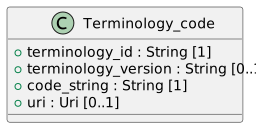
The base.foundation_types.terminology package provides leaf types used to represent a terminology code, i.e. a code within a terminology, and a term, which is the combination of a code and one rubric (natural language) string associated with it. Terminology codes are sometimes called concept codes among terminology experts, and when used as references, concept references.
An instance of Terminology_code is a reference to any referenceable entity within a terminology or ontology, which may be:
-
a single term, for which a rubric(s) and potentially relationships (at least the
IS-Arelationship) are defined; -
a value set i.e. a set of single terms, possibly in a tree or other structure corresponding to relationships between the member terms;
-
any other terminological entity referencable with a code.
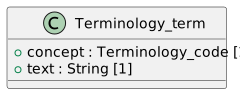
An instance of Terminology_term provides a way to record a terminology code and the rubric used in some operational context, allowing the receiver or reader of the data to avoid having to perform a terminology lookup to obtain the rubric, e.g. for display purposes.

base.foundation_types.terminology packageClass Definitions
Terminology_term Class
-
Definition
-
Effective
-
BMM
-
UML
Class |
Terminology_term |
|
|---|---|---|
Description |
Leaf type representing a term from a terminology, which consists of the term text and the code, i.e. a concept reference. |
|
Inherit |
||
Attributes |
Signature |
Meaning |
1..1 |
concept: |
Refrence to the terminology concept formally representing this term. |
1..1 |
text: |
Text of term. |
| Terminology_term | |||
|---|---|---|---|
Leaf type representing a term from a terminology, which consists of the term text and the code, i.e. a concept reference. |
|||
Inherits: Any |
|||
Attributes |
|||
concept: |
Refrence to the terminology concept formally representing this term. |
||
text: |
Text of term. |
||
Functions |
|||
Value equality. |
|||
Reference equality. Parameters
|
|||
Create new instance of a type. |
|||
Type name of an object as a string. May include generic parameters, as in "Interval<Time>". |
|||
{
    "name": "Terminology_term",
    "documentation": "Leaf type representing a term from a terminology, which consists of the term text and the code, i.e. a concept reference.",
    "ancestors": [
        "Any"
    ],
    "properties": {
        "concept": {
            "_type": "P_BMM_SINGLE_PROPERTY",
            "name": "concept",
            "documentation": "Refrence to the terminology concept formally representing this term.",
            "is_mandatory": true,
            "type": "Terminology_code"
        },
        "text": {
            "_type": "P_BMM_SINGLE_PROPERTY",
            "name": "text",
            "documentation": "Text of term.",
            "is_mandatory": true,
            "type": "String"
        }
    }
}
Terminology_code Class
-
Definition
-
Effective
-
BMM
-
UML
Class |
Terminology_code |
|
|---|---|---|
Description |
Logically primitive type representing a reference to a terminology concept, in the form of a terminology identifier, optional version, and a code or code string from the terminology. |
|
Inherit |
||
Attributes |
Signature |
Meaning |
1..1 |
terminology_id: |
The archetype environment namespace identifier used to identify a terminology. Typically a value like |
0..1 |
terminology_version: |
Optional string value representing terminology version, typically a date or dotted numeric. |
1..1 |
code_string: |
A terminology code or post-coordinated code expression, if supported by the terminology. The code may refer to a single term, a value set consisting of multiple terms, or some other entity representable within the terminology. |
0..1 |
uri: |
The URI reference that may be used as a concrete key into a notional terminology service for queries that can obtain the term text, definition, and other associated elements. |
| Terminology_code | |||
|---|---|---|---|
Logically primitive type representing a reference to a terminology concept, in the form of a terminology identifier, optional version, and a code or code string from the terminology. |
|||
Inherits: Any |
|||
Attributes |
|||
terminology_id: |
The archetype environment namespace identifier used to identify a terminology. Typically a value like |
||
terminology_version: |
Optional string value representing terminology version, typically a date or dotted numeric. |
||
code_string: |
A terminology code or post-coordinated code expression, if supported by the terminology. The code may refer to a single term, a value set consisting of multiple terms, or some other entity representable within the terminology. |
||
uri: |
The URI reference that may be used as a concrete key into a notional terminology service for queries that can obtain the term text, definition, and other associated elements. |
||
Functions |
|||
Value equality. |
|||
Reference equality. Parameters
|
|||
Create new instance of a type. |
|||
Type name of an object as a string. May include generic parameters, as in "Interval<Time>". |
|||
{
    "name": "Terminology_code",
    "documentation": "Logically primitive type representing a reference to a terminology concept, in the form of a terminology identifier, optional version, and a code or code string from the terminology.",
    "ancestors": [
        "Any"
    ],
    "properties": {
        "terminology_id": {
            "_type": "P_BMM_SINGLE_PROPERTY",
            "name": "terminology_id",
            "documentation": "The archetype environment namespace identifier used to identify a terminology. Typically a value like `\"snomed_ct\"` that is mapped elsewhere to the full URI identifying the terminology.",
            "is_mandatory": true,
            "type": "String"
        },
        "terminology_version": {
            "_type": "P_BMM_SINGLE_PROPERTY",
            "name": "terminology_version",
            "documentation": "Optional string value representing terminology version, typically a date or dotted numeric.",
            "type": "String"
        },
        "code_string": {
            "_type": "P_BMM_SINGLE_PROPERTY",
            "name": "code_string",
            "documentation": "A terminology code or post-coordinated code expression, if supported by the terminology. The code may refer to a single term, a value set consisting of multiple terms, or some other entity representable within the terminology.",
            "is_mandatory": true,
            "type": "String"
        },
        "uri": {
            "_type": "P_BMM_SINGLE_PROPERTY",
            "name": "uri",
            "documentation": "The URI reference that may be used as a concrete key into a notional terminology service for queries that can obtain the term text, definition, and other associated elements.",
            "type": "Uri"
        }
    }
}