Constraint Model Package
Overview
am.aom2.constraint_model Package and am.aom2.constraint_model.primitive Package illustrate the object model of constraints used in an archetype definition. This model is completely generic, and is designed to express the semantics of constraints on instances of classes which are themselves described in any orthodox object-oriented formalism, such as UML. Accordingly, the major abstractions in this model correspond to major abstractions in object-oriented formalisms, including several variations of the notion of 'object' and the notion of 'attribute'. The notion of 'object' rather than 'class' or 'type' is used because archetypes are about constraints on data (i.e. 'instances', or 'objects') rather than models, which are constructed from 'classes'. In this document, the word 'attribute' refers to any data property of a class, regardless of whether regarded as a 'relationship' (i.e. association, aggregation, or composition) or 'primitive' (i.e. value) attribute in an object model.
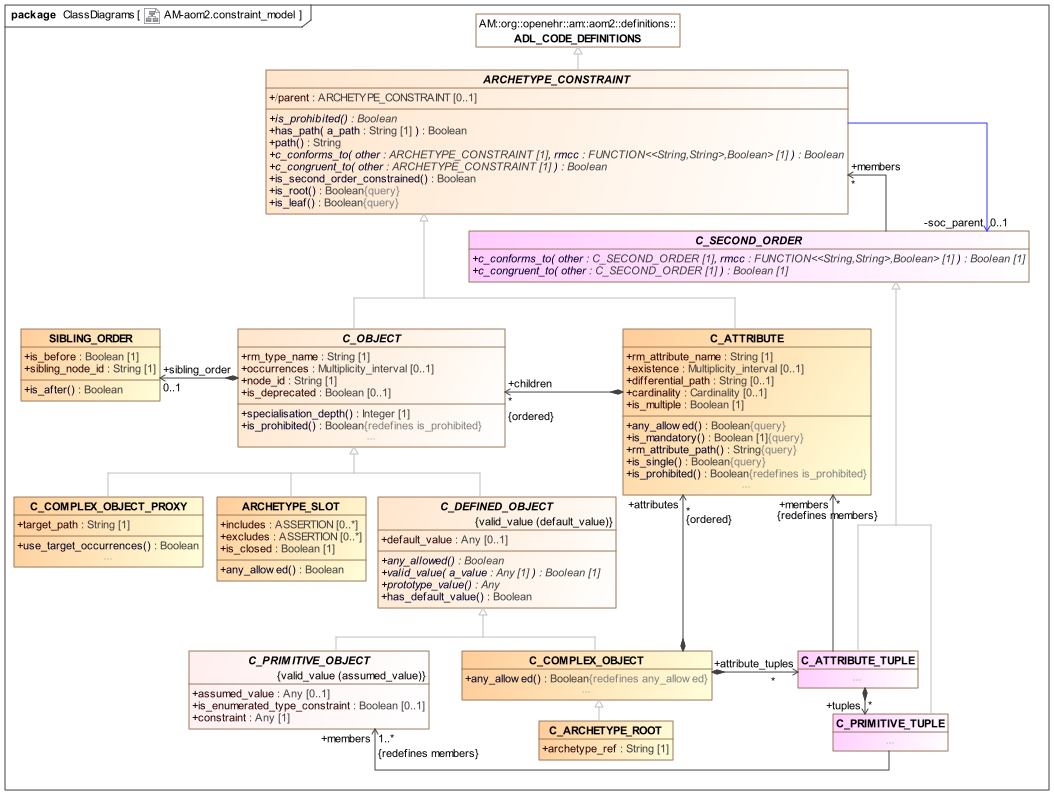
am.aom2.constraint_model PackageThe definition part of an archetype is an instance of a C_COMPLEX_OBJECT and consists of alternate layers of object and attribute constrainer nodes, each containing the next level of nodes. At the leaves are primitive object constrainer nodes constraining primitive types such as String , Integer etc. There are also nodes that represent internal references to other nodes, constraint reference nodes that refer to a text constraint in the constraint binding part of the archetype terminology, and archetype constraint nodes, which represent constraints on other archetypes allowed to appear at a given point. The full list of concrete node types is as follows:
-
C_COMPLEX_OBJECT: any interior node representing a constraint on instances of some non-primitive type, e.g.OBSERVATION,SECTION; -
C_ATTRIBUTE: a node representing a constraint on an attribute (i.e. UML 'relationship' or 'primitive attribute') in an object type; -
C_PRIMITIVE_OBJECT: a node representing a constraint on a primitive (built-in) object type; -
C_COMPLEX_OBJECT_PROXY: a node that refers to a previously definedC_COMPLEX_OBJECTnode in the same archetype. The reference is made using a path; -
ARCHETYPE_SLOT: a node whose statements define a constraint that determines which other archetypes can appear at that point in the current archetype. It can be thought of as a keyhole, into which few or many keys might fit, depending on how specific its shape is. Logically it has the same semantics as aC_COMPLEX_OBJECT, except that the constraints are expressed in another archetype, not the current one. -
C_ARCHETYPE_ROOT: stands for the root node of an archetype; enables another archetype to be referenced from the present one. Used in both archetypes and templates.
The constraints define which configurations of reference model class instances are considered to conform to the archetype. For example, certain configurations of the classes PARTY, ADDRESS, CLUSTER and ELEMENT might be defined by a Person archetype as allowable structures for 'people with identity, contacts, and addresses'. Because the constraints allow optionality, cardinality and other choices, a given archetype usually corresponds to a set of similar configurations of objects.
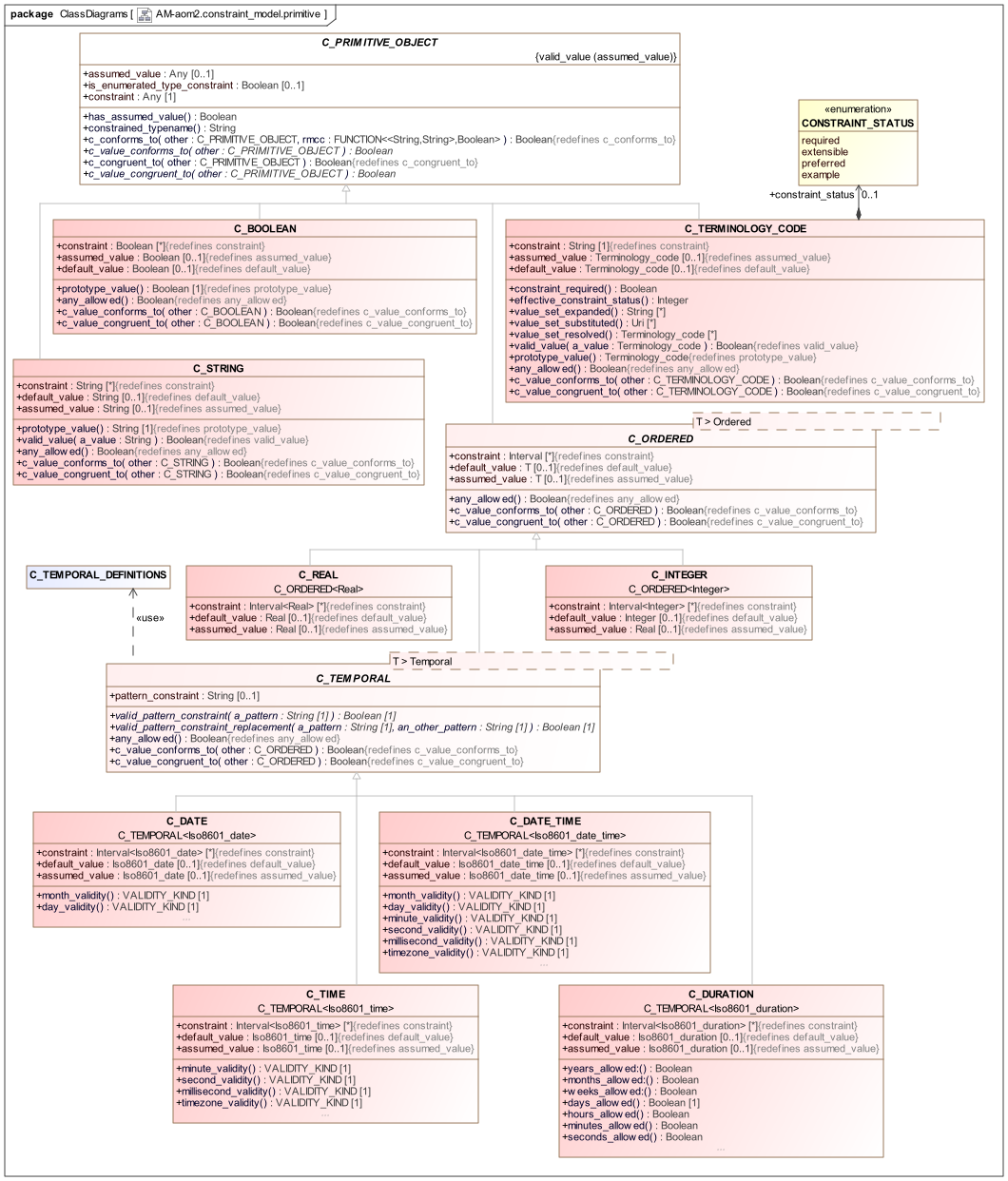
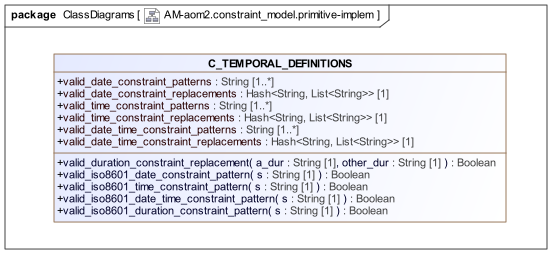
am.aom2.constraint_model.primitive Packageam.aom2.constraint_model.primitive-implem Package below shows the detailed temporal constraint definitions, used by the C_TEMPORAL class and descendants in the primitive package above.
am.aom2.constraint_model.primitive-implem PackageThe type-name nomenclature C_XXX used here is intended to be read as 'constraint on objects of type XXXX ', i.e. a C_COMPLEX_OBJECT is a 'constraint on a complex object (defined by a complex reference model type)'. These type names are used below in the formal model.
Semantics
The effect of the model is to create archetype definition structures that are a hierarchical alternation of object and attribute constraints. This structure can be seen by inspecting an ADL archetype, or by viewing an archetype in an AOM-based tool such as the openEHR ADL workbench, and is a direct consequence of the object-oriented principle that classes consist of properties, which in turn have types that are classes. (To be completely correct, types do not always correspond to classes in an object model, but it does not make any difference here). The repeated object/attribute hierarchical structure of an archetype provides the basis for using paths to reference any node in an archetype. Archetype paths follow a syntax that is a directly convertible in and out of the W3C Xpath syntax.
All Node Types
Some properties are defined for all node types, described in the following sections.
Path Functions
The path feature computes the path to the current node from the root of the archetype, while the has_path function indicates whether a given path can be found in an archetype.
Conformance Functions
All node types include two functions that formalise the notion of conformance of a specialised archetype to a parent archetype. Both functions take an argument which must be a corresponding node in a parent archetype, not necessarily the immediate parent. A 'corresponding' node is one found at the same or a congruent path. A congruent path is one in which one or more at-codes have been redefined in the specialised archetype.
The c_conforms_to function returns True if the node on which it is called is a valid specialisation of the 'other' node. The c_congruent_to function returns True if the node on which it is called is the same as the other node, with the possible exception of a redefined at-code. The latter may happen due to the need to restrict the domain meaning of node to a meaning narrower than that of the same node in the parent. The formal semantics of both functions are given in the class definitions, [_class_definitions_2].
Any_allowed
The any_allowed function defined on some node types indicates that any value permitted by the reference model for the attribute or type in question is allowed by the archetype; its use permits the logical idea of a completely "open" constraint to be simply expressed, avoiding the need for any further substructure.
Attribute Nodes
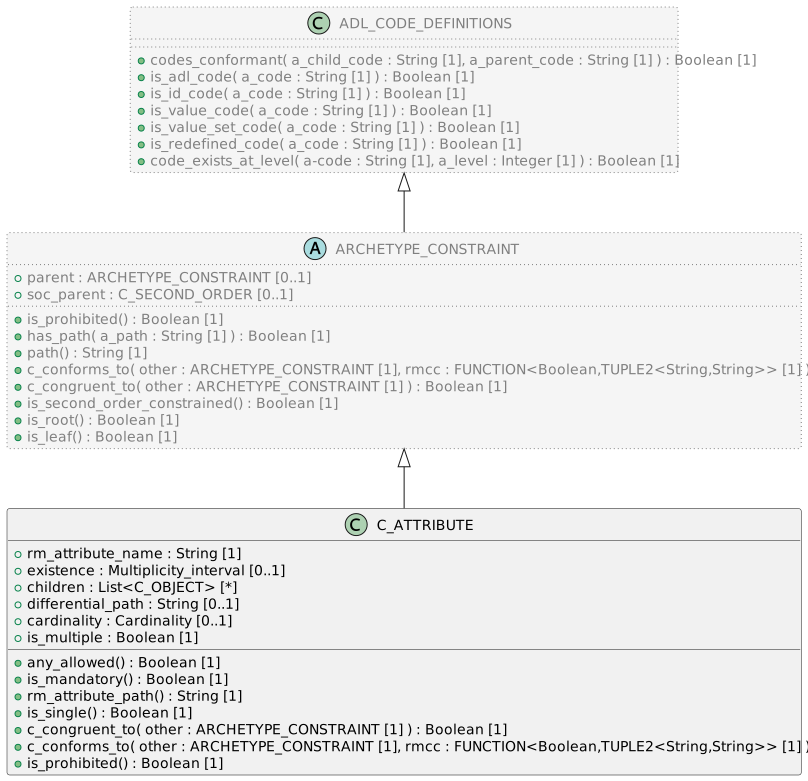
Constraints on reference model attributes, including computed attributes (represented by functions with no arguments in most programming languages), are represented by instances of C_ATTRIBUTE. The expressible constraints include:
-
is_multiple: a flag that indicates whether theC_ATTRIBUTEis constraining a multiply-valued (i.e. container) RM attribute or a single-valued one; -
existence: whether the corresponding instance (defined by therm_attribute_nameattribute) must exist; -
child objects: representing allowable values of the object value(s) of the attribute.
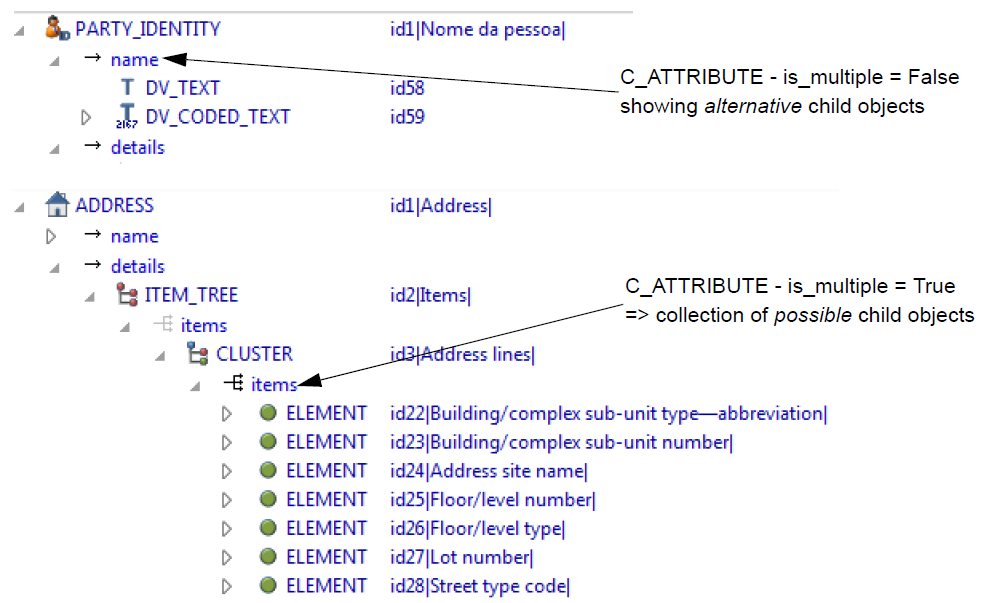
In the case of single-valued attributes (such as Person.date_of_birth) the children represent one or more alternative object constraints for the attribute value.
For multiply-valued attributes (such as Person.contacts: List<Contact>), a cardinality constraint on the container can be defined. The constraint on child objects is essentially the same except that more than one of the alternatives can co-exist in the data. C_ATTRIBUTE variants illustrates the two possibilities.
The appearance of both existence and cardinality constraints in C_ATTRIBUTE deserves some explanation, especially as the meanings of these notions are often confused in object-oriented literature. An existence constraint indicates whether an object will be found in a given attribute field, while a cardinality constraint indicates what the valid membership of a container object is. Cardinality is only required for container objects such as List<T> , Set<T> and so on, whereas existence is always possible. If both are used, the meaning is as follows: the existence constraint says whether the container object will be there (at all), while the cardinality constraint says how many items must be in the container, and whether it acts logically as a list, set or bag. Both existence and cardinality are optional in the model, since they are only needed to override the settings from the reference model.
Object Node Types
The following sections apply to all object nodes in an archetype, i.e. instances of any descendant of C_OBJECT.
Rm_type_name and Reference Model Type Matching
Every object node has an rm_type_name attribute that states the RM type to be matched by that node in the archetype. The value of rm_type_name is understood as a constraint on the dynamic type of data instances of the stated Reference Model type. It is either a class name from the RM, or a generic type constructed from RM class names, as described in the Reference model type matching section of the ADL2 specification.
The RM type stated in an archetype object node is understood to be a static type constraint. Accordingly, it will match an instance of any RM subtype of the stated type, as long as the inheritance relationship is stated in the RM definition. This holds both for sub-classes, and subtypes of generic types, in a covariant fashion. The following matching will thus succeed:
-
rm_type_name="PARTY"matchesPERSON, wherePERSONinherits fromPARTYin the relevant RM; -
rm_type_name="Interval<Ordered>"matches a dynamic type of data items ofInterval<Quantity>,SimpleInterval<Ordered>andSimpleInterval<Quantity>whereQuantityinherits fromOrderedandSimpleIntervalinherits fromIntervalin the relevant RM.
There are some special rules that apply to primitive type matching that enable 'logical' primitive type names in archetypes to match multiple 'concrete' variants that occur in some reference models and programming type systems. These are described in detail below.
Node_id and Paths
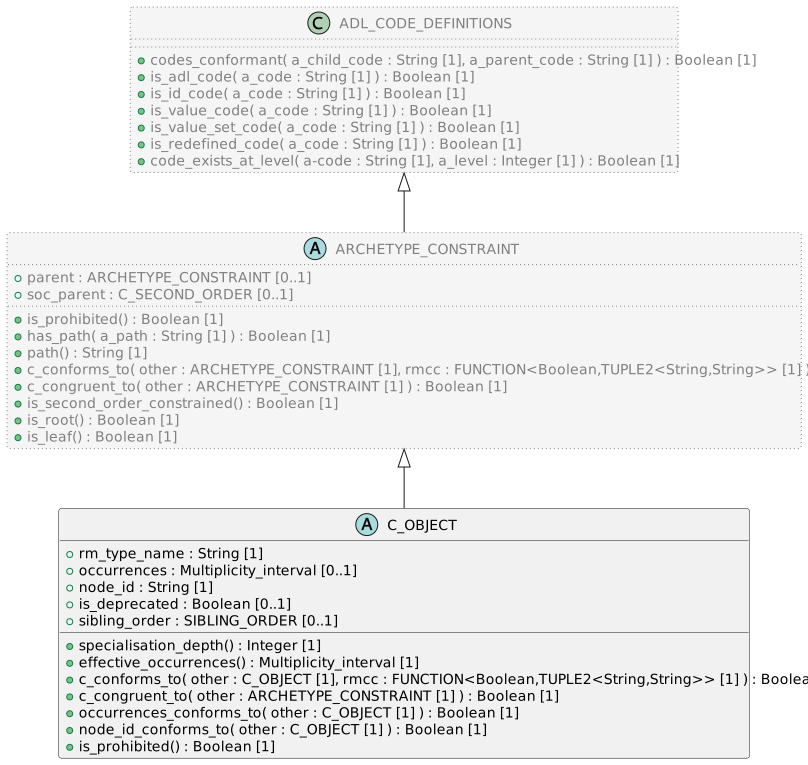
The node_id attribute in the class C_OBJECT, inherited by all subtypes, is of key importance in the archetype constraint model. It has two functions:
-
it allows archetype object constraint nodes to be individually identified, and in particular, guarantees sibling node unique identification;
-
it provides a code to which a human-understanding terminology definition can be attached, as well as potentially a terminology binding.
The existence of node_ids in an archetype allows archetype paths to be created, which refer to each node. Every node in the archetype needs a node_id , but only node_ids for nodes under container attributes must have a terminology definition. For nodes under single-valued attributes, the terminology definition is optional (and typically not supplied), since the meaning is given by the reference model attribute definition.
Note that instances of C_PRIMITIVE_OBJECT have a constant node_id (see below) and thus do not require node identifiers to be supplied in syntax or serial forms that are converted to AOM structural form.
Sibling Ordering
Within a specialised archetype, redefined or added object nodes may be defined under a container attribute. Since specialised archetypes are in differential form, i.e. only redefined or added nodes are expressed, not nodes inherited unchanged, the relative ordering of siblings can’t be stated simply by the ordering of such items within the relevant list within the differential form of the archetype. An explicit ordering indicator is required if indeed order is specific. The C_OBJECT.sibling_order attribute provides this capability. It can only be set on a C_OBJECT descendant within a multiply-valued attribute, i.e. an instance of C_ATTRIBUTE for which the cardinality is ordered.
Node Deprecation
It is possible to mark an instance of any defined node type as deprecated, meaning that by preference it should not be used, and that there is an alternative solution for recording the same information. Rules or recommendations for how deprecation should be handled are outside the scope of the archetype proper, and should be provided by the governance framework under which the archetype is managed.
Reference Objects
Two subtypes of C_OBJECT, namely ARCHETYPE_SLOT and C_COMPLEX_OBJECT_PROXY are used to express constraints in the form of references to other constraints, rather than directly.
An ARCHETYPE_SLOT defines a 'slot' specifying other archetypes that can be plugged in at that point, in terms of constraints on archetype identifiers. These are expressed as instances of the ARCHETYPE_ID_CONSTRAINT class, a specialised version of the ELOM EL_CONSTRAINT_EXPRESSION class.
The type C_COMPLEX_OBJECT_PROXY represents a reference to another part of the current archetype that expresses exactly the same constraints needed at the point where the proxy appears.
Defined Object Nodes (C_DEFINED_OBJECT)
The C_DEFINED_OBJECT subtype corresponds to the category of C_OBJECTs that are defined in an archetype by value, i.e. by inline definition. Four properties characterise C_DEFINED_OBJECTs as follows.
Valid_value
The valid_value function tests a reference model object for conformance to the archetype. It is designed for recursive implementation in which a call to the function at the top of the archetype definition would cause a cascade of calls down the tree. This function is the key function of an 'archetype-enabled kernel' component that can perform runtime data validation based on an archetype definition.
Prototype_value
This function is used to generate a reasonable default value of the reference object being constrained by a given node. This allows archetype-based software to build a 'prototype' object from an archetype which can serve as the initial version of the object being constrained, assuming it is being created new by user activity (e.g. via a GUI application). Implementation of this function will usually involve use of reflection libraries or similar.
Default_value
This attribute allows a user-specified default value to be defined within an archetype. The default_value object must be of the same type as defined by the prototype_value function, pass the valid_value test. Where defined, the prototype_value function would return this value instead of a synthesised value.
Complex Objects (C_COMPLEX_OBJECT)
Along with C_ATTRIBUTE, C_COMPLEX_OBJECT is the key structuring type of the constraint_model package, and consists of attributes of type C_ATTRIBUTE, which are constraints on the attributes (i.e. any property, including relationships) of the reference model type. Accordingly, each C_ATTRIBUTE records the name of the constrained attribute (in rm_attr_name) , the existence and cardinality expressed by the constraint (depending on whether the attribute it constrains is a multiple or single relationship), and the constraint on the object to which this C_ATTRIBUTE refers via its children attribute (according to its reference model) in the form of further C_OBJECTs.
Primitive Types (C_PRIMITIVE_OBJECT descendants)
Constraints on primitive types are defined by the descendants of C_PRIMITIVE_OBJECT, i.e. C_STRING , C_INTEGER and so on. The primitive constraint types are represented in such a way as to accommodate both 'tuple' constraints and logically unary constraints, using a tuple array (C_PRIMITIVE_TUPLE.members) whose members are each a primitive constraint corresponding to each primitive type in the tuple. Tuple constraints are second order constraints, described below, enabling co-varying constraints to be stated. In the unary case, the constraint is the first member of a tuple array.
C_PRIMITIVE_OBJECT instances represented in ADL 'short' form are created with a fixed id-code ADL_CODE_DEFINITIONS.primitive_node_id as the value of node_id (see [ADL_CODE_DEFINITIONS Class]). For regularly structured C_PRIMITIVE_OBJECT instances, a normal node identifier is required.
The primitive constraint for each primitive type may itself be complex. Its formal type is the type of the constraint accessor in each C_PRIMITIVE_OBJECT descendant. The use of constrainer types for each assumed primitive RM type is summarised in the following table.
| RM Primitive type | AOM type | AOM Primitive constrainer type | Constraint description |
|---|---|---|---|
|
|
|
One or two Boolean values, enabling the logical constraints 'true', 'false' and 'true or false' to be expressed. |
|
|
|
A list of possible string values, which may include regular expressions, which are delimited by '/' characters. |
|
|
Terminology constraint - |
A string containing either a single at-code or a single ac-code. In the latter case, the constraint refers to either a locally defined value set or (via a binding) an external value set. |
Descendants of |
|
|
A single value (which is a point interval), a list of values (list of point intervals), a list of intervals, which may be mixed proper and point intervals. |
|
|
|
As for Ordered type, with T = |
|
|
|
As for Ordered type, with T = |
Descendants of |
|
|
As for ordered types, with T being an sub-type type of |
|
|
|
As for Temporal types with T = |
|
|
|
As for Temporal types with T = |
|
|
|
As for Temporal types with T = |
|
|
|
As for Temporal types with T = |
|
|
|
Members of List value match any value in constraint list |
|
|
|
Interval value matches any (Interval) value in constraint list |
The RM primitive types listed above are assumed to exist (possibly with different names) within any RM used as the basis for creating archetypes. Where any do not exist - e.g. if there are no date/time types in a particular RM - no archetype constraints can be defined for such nodes. Where the types have different names, name mapping can be performed as described in [RM Primitive Type Equivalences] below.
This facility can be used to effect the following mappings from C_PRIMITIVE_OBJECT descendants (C_STRING, C_INTEGER etc) to the types found in any particular RM.
-
Stringvariants: in addition to matchingString,C_STRINGshould matchStringNandString_Ninstances, to accommodate RM types such asString8,String_32etc; -
Integervariants: in addition to matchingInteger,C_INTEGERshould matchIntegerNandInteger_N, to accommodate RM types such asInteger_16,Integer64etc; -
Realvariants: in addition to matchingReal,C_REALshould matchRealNandReal_NandDouble, to accommodate RM types such asReal_32,Real64andDouble; -
Date_timevariants: typical names forDate_timesuch asDateTime,TimeStampetc should be mapped toC_DATE.
Assumed_value
The assumed_value attribute is useful for archetypes containing any optional constraint. and provides an ability to define a value that can be assumed for a data item for which no data is found at execution time. If populated, it can contain a single at-code that must be in the local value set referred to by the ac-code in the constraint attribute.
For example, an archetype for the concept 'blood pressure measurement' might contain an optional protocol section containing a data point for patient position, with choices 'lying', 'sitting' and 'standing'. Since the section is optional, data could be created according to the archetype which does not contain the protocol section. However, a blood pressure cannot be taken without the patient in some position, so clearly there is an implied value for patient position. Amongst clinicians, basic assumptions are nearly always made for such things: in general practice, the position could always safely be assumed to be 'sitting' if not otherwise stated; in the hospital setting, 'lying' would be the normal assumption. The assumed_value feature of archetypes allows such assumptions to be explicitly stated so that all users/systems know what value to assume when optional items are not included in the data.
Note that the notion of assumed values is distinct from that of 'default values'. The latter notion is that of a default 'pre-filled' value that is provided (normally in a local context by a template) for a data item that is to be filled in by the user, but which is typically the same in many cases. Default values are thus simply an efficiency mechanism for users. As a result, default values do appear in data, while assumed values don’t.
Terminology Constraints
Formal Definition
The C_TERMINOLOGY_CODE type entails some complexity and merits further explanation. This is the only constrainer type whose constraint semantics are not self-contained, but located in the archetype terminology and/or in external terminologies.
A C_TERMINOLOGY_CODE instance in an archetype is structurally simple: it can only be one of the following constraints:
-
a single ac-code, referring to either a value-set defined in the archetype terminology or bound to an external value set or ref set;
-
in this case, an additional at-code may be included as an assumed value; the at-code must come from the locally defined value set;
-
-
a single at-code, representing a single possible value.
| The second case in theory could be done using an ac-code referring to a value set containing a single value, but there seems little value in this extra verbiage, and little cost in providing the single-member value set short cut. |
Constraint Strengths
Uniquely in the AOM, a Terminology code constraint may not be required, and may instead be considered informal. This is achieved via the attribute constraint_status which indicates either that the constraint is required (0) (i.e. the data item must formally conform to the constraint), or three levels of informal constraint, namely extensible (1) | preferred (2) | example (3). This particular model of constraint 'strength' follows the HL7 FHIR 'binding strengths' model. The convenience function constraint_required() can be used to determine if the constraint is formal, i.e. if constraint_status has the value required (0) or else is not set.
The informal constraint feature in C_TERMINOLOGY_CODE is provided to address the common real-world mismatch between local terminology use and more centrally defined archetypes. The enumeration values of 0 - 3 are designed such that the required constraint status (value = 0) is considered the default. Additionally, the constraint_status attribute is optional, and will not be present in archetypes authored with tools not including this feature. Accordingly, the constraint_required() function returns True if constraint_status is Void. This means that in all archetypes containing C_TERMINOLOGY_CODE nodes with no constraint_status, such nodes are considered to express a formally required constraint.
For the non-required settings of constraint_status, a data instance value may be a non-matching terminology code, including from another terminology. It might also be a plain text (i.e. not coded), in which case it will not be matched by a C_TERMINOLOGY_CODE archetype node, but an archetype node corresponding to the relevant RM type. In openEHR, this would usually be DV_TEXT. To allow for coded text or text matching therefore, at least 2 sibling archetype nodes are required, with one containing the appropriately configured C_TERMINOLOGY_CODE, and another representing a text-only constraint.
With respect to redefinition in specialised archetypes, the constraint strength may be redefined to be stronger, i.e. the enumeration value must be lower. Thus, a term constraint with strength of preferred (2) can be redefined to a strength of required (0).
Terminology Code Resolution
When an archetype is deployed in the form of an operational template, the internally defined value sets, and any bindings are processed in stages in order to obtain the final terminology codes from which the user should choose. The C_TERMINOLOGY_CODE class provides a number of functions to formalise this as follows.
-
value_set_expanded: List<String>: this function converts an ac-code to its corresponding set of at-codes, as defined in thevalue_setssection of the archetype. -
value_set_substituted: List<URI>: where bindings exist to he value set at-codes, this function converts each code to its corresponding binding target, i.e. a URI. -
value_set_resolved: List<TERMINOLOGY_CODE>: this function converts the list of URIs to final terms, including with textual rubrics, i.e. a list ofTERMINOLOGY_CODEs.
These functions would normally be implemented as 'lambdas' or 'agents', in order to obtain access to the target terminologies.
| Since an archetype might not contain external terminology bindings for all (or even any) of its terminological constraints, a 'resolved' archetype will usually contain at-codes in its cADL definition. These at-codes would be treated as real coded terms in any implementation that was creating data, and as a consequence, archetype at-codes could occur in real data, as described in the Terminology Integration section of the ADL specification. |
Date/Time Constraints
The openEHR architecture assumes that primitive types representing 'date', 'time' and 'date_time' exist within every development environment, however such types or classes may be named. Within openEHR, these primitive types are named Iso8601_date etc., and are defined in the openEHR Foundation Types Specification.
As described in the openEHR ADL2 specification, these types are constrained using either value intervals or patterns. Both kinds of constraint are formally represented by the classes C_DATE, C_TIME and C_DATE_TIME. (A fourth time-related type, 'Duration' is constrained somewhat differently by the AOM class C_DURATION).
ADL2 value range constraints, such as the date range |2004-05-20..2005-05-19| are represented in the relevant constrainer meta-class (in this case C_DATE) by an attribute of the form constraint: List<Interval<Iso8601_date>>. Similarly, an ADL2 date/time range constraint such as |<2005-05-19T23:59:59| is represented by C_DATE_TIME.constraint of type List<Interval<Iso8601_date_time>>. The List<> structure allows such constraints to include more than one disjoint range.
The other means of expressing constraints in ADL2 is via patterns based on the ISO 8601 extended syntax form (i.e. the form that uses '-' and ':' characters in dates and times, respectively). These allow partial dates and times to be stated. Thus, the time constraint hh:??:XX means: any time consisting of hours, optional minutes, and no seconds. A full table of such constraint patterns is provided in the ADL2 specification.
Pattern constraints are represented within the AOM classes C_DATE etc. via the attribute pattern_constraint: String, inherited from the abstract class C_TEMPORAL. Validity may be checked using features defined on the class C_TEMPORAL_DEFINITIONS, such as valid_date_constraint_patterns, and also valid_date_constraint_replacements, for checking redefinitions within specialised archetypes.
Date/time pattern constraints are computationally represented via functions like month_validity(): VALIDITY_KIND, defined on C_DATE, C_TIME and C_DATE_TIME, where VALIDITY_KIND is an enumeration type defined in the openEHR Base Types. The lexical elements of the patterns are mapped to the values of VALIDITY_KIND as follows:
-
yyyy,mm,dd→VALIDITY_KIND.mandatory -
hh,mm,ss→VALIDITY_KIND.mandatory -
??→VALIDITY_KIND.optional -
XX→VALIDITY_KIND.prohibited
Accordingly, the '??' within the date constrainer pattern yyyy-??-XX maps to the result optional of the function C_DATE.month_validity().
Duration Constraints
Duration constraints follow the same general approach as Date/time constraints, such that the C_DURATION meta-class provides a range constraint attribute constraint: List<Interval<Iso8601_duration>> as well as the inherited attribute pattern_constraint: String to represent pattern constraints. These are described in openEHR ADL2 specification.
However, the pattern constraints are of a simpler form, and do not use the ?? or XX lexical elements. The pattern interpretation functions defined on C_DURATION are therefore of the form years_allowed: (): Boolean, months_allowed: (): Boolean. Validity of duration pattern constraints may be checked using relevant functions defined on C_TEMPORAL_DEFINITIONS.
Constraints on Enumeration Types
Enumeration types in the reference model are assumed to have semantics expected in UML, and mainstream programming languages, i.e. to be a distinct type based on a primitive type, normally Integer or String. Each such type consists of a set of values from the domain of its underlying type, thus, a set of Integer, String or other primitive values. Each of these values is assumed to be named in the manner of a symbolic constant. Although strictly speaking UML doesn’t require an enumerated type to be based on an underlying primitive type, programming languages do, hence the assumption here that values from the domain of such a type are involved.
A constraint on an enumerated type therefore consists of an AOM instance of a C_PRIMITIVE descendant, almost always C_INTEGER or C_STRING . The flag is_enumerated_type_constraint defined on C_PRIMITIVE indicates that a given C_PRIMITIVE is a constrainer for an enumerated type.
Since C_PRIMITIVEs don’t have type names in ADL, the type name is inferred by any parser or compiler tool that deserialises an archetype from ADL, and stored in the rm_type attribute inherited from C_OBJECT . An example is shown below of a type enumeration.
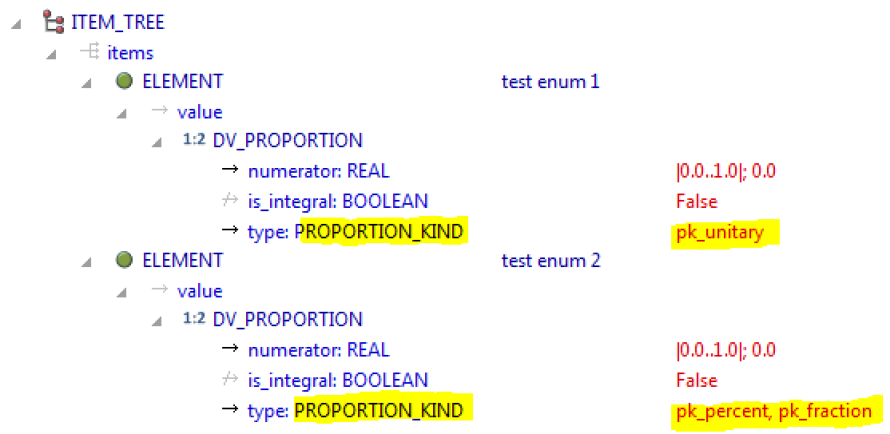
A parser that deserialises from an object dump format such as ODIN, JSON or XML will not need to do this.
The form of the constraint itself is simply a series of Integer, String or other primitive values, or an equivalent range or ranges. In the above example, the ADL equivalent of the pk_percent, pk_fraction constraint on a field of type PROPORTION_KIND is in fact just \{2, 3}, and it is visualised by lookup to show the relevant symbolic names.
Second Order Constraints
All the constraint semantics described above can be considered 'first order' in the sense that they define how specific object/attribute/object hierarchies are defined in the instance possibility space of some part of a reference model.
Some constraints however do not fit directly within the object/attribute/object hierarchy scheme, and are considered 'second order constraints' in the archetype formalism. The 'rule' constraints ('invariants' in ADL/AOM 1.4) constitute one such group. These constraints are defined in terms of first order predicate logic statements that can refer to any number of constraint nodes within the main hierarchy. These are described in [rules_package].
Another type of second order constraint can be 'attached' to the object/attribute/object hierarchy in order to further limit structural possibilities. Although these constraints could also theoretically be expressed as rules, they are supported by direct additions to the main constraint model since they can be easily and intuitively represented inline in ADL and corresponding AOM structures.
Tuple Constraints
Tuple constraints are designed to account for the very common need to constrain the values of more than one RM class attribute together. This effectively treats the attributes in question as a tuple, and the corresponding object constraints are accordingly modelled as tuples as well. A detailed explanation of tuples can be found in the ADL2 specification’s section on second order constraints. Additions to the main constraint model to support tuples are shown below.
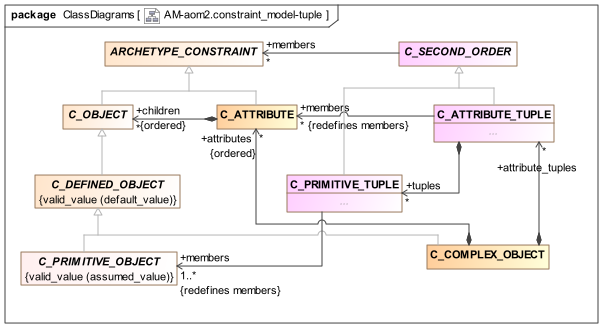
In this model, the type C_ATTRIBUTE_TUPLE groups the co-constrained C_ATTRIBUTEs under a C_COMPLEX_OBJECT. Currently, the concrete type is limited to being C_PRIMITIVE_OBJECT to reduce complexity, and since it caters for all known examples of tuple constraints. In principle, any C_DEFINED_OBJECT could be allowed, and this may change in the future.
The tuple constraint type replaces all domain-specific constraint types defined in ADL/AOM 1.4, including C_DV_QUANTITY and C_DV_ORDINAL.
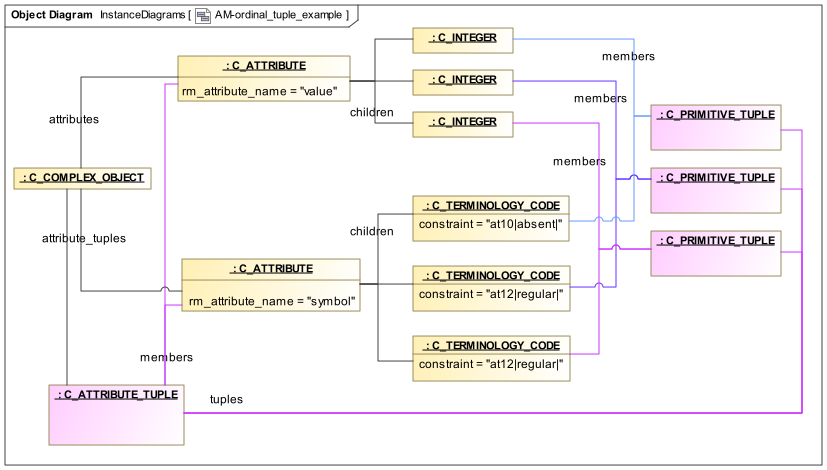
These additions allow standard constraint structures (i.e. C_ATTRIBUTE / C_COMPLEX_OBJECT / C_PRIMITIVE_OBJECT hierarchies) to be 'annotated', while leaving the first order structure intact. The following example shows an archetype instance structure in which a notional ORDINAL type is constrained. The logical requirement is to constrain a ORDINAL to one of three instance possibilities, each of which consists of a pair of values for the attributes value and symbol, of type Integer and TERMINOLOGY_CODE respectively. Each of these three instance constraints should be understood as an alternative for the single valued owning attribute, ELEMENT .value. Tuple constraints achieve the requirement to express the constraints as pairs not just as allowable alternatives at the final leaf level, which would incorrectly allowing any mixing of the Integer and code values.

Assertions
Assertions are used in ARCHETYPE_SLOTs, in order to express the 'included' and 'excluded' archetypes for the slot. In this case, each assertion is an expression that refers to parts of other archetypes, such as its identifier (e.g. 'include archetypes with short_concept_name matching xxxx '). Assertions are modelled here as a generic expression tree of unary prefix and binary infix operators. Examples of archetype slots in ADL syntax are given in the openEHR ADL2 specification.
AOM Type Substitutions
The C_OBJECT types defined in Object Node Types are reproduced below, with concrete types that may actually occur in archetypes shown in dark yellow / non-italic.

Within a specialised archetype, nodes that redefine corresponding nodes in the parent are normally of the same C_OBJECT type (we can think of this as a 'meta-type', since the RM type is the 'type' in the information model sense), but in some cases may also be of different C_OBJECT types.
The rules for meta-type redefinition are as follows:
-
A node of each meta-type can be redefined by a node of the same meta-type, with narrowed / added constraints;
-
ARCHETYPE_SLOTcan be redefined by:-
one or more
C_ARCHETYPE_ROOTnodes taken together, considered to define a 'filled' version of the slot; -
an
ARCHETYPE_SLOT, in order to close the slot.
-
-
A
C_ARCHETYPE_ROOTnode can be redefined by:-
A
C_ARCHETYPE_ROOT, where the archetype_ref of the redefining node is a specialisation of that mentioned in the parent node.
-
-
A 'terminal'
C_COMPLEX_OBJECTnode containing no constraint other than RM type,node_idand possibly occurrences (i.e. having no substructure), can be redefined by a constraint of any other AOM type other thanC_PRMITIVE_OBJECT.
The 'terminal' C_COMPLEX_OBJECT can be understood as a placeholder node primarily defined for the purpose of stating RM type and meaning (id-code).
Class Definitions
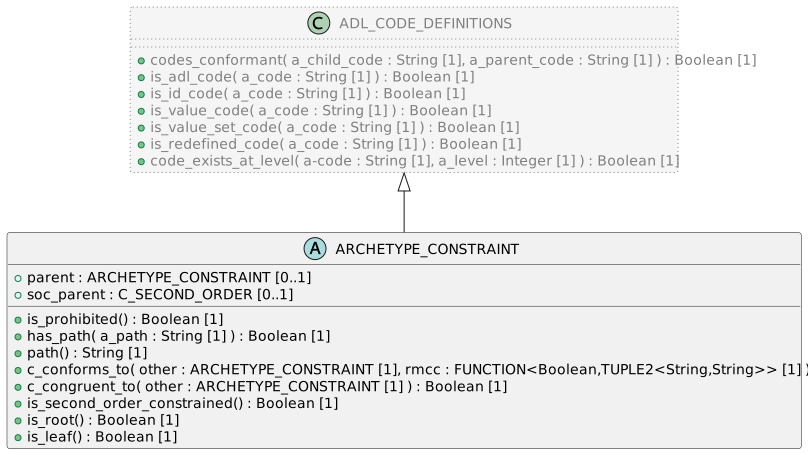
ARCHETYPE_CONSTRAINT Class
-
Definition
-
Effective
-
BMM
-
UML
Class |
ARCHETYPE_CONSTRAINT (abstract) |
|||
|---|---|---|---|---|
Description |
Abstract parent of all constraint model types. Defines conformance and congruence function signatures. |
|||
Inherit |
||||
Attributes |
Signature |
Meaning |
||
0..1 |
parent: |
Parent node, except in the case of the top of a tree, i.e. root |
||
0..1 |
soc_parent: |
|||
Functions |
Signature |
Meaning |
||
1..1 |
is_prohibited (): |
True if this node is prohibited. Implemented in subtypes. |
||
1..1 |
True if the relative path |
|||
1..1 |
path (): |
Path of this node relative to root of archetype. |
||
1..1 |
c_conforms_to ( |
True if constraints represented by this node, ignoring any sub-parts, are narrower or the same as other. Typically used during validation of specialised archetype nodes. Parameters
|
||
1..1 |
c_congruent_to ( |
True if constraints represented by this node contain no further redefinitions with respect to the node other, with the exception of Typically used to test if an inherited node locally contains any constraints. |
||
1..1 |
is_second_order_constrained (): |
True if there is a second order constraint such as a tuple constraint on this node. |
||
1..1 |
is_root (): |
True if this node is the root of the tree. |
||
1..1 |
is_leaf (): |
True if this node is a terminal node in the tree structure, i.e. having no child nodes. |
||
Invariants |
Post: |
|||
| ARCHETYPE_CONSTRAINT (abstract) | |||
|---|---|---|---|
Abstract parent of all constraint model types. Defines conformance and congruence function signatures. |
|||
Inherits: ADL_CODE_DEFINITIONS |
|||
Constants |
|||
Id_code_leader: |
String leader of ‘identifier’ codes, i.e. codes used to identify archetype nodes. |
||
Value_code_leader: |
String leader of ‘value’ codes, i.e. codes used to identify codes values, including value set members. |
||
Value_set_code_leader: |
String leader of ‘value set’ codes, i.e. codes used to identify value sets. |
||
Specialisation_separator: |
Character used to separate numeric parts of codes belonging to different specialisation levels. |
||
Code_regex_pattern: |
Regex used to define the legal numeric part of any archetype code. Corresponds to the simple pattern of dotted numbers, as used in typical multi-level numbering schemes. |
||
Root_code_regex_pattern: |
Regex pattern of the root id code of any archetype. Corresponds to codes of the form |
||
Primitive_node_id: |
Code id used for |
||
Attributes |
|||
parent: |
Parent node, except in the case of the top of a tree, i.e. root |
||
soc_parent: |
|||
Functions |
|||
codes_conformant ( |
True if |
||
is_adl_code ( |
True if |
||
is_id_code ( |
True if |
||
is_value_code ( |
True if |
||
is_value_set_code ( |
True if |
||
A code has been specialised if there is a non-zero code index anywhere above the last index e.g.
|
|||
code_exists_at_level ( |
Is |
||
(abstract) is_prohibited (): |
True if this node is prohibited. Implemented in subtypes. |
||
True if the relative path |
|||
path (): |
Path of this node relative to root of archetype. |
||
(abstract) c_conforms_to ( |
True if constraints represented by this node, ignoring any sub-parts, are narrower or the same as other. Typically used during validation of specialised archetype nodes. Parameters
|
||
(abstract) c_congruent_to ( |
True if constraints represented by this node contain no further redefinitions with respect to the node other, with the exception of Typically used to test if an inherited node locally contains any constraints. |
||
is_second_order_constrained (): |
True if there is a second order constraint such as a tuple constraint on this node. |
||
is_root (): |
True if this node is the root of the tree. |
||
is_leaf (): |
True if this node is a terminal node in the tree structure, i.e. having no child nodes. |
||
Invariants |
|||
Post: |
|||
{
    "name": "ARCHETYPE_CONSTRAINT",
    "documentation": "Abstract parent of all constraint model types. Defines conformance and congruence function signatures. ",
    "is_abstract": true,
    "ancestors": [
        "ADL_CODE_DEFINITIONS"
    ],
    "properties": {
        "parent": {
            "_type": "P_BMM_SINGLE_PROPERTY",
            "name": "parent",
            "documentation": "Parent node, except in the case of the top of a tree, i.e. root `C_COMPLEX_OBJECT` of an archetype definition.",
            "type": "ARCHETYPE_CONSTRAINT"
        },
        "soc_parent": {
            "_type": "P_BMM_SINGLE_PROPERTY",
            "name": "soc_parent",
            "type": "C_SECOND_ORDER"
        }
    },
    "functions": {
        "is_prohibited": {
            "name": "is_prohibited",
            "documentation": "True if this node is prohibited. Implemented in subtypes.",
            "is_abstract": true,
            "result": {
                "_type": "P_BMM_SIMPLE_TYPE",
                "type": "Boolean"
            }
        },
        "has_path": {
            "name": "has_path",
            "documentation": "True if the relative path `_a_path_` exists at this node.",
            "parameters": {
                "a_path": {
                    "_type": "P_BMM_SINGLE_FUNCTION_PARAMETER",
                    "name": "a_path",
                    "type": "String"
                }
            },
            "result": {
                "_type": "P_BMM_SIMPLE_TYPE",
                "type": "Boolean"
            }
        },
        "path": {
            "name": "path",
            "documentation": "Path of this node relative to root of archetype.",
            "result": {
                "_type": "P_BMM_SIMPLE_TYPE",
                "type": "String"
            }
        },
        "c_conforms_to": {
            "name": "c_conforms_to",
            "documentation": "True if constraints represented by this node, ignoring any sub-parts, are narrower or the same as other. \nTypically used during validation of specialised archetype nodes.",
            "is_abstract": true,
            "parameters": {
                "other": {
                    "_type": "P_BMM_SINGLE_FUNCTION_PARAMETER",
                    "name": "other",
                    "type": "ARCHETYPE_CONSTRAINT"
                },
                "rmcc": {
                    "_type": "P_BMM_GENERIC_FUNCTION_PARAMETER",
                    "name": "rmcc",
                    "documentation": "RM conformance checker - a lambda (i.e. function object) that can compute conformance of type-names within the  Reference Model on which the current archetype is based. The signature provides two arguments representing respectively, the `_rm_type_name_` of the current node and the `_rm_type_name_` of the node being redefined in a specialisation parent archetype.",
                    "type_def": {
                        "root_type": "FUNCTION",
                        "generic_parameters": [
                            "Boolean",
                            {
                                "_type": "P_BMM_GENERIC_TYPE",
                                "root_type": "TUPLE2",
                                "generic_parameters": [
                                    "String",
                                    "String"
                                ]
                            }
                        ]
                    }
                }
            },
            "result": {
                "_type": "P_BMM_SIMPLE_TYPE",
                "type": "Boolean"
            }
        },
        "c_congruent_to": {
            "name": "c_congruent_to",
            "documentation": "True if constraints represented by this node contain no further redefinitions with respect to the node other, with the exception of `_node_id_` redefinition in `C_OBJECT` nodes. \n\nTypically used to test if an inherited node locally contains any constraints.",
            "is_abstract": true,
            "parameters": {
                "other": {
                    "_type": "P_BMM_SINGLE_FUNCTION_PARAMETER",
                    "name": "other",
                    "type": "ARCHETYPE_CONSTRAINT"
                }
            },
            "result": {
                "_type": "P_BMM_SIMPLE_TYPE",
                "type": "Boolean"
            }
        },
        "is_second_order_constrained": {
            "name": "is_second_order_constrained",
            "documentation": "True if there is a second order constraint such as a tuple constraint on this node.",
            "post_conditions": {
                "Post": "soc_parent /= Void or else (parent /= Void and then parent.is_second_order_constrained)"
            },
            "result": {
                "_type": "P_BMM_SIMPLE_TYPE",
                "type": "Boolean"
            }
        },
        "is_root": {
            "name": "is_root",
            "documentation": "True if this node is the root of the tree.",
            "result": {
                "_type": "P_BMM_SIMPLE_TYPE",
                "type": "Boolean"
            }
        },
        "is_leaf": {
            "name": "is_leaf",
            "documentation": "True if this node is a terminal node in the tree structure, i.e. having no child nodes.",
            "result": {
                "_type": "P_BMM_SIMPLE_TYPE",
                "type": "Boolean"
            }
        }
    },
    "invariants": {
        "Post": "Result = soc_parent /= Void or parent.soc_parent /= Void"
    }
}
C_ATTRIBUTE Class
-
Definition
-
Effective
-
BMM
-
UML
Class |
C_ATTRIBUTE |
|
|---|---|---|
Description |
Abstract model of constraint on any kind of attribute in a class model. |
|
Inherit |
||
Attributes |
Signature |
Meaning |
1..1 |
rm_attribute_name: |
Reference model attribute within the enclosing type represented by a |
0..1 |
existence: |
Constraint settable on every attribute, regardless of whether it is singular or of a container type, which indicates whether its target object exists or not (i.e. is mandatory or not). Only set if it overrides the underlying reference model or parent archetype in the case of specialised archetypes. |
0..1 |
Child |
|
0..1 |
differential_path: |
Path to the parent object of this attribute (i.e. doesn’t include the name of this attribute). Used only for attributes in differential form, specialised archetypes. Enables only the re-defined parts of a specialised archetype to be expressed, at the path where they occur. |
0..1 |
cardinality: |
Cardinality constraint of attribute, if a container attribute. |
1..1 |
is_multiple: |
Flag indicating whether this attribute constraint is on a container (i.e. multiply-valued) attribute. |
Functions |
Signature |
Meaning |
1..1 |
any_allowed (): |
True if there is no effective constraint on the children of the RM attribute to which this |
1..1 |
is_mandatory (): |
True if this |
1..1 |
rm_attribute_path (): |
Path of this attribute with respect to owning |
1..1 |
is_single (): |
True if this node logically represents a single-valued attribute. Evaluated as not |
1..1 |
c_congruent_to ( |
True if constraints represented by this node contain no further redefinitions with respect to the node other, with the exception of Typically used to test if an inherited node locally contains any constraints. |
1..1 |
c_conforms_to ( |
True if constraints represented by this node, ignoring any sub-parts, are narrower or the same as other. Typically used during validation of specialised archetype nodes. |
1..1 |
is_prohibited (): |
True if this |
| C_ATTRIBUTE | |
|---|---|
Abstract model of constraint on any kind of attribute in a class model. |
|
Inherits: ADL_CODE_DEFINITIONS, ARCHETYPE_CONSTRAINT |
|
Constants |
|
Id_code_leader: |
String leader of ‘identifier’ codes, i.e. codes used to identify archetype nodes. |
Value_code_leader: |
String leader of ‘value’ codes, i.e. codes used to identify codes values, including value set members. |
Value_set_code_leader: |
String leader of ‘value set’ codes, i.e. codes used to identify value sets. |
Specialisation_separator: |
Character used to separate numeric parts of codes belonging to different specialisation levels. |
Code_regex_pattern: |
Regex used to define the legal numeric part of any archetype code. Corresponds to the simple pattern of dotted numbers, as used in typical multi-level numbering schemes. |
Root_code_regex_pattern: |
Regex pattern of the root id code of any archetype. Corresponds to codes of the form |
Primitive_node_id: |
Code id used for |
Attributes |
|
parent: |
Parent node, except in the case of the top of a tree, i.e. root |
soc_parent: |
+ Inherited from ARCHETYPE_CONSTRAINT |
rm_attribute_name: |
Reference model attribute within the enclosing type represented by a |
existence: |
Constraint settable on every attribute, regardless of whether it is singular or of a container type, which indicates whether its target object exists or not (i.e. is mandatory or not). Only set if it overrides the underlying reference model or parent archetype in the case of specialised archetypes. |
Child |
|
differential_path: |
Path to the parent object of this attribute (i.e. doesn’t include the name of this attribute). Used only for attributes in differential form, specialised archetypes. Enables only the re-defined parts of a specialised archetype to be expressed, at the path where they occur. |
cardinality: |
Cardinality constraint of attribute, if a container attribute. |
is_multiple: |
Flag indicating whether this attribute constraint is on a container (i.e. multiply-valued) attribute. |
Functions |
|
codes_conformant ( |
True if |
is_adl_code ( |
True if |
is_id_code ( |
True if |
is_value_code ( |
True if |
is_value_set_code ( |
True if |
A code has been specialised if there is a non-zero code index anywhere above the last index e.g.
|
|
code_exists_at_level ( |
Is |
is_prohibited (): |
True if this |
True if the relative path |
|
path (): |
Path of this node relative to root of archetype. |
c_conforms_to ( |
True if constraints represented by this node, ignoring any sub-parts, are narrower or the same as other. Typically used during validation of specialised archetype nodes. |
c_congruent_to ( |
True if constraints represented by this node contain no further redefinitions with respect to the node other, with the exception of Typically used to test if an inherited node locally contains any constraints. |
is_second_order_constrained (): |
True if there is a second order constraint such as a tuple constraint on this node. |
is_root (): |
True if this node is the root of the tree. |
is_leaf (): |
True if this node is a terminal node in the tree structure, i.e. having no child nodes. |
any_allowed (): |
True if there is no effective constraint on the children of the RM attribute to which this |
is_mandatory (): |
True if this |
rm_attribute_path (): |
Path of this attribute with respect to owning |
is_single (): |
True if this node logically represents a single-valued attribute. Evaluated as not |
Invariants |
|
Post: |
|
{
    "name": "C_ATTRIBUTE",
    "documentation": "Abstract model of constraint on any kind of attribute in a class model.",
    "ancestors": [
        "ARCHETYPE_CONSTRAINT"
    ],
    "properties": {
        "rm_attribute_name": {
            "_type": "P_BMM_SINGLE_PROPERTY",
            "name": "rm_attribute_name",
            "documentation": "Reference model attribute within the enclosing type represented by a `C_OBJECT`.",
            "is_mandatory": true,
            "type": "String"
        },
        "existence": {
            "_type": "P_BMM_SINGLE_PROPERTY",
            "name": "existence",
            "documentation": "Constraint settable on every attribute, regardless of whether it is singular or of a container type, which indicates whether its target object exists or not (i.e. is mandatory or not). Only set if it overrides the underlying reference model or parent archetype in the case of specialised archetypes.",
            "type": "Multiplicity_interval"
        },
        "children": {
            "_type": "P_BMM_CONTAINER_PROPERTY",
            "name": "children",
            "documentation": "Child `C_OBJECT` nodes. Each such node represents a constraint on the type of this attribute in its reference model. Multiples occur both for multiple items in the case of container attributes, and alternatives in the case of singular attributes. ",
            "type_def": {
                "container_type": "List",
                "type": "C_OBJECT"
            },
            "cardinality": {
                "lower": 0,
                "upper_unbounded": true
            }
        },
        "differential_path": {
            "_type": "P_BMM_SINGLE_PROPERTY",
            "name": "differential_path",
            "documentation": "Path to the parent object of this attribute (i.e. doesn’t include the name of this attribute). Used only for attributes in differential form, specialised archetypes. Enables only the re-defined parts of a specialised archetype to be expressed, at the path where they occur.",
            "type": "String"
        },
        "cardinality": {
            "_type": "P_BMM_SINGLE_PROPERTY",
            "name": "cardinality",
            "documentation": "Cardinality constraint of attribute, if a container attribute.",
            "type": "Cardinality"
        },
        "is_multiple": {
            "_type": "P_BMM_SINGLE_PROPERTY",
            "name": "is_multiple",
            "documentation": "Flag indicating whether this attribute constraint is on a container (i.e. multiply-valued) attribute.",
            "is_mandatory": true,
            "type": "Boolean"
        }
    },
    "functions": {
        "any_allowed": {
            "name": "any_allowed",
            "documentation": "True if there is no effective constraint on the children of the RM attribute to which this `C_ATTRIBUTE` refers.",
            "post_conditions": {
                "Post": "Result := children.is_empty and not is_prohibited"
            },
            "result": {
                "_type": "P_BMM_SIMPLE_TYPE",
                "type": "Boolean"
            }
        },
        "is_mandatory": {
            "name": "is_mandatory",
            "documentation": "True if this `C_ATTRIBUTE` has an existence constraint of 1..1, i.e. mandation.",
            "post_conditions": {
                "Post": "Result = existence /= Void and then existence.is_mandatory"
            },
            "result": {
                "_type": "P_BMM_SIMPLE_TYPE",
                "type": "Boolean"
            }
        },
        "rm_attribute_path": {
            "name": "rm_attribute_path",
            "documentation": "Path of this attribute with respect to owning `C_OBJECT`, including differential path where applicable.",
            "result": {
                "_type": "P_BMM_SIMPLE_TYPE",
                "type": "String"
            }
        },
        "is_single": {
            "name": "is_single",
            "documentation": "True if this node logically represents a single-valued attribute. Evaluated as not `_is_multiple_`.",
            "result": {
                "_type": "P_BMM_SIMPLE_TYPE",
                "type": "Boolean"
            }
        },
        "c_congruent_to": {
            "name": "c_congruent_to",
            "documentation": "True if constraints represented by this node contain no further redefinitions with respect to the node other, with the exception of `_node_id_` redefinition in `C_OBJECT` nodes. \n\nTypically used to test if an inherited node locally contains any constraints.",
            "parameters": {
                "other": {
                    "_type": "P_BMM_SINGLE_FUNCTION_PARAMETER",
                    "name": "other",
                    "type": "ARCHETYPE_CONSTRAINT"
                }
            },
            "post_conditions": {
                "Post": "Result = existence = Void and ((is_single and other.is_single) or (is_multiple and other.is_multiple and cardinality = Void))"
            },
            "result": {
                "_type": "P_BMM_SIMPLE_TYPE",
                "type": "Boolean"
            }
        },
        "c_conforms_to": {
            "name": "c_conforms_to",
            "documentation": "True if constraints represented by this node, ignoring any sub-parts, are narrower or the same as other. \nTypically used during validation of specialised archetype nodes.",
            "parameters": {
                "other": {
                    "_type": "P_BMM_SINGLE_FUNCTION_PARAMETER",
                    "name": "other",
                    "type": "ARCHETYPE_CONSTRAINT"
                },
                "rmcc": {
                    "_type": "P_BMM_GENERIC_FUNCTION_PARAMETER",
                    "name": "rmcc",
                    "type_def": {
                        "root_type": "FUNCTION",
                        "generic_parameters": [
                            "Boolean",
                            {
                                "_type": "P_BMM_GENERIC_TYPE",
                                "root_type": "TUPLE2",
                                "generic_parameters": [
                                    "String",
                                    "String"
                                ]
                            }
                        ]
                    }
                }
            },
            "post_conditions": {
                "Post": "Result = existence_conforms_to (other) and ((is_single and other.is_single) or else (is_multiple and cardinality_conforms_to (other)))"
            },
            "result": {
                "_type": "P_BMM_SIMPLE_TYPE",
                "type": "Boolean"
            }
        },
        "is_prohibited": {
            "name": "is_prohibited",
            "documentation": "True if this `C_ATTRIBUTE` has an existence constraint of `0..0`, i.e. prohibition.",
            "post_conditions": {
                "Post": "Result = existence /= Void and then existence.is_prohibited"
            },
            "result": {
                "_type": "P_BMM_SIMPLE_TYPE",
                "type": "Boolean"
            }
        }
    }
}
Conformance Semantics: C_ATTRIBUTE
The following functions formally define the conformance interfaces of any ARCHETYPE_CONSTRAINT node in a specialised archetype to the corresponding node in a parent archetype, where 'corresponding' means a node found at the same or a congruent path.
c_conforms_to (other: ARCHETYPE_CONSTRAINT; rmcc: FUNCTION<<a_type, other_type: String>, Boolean>): Boolean
        -- True if this node on its own (ignoring any subparts) expresses the same or narrower
        -- constraints as `other`.
        -- Returns False if any of the following is incompatible:
        --	 * cardinality
        --	 * existence
    require
        other /= Void
        rmcc /= Void
    deferred
    end

c_congruent_to (other: ARCHETYPE_CONSTRAINT): Boolean
        -- True if this node on its own (ignoring any subparts) expresses no additional
        -- constraints than `other`.
    require
        other /= Void
    deferred
    end
The following effected functions defined in C_ATTRIBUTE define the conformance of an attribute node in a specialised archetype to the corresponding node in a parent archetype, where 'corresponding' means a node found at the same or a congruent path.
c_conforms_to (other: C_ATTRIBUTE; rmcc: FUNCTION<<a_type, other_type: String>, Boolean>): Boolean
        -- True if this node on its own (ignoring any subparts) expresses the same or narrower
        -- constraints as `other'.
        -- Returns False if any of the following is incompatible:
        --	 * cardinality
        --	 * existence
    do
        Result := existence_conforms_to (other) and
            ((is_single and other.is_single) or else
            (is_multiple and cardinality_conforms_to (other)))
    end

c_congruent_to (other: C_ATTRIBUTE): Boolean
		-- True if this node on its own (ignoring any subparts) expresses no additional
        -- constraints than `other'.
    do
        Result := existence = Void and ((is_single and other.is_single) or
                (is_multiple and other.is_multiple and cardinality = Void))
    end

existence_conforms_to (other: C_ATTRIBUTE): Boolean
		-- True if the existence of this node conforms to other.existence
    require
        other /= Void
    do
        if existence /= Void and other.existence /= Void then
            Result := other.existence.contains (existence)
        else
            Result := True
        end
    end

cardinality_conforms_to (other: C_ATTRIBUTE): Boolean
		-- True if the cardinality of this node conforms to other.cardinality, if it exists
    require
        other /= Void
    do
        if cardinality /= Void and other.cardinality /= Void then
            Result := other.cardinality.contains (cardinality)
        else
            Result := True
        end
    end

collective_occurrences_of (parent_object: C_OBJECT;
            rm_prop_mult: FUNCTION <<rm_type_name, rm_property_path: String>, Multiplicity_interval>): Multiplicity_interval
        -- compute collective occurrences according to VSONCO, of all object nodes under this
        -- attribute node that redefine `parent_object`, which is assumed to be an object node
        -- within `other`, the specialisation parent of this C_ATTRIBUTE
    require
        parent_object /= Void
        other.is_multiple
    do
        -- make a 0..0 interval
        create Result.make_prohibited

        children.do_all (
            agent (child_co, parent_co: C_OBJECT;
                    rm_prop_mult: FUNCTION <<rm_type_name, rm_property_path: String>, Multiplicity_interval>;
                    interval: Multiplicity_interval)
                local
                    child_occ: Multiplicity_interval
                do
                    if child_co.node_id_conforms_to (parent_co) then
                        -- child object node may have no occurrences
                        child_occ := child_obj.effective_occurrences (rm_prop_mult)

                        interval.set_lower (interval.lower + child_occ.lower)
                        if child_occ.upper_unbounded then
                            interval.set_upper_unbounded
                        elseif not interval.upper_unbounded then
                            interval.set_upper (interval.upper + child_occ.upper)
                        end
                    end
                end (?, a_parent_co, rm_prop_mult, Result)
        )

        if cardinality /= Void and then not cardinality.upper_unbounded then
            Result.set_upper (if Result.upper_unbounded then cardinality.upper else Result.upper.min (cardinality.upper) end)
        end
    end
Validity Rules: C_ATTRIBUTE
The validity rules are as follows:
VCARM: attribute name reference model validity: an attribute name introducing an attribute constraint block must be defined in the underlying information model as an attribute (stored or computed) of the type which introduces the enclosing object block.
VCAEX: archetype attribute reference model existence conformance: the existence of an attribute, if set, must conform, i.e. be the same or narrower, to the existence of the corresponding attribute in the underlying information model.
VCAM: archetype attribute reference model multiplicity conformance: the multiplicity, i.e. whether an attribute is multiply- or single-valued, of an attribute must conform to that of the corresponding attribute in the underlying information model.
VDIFV: archetype attribute differential path validity: an archetype may only have a differential path if it is specialised..
The following validity rule applies to redefinition in a specialised archetype:
VDIFP: specialised archetype attribute differential path validity: if an attribute constraint has a differential path, the path must exist in the flat parent, and also be valid with respect to the reference model, i.e. in the sense that it corresponds to a legal potential construction of objects.
VSANCE: specialised archetype attribute node existence conformance: the existence of a redefined attribute node in a specialised archetype, if stated, must conform to the existence of the corresponding node in the flat parent archetype, by having an identical range, or a range wholly contained by the latter.
VSAM: specialised archetype attribute multiplicity conformance: the multiplicity, i.e. whether an attribute is multiply- or single-valued, of a redefined attribute must conform to that of the corresponding attribute in the parent archetype.
The following validity rules apply to single-valued attributes, i.e when C_ATTRIBUTE.is_multiple is False:
VACSO: single-valued attribute child object occurrences validity: the occurrences of a child object of a single-valued attribute cannot have an upper limit greater than 1.
The following validity rules apply to container attributes, i.e when C_ATTRIBUTE.is_multiple is True:
VACMCU: cardinality/occurrences upper bound validity: where a cardinality with a finite upper bound is stated on an attribute, for all immediate child objects for which an occurrences constraint is stated, the occurrences must either have an open upper bound (i.e. n..*) which is interpreted as the maximum value allowed within the cardinality, or else a finite upper bound which is <= the cardinality upper bound.
VACMCO: cardinality/occurrences orphans: it must be possible for at least one instance of one optional child object (i.e. an object for which the occurrences lower bound is 0) and one instance of every mandatory child object (i.e. object constraints for which the occurrences lower bound is >= 1) to be included within the cardinality range.
VCACA: archetype attribute reference model cardinality conformance: the cardinality of an attribute must conform, i.e. be the same or narrower, to the cardinality of the corresponding attribute in the underlying information model.
The following validity warnings apply to container attributes, i.e when C_ATTRIBUTE.is_multiple is True:
WACMCL: cardinality/occurrences lower bound validity: where a cardinality with a finite upper bound is stated on an attribute, for all immediate child objects for which an occurrences constraint is stated, the sum of occurrences lower bounds should be lower than the cardinality upper limit.
The following validity rule applies to cardinality redefinition in a specialised archetype:
VSANCC: specialised archetype attribute node cardinality conformance: the cardinality of a redefined (multiply-valued) attribute node in a specialised archetype, if stated, must conform to the cardinality of the corresponding node in the flat parent archetype by either being identical, or being wholly contained by the latter.
C_OBJECT Class
-
Definition
-
Effective
-
BMM
-
UML
Class |
C_OBJECT (abstract) |
|||
|---|---|---|---|---|
Description |
Abstract model of constraint on any kind of object node. |
|||
Inherit |
||||
Attributes |
Signature |
Meaning |
||
1..1 |
rm_type_name: |
Reference model type that this node corresponds to. |
||
0..1 |
occurrences: |
Occurrences of this object node in the data, under the owning attribute. Upper limit can only be greater than 1 if owning attribute has a cardinality of more than 1. Only set if it overrides the parent archetype in the case of specialised archetypes, or else the occurrences inferred from the underlying reference model existence and/or cardinality of the containing attribute. |
||
1..1 |
node_id: |
Semantic identifier of this node, used to distinguish sibling nodes. All nodes must have a For |
||
0..1 |
is_deprecated: |
True if this node and by implication all sub-nodes are deprecated for use. |
||
0..1 |
sibling_order: |
Optional indicator of order of this node with respect to another sibling. Only meaningful in a specialised archetype for a |
||
Functions |
Signature |
Meaning |
||
1..1 |
specialisation_depth (): |
Level of specialisation of this archetype node, based on its |
||
1..1 |
effective_occurrences (): |
Compute effective occurrences, where no local occurrences constraint set. If the owning If local |
||
1..1 |
c_conforms_to ( |
True if constraints represented by this node, ignoring any sub-parts, are narrower or the same as other. Typically used during validation of specialised archetype nodes. Parameters
|
||
1..1 |
c_congruent_to ( |
True if constraints represented by this node contain no further redefinitions with respect to the node Typically used to test if an inherited node locally contains any constraints. |
||
1..1 |
True if this node Parameters
|
|||
1..1 |
node_id_conforms_to ( |
True if this node id conforms to |
||
1..1 |
is_prohibited (): |
True if this |
||
| C_OBJECT (abstract) | |||
|---|---|---|---|
Abstract model of constraint on any kind of object node. |
|||
Inherits: ADL_CODE_DEFINITIONS, ARCHETYPE_CONSTRAINT |
|||
Constants |
|||
Id_code_leader: |
String leader of ‘identifier’ codes, i.e. codes used to identify archetype nodes. |
||
Value_code_leader: |
String leader of ‘value’ codes, i.e. codes used to identify codes values, including value set members. |
||
Value_set_code_leader: |
String leader of ‘value set’ codes, i.e. codes used to identify value sets. |
||
Specialisation_separator: |
Character used to separate numeric parts of codes belonging to different specialisation levels. |
||
Code_regex_pattern: |
Regex used to define the legal numeric part of any archetype code. Corresponds to the simple pattern of dotted numbers, as used in typical multi-level numbering schemes. |
||
Root_code_regex_pattern: |
Regex pattern of the root id code of any archetype. Corresponds to codes of the form |
||
Primitive_node_id: |
Code id used for |
||
Attributes |
|||
parent: |
Parent node, except in the case of the top of a tree, i.e. root |
||
soc_parent: |
+ Inherited from ARCHETYPE_CONSTRAINT |
||
rm_type_name: |
Reference model type that this node corresponds to. |
||
occurrences: |
Occurrences of this object node in the data, under the owning attribute. Upper limit can only be greater than 1 if owning attribute has a cardinality of more than 1. Only set if it overrides the parent archetype in the case of specialised archetypes, or else the occurrences inferred from the underlying reference model existence and/or cardinality of the containing attribute. |
||
node_id: |
Semantic identifier of this node, used to distinguish sibling nodes. All nodes must have a For |
||
is_deprecated: |
True if this node and by implication all sub-nodes are deprecated for use. |
||
sibling_order: |
Optional indicator of order of this node with respect to another sibling. Only meaningful in a specialised archetype for a |
||
Functions |
|||
codes_conformant ( |
True if |
||
is_adl_code ( |
True if |
||
is_id_code ( |
True if |
||
is_value_code ( |
True if |
||
is_value_set_code ( |
True if |
||
A code has been specialised if there is a non-zero code index anywhere above the last index e.g.
|
|||
code_exists_at_level ( |
Is |
||
is_prohibited (): |
True if this |
||
True if the relative path |
|||
path (): |
Path of this node relative to root of archetype. |
||
c_conforms_to ( |
True if constraints represented by this node, ignoring any sub-parts, are narrower or the same as other. Typically used during validation of specialised archetype nodes. Parameters
|
||
c_congruent_to ( |
True if constraints represented by this node contain no further redefinitions with respect to the node Typically used to test if an inherited node locally contains any constraints. |
||
is_second_order_constrained (): |
True if there is a second order constraint such as a tuple constraint on this node. |
||
is_root (): |
True if this node is the root of the tree. |
||
is_leaf (): |
True if this node is a terminal node in the tree structure, i.e. having no child nodes. |
||
specialisation_depth (): |
Level of specialisation of this archetype node, based on its |
||
effective_occurrences (): |
Compute effective occurrences, where no local occurrences constraint set. If the owning If local |
||
occurrences_conforms_to ( |
True if this node Parameters
|
||
node_id_conforms_to ( |
True if this node id conforms to |
||
Invariants |
|||
Post: |
|||
{
    "name": "C_OBJECT",
    "documentation": "Abstract model of constraint on any kind of object node. ",
    "is_abstract": true,
    "ancestors": [
        "ARCHETYPE_CONSTRAINT"
    ],
    "properties": {
        "rm_type_name": {
            "_type": "P_BMM_SINGLE_PROPERTY",
            "name": "rm_type_name",
            "documentation": "Reference model type that this node corresponds to. ",
            "is_mandatory": true,
            "type": "String"
        },
        "occurrences": {
            "_type": "P_BMM_SINGLE_PROPERTY",
            "name": "occurrences",
            "documentation": "Occurrences of this object node in the data, under the owning attribute. Upper limit can only be greater than 1 if owning attribute has a cardinality of more than 1.\nOnly set if it overrides the parent archetype in the case of specialised archetypes, or else the occurrences inferred from the underlying reference model existence and/or cardinality of the containing attribute.",
            "type": "Multiplicity_interval"
        },
        "node_id": {
            "_type": "P_BMM_SINGLE_PROPERTY",
            "name": "node_id",
            "documentation": "Semantic identifier of this node, used to distinguish sibling nodes. All nodes must have a `_node_id_`; for nodes under a container `C_ATTRIBUTE`, the id must be an id-code must be defined in the archetype terminology. For valid structures, all node ids are id-codes.\n\nFor `C_PRIMITIVE_OBJECTs` represented in ADL inline form, this attribute will have the special value `Primitive_node_id`; otherwise it will have the node id read during parsing.",
            "is_mandatory": true,
            "type": "String"
        },
        "is_deprecated": {
            "_type": "P_BMM_SINGLE_PROPERTY",
            "name": "is_deprecated",
            "documentation": "True if this node and by implication all sub-nodes are deprecated for use.",
            "type": "Boolean"
        },
        "sibling_order": {
            "_type": "P_BMM_SINGLE_PROPERTY",
            "name": "sibling_order",
            "documentation": "Optional indicator of order of this node with respect to another sibling. Only meaningful in a specialised archetype for a `C_OBJECT` within a `C_ATTRIBUTE` with `_is_multiple_ = True`.",
            "type": "SIBLING_ORDER"
        }
    },
    "functions": {
        "specialisation_depth": {
            "name": "specialisation_depth",
            "documentation": "Level of specialisation of this archetype node, based on its `_node_id_`. The value 0 corresponds to non-specialised, 1 to first-level specialisation and so on. The level is the same as the number of ‘.’ characters in the node_id code. If `_node_id_` is not set, the return value is -1, signifying that the specialisation level should be determined from the nearest parent `C_OBJECT` node having a node_id.",
            "result": {
                "_type": "P_BMM_SIMPLE_TYPE",
                "type": "Integer"
            }
        },
        "effective_occurrences": {
            "name": "effective_occurrences",
            "documentation": "Compute effective occurrences, where no local occurrences constraint set. If the owning `C_ATTRIBUTE._cardinality_` is set, use its upper value, else use RM multiplicity of the owning attribute.\n\nIf local `occurrences` not set, always assume 0 as the lower bound.",
            "result": {
                "_type": "P_BMM_SIMPLE_TYPE",
                "type": "Multiplicity_interval"
            }
        },
        "c_conforms_to": {
            "name": "c_conforms_to",
            "documentation": "True if constraints represented by this node, ignoring any sub-parts, are narrower or the same as other. \nTypically used during validation of specialised archetype nodes.",
            "parameters": {
                "other": {
                    "_type": "P_BMM_SINGLE_FUNCTION_PARAMETER",
                    "name": "other",
                    "type": "C_OBJECT"
                },
                "rmcc": {
                    "_type": "P_BMM_GENERIC_FUNCTION_PARAMETER",
                    "name": "rmcc",
                    "documentation": "Reference Model conformance checker agent (lambda).",
                    "type_def": {
                        "root_type": "FUNCTION",
                        "generic_parameters": [
                            "Boolean",
                            {
                                "_type": "P_BMM_GENERIC_TYPE",
                                "root_type": "TUPLE2",
                                "generic_parameters": [
                                    "String",
                                    "String"
                                ]
                            }
                        ]
                    }
                }
            },
            "result": {
                "_type": "P_BMM_SIMPLE_TYPE",
                "type": "Boolean"
            }
        },
        "c_congruent_to": {
            "name": "c_congruent_to",
            "documentation": "True if constraints represented by this node contain no further redefinitions with respect to the node `_other_`, with the exception of `_node_id_` redefinition in `C_OBJECT` nodes. \n\nTypically used to test if an inherited node locally contains any constraints.",
            "parameters": {
                "other": {
                    "_type": "P_BMM_SINGLE_FUNCTION_PARAMETER",
                    "name": "other",
                    "type": "ARCHETYPE_CONSTRAINT"
                }
            },
            "result": {
                "_type": "P_BMM_SIMPLE_TYPE",
                "type": "Boolean"
            }
        },
        "occurrences_conforms_to": {
            "name": "occurrences_conforms_to",
            "documentation": "True if this node `_occurrences_` conforms to `_other.occurrences_`; `other` is assumed to be in a flat archetype.",
            "parameters": {
                "other": {
                    "_type": "P_BMM_SINGLE_FUNCTION_PARAMETER",
                    "name": "other",
                    "documentation": "`C_OBJECT` from a flat parent archetype.",
                    "type": "C_OBJECT"
                }
            },
            "result": {
                "_type": "P_BMM_SIMPLE_TYPE",
                "type": "Boolean"
            }
        },
        "node_id_conforms_to": {
            "name": "node_id_conforms_to",
            "documentation": "True if this node id conforms to `_other.node_id_`, which includes the ids being identical; `_other_` is assumed to be in a flat archetype.",
            "parameters": {
                "other": {
                    "_type": "P_BMM_SINGLE_FUNCTION_PARAMETER",
                    "name": "other",
                    "type": "C_OBJECT"
                }
            },
            "post_conditions": {
                "Post": "Result = codes_conformant (node_id, other.node_id)"
            },
            "result": {
                "_type": "P_BMM_SIMPLE_TYPE",
                "type": "Boolean"
            }
        },
        "is_prohibited": {
            "name": "is_prohibited",
            "documentation": "True if this `C_OBJECT` node is prohibited, i.e. if its `_occurrences_` is `0..0`.",
            "post_conditions": {
                "Post": "Result = occurrences /= Void and then occurrences.is_prohibited"
            },
            "result": {
                "_type": "P_BMM_SIMPLE_TYPE",
                "type": "Boolean"
            }
        }
    }
}
SIBLING_ORDER Class
-
Definition
-
Effective
-
BMM
-
UML
Class |
SIBLING_ORDER |
|
|---|---|---|
Description |
Defines the order indicator that can be used on a Misuse: This type cannot be used on a |
|
Attributes |
Signature |
Meaning |
1..1 |
is_before: |
True if the order relationship is ‘before’, if False, it is ‘after’. |
1..1 |
sibling_node_id: |
Node identifier of sibling before or after which this node should come. |
Functions |
Signature |
Meaning |
1..1 |
is_after (): |
True if the order relationship is |
| SIBLING_ORDER | |
|---|---|
Defines the order indicator that can be used on a Misuse: This type cannot be used on a |
|
Attributes |
|
is_before: |
True if the order relationship is ‘before’, if False, it is ‘after’. |
sibling_node_id: |
Node identifier of sibling before or after which this node should come. |
Functions |
|
is_after (): |
True if the order relationship is |
{
    "name": "SIBLING_ORDER",
    "documentation": "Defines the order indicator that can be used on a `C_OBJECT` within a container attribute in a specialised archetype to indicate its order with respect to a sibling defined in a higher specialisation level.\n\nMisuse: This type cannot be used on a `C_OBJECT` other than one within a container attribute in a specialised archetype.",
    "properties": {
        "is_before": {
            "_type": "P_BMM_SINGLE_PROPERTY",
            "name": "is_before",
            "documentation": "True if the order relationship is ‘before’, if False, it is ‘after’.",
            "is_mandatory": true,
            "type": "Boolean"
        },
        "sibling_node_id": {
            "_type": "P_BMM_SINGLE_PROPERTY",
            "name": "sibling_node_id",
            "documentation": "Node identifier of sibling before or after which this node should come.",
            "is_mandatory": true,
            "type": "String"
        }
    },
    "functions": {
        "is_after": {
            "name": "is_after",
            "documentation": "True if the order relationship is `_after_`, computed as the negation of `_is_before_`.",
            "result": {
                "_type": "P_BMM_SIMPLE_TYPE",
                "type": "Boolean"
            }
        }
    }
}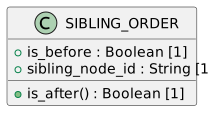
Occurrences inferencing rules
The notion of 'occurrences' does not exist in an object model that might be used as the reference model on which archetypes are based, because it is a class model. However, archetypes commonly constrain the occurrences of object nodes under a container attribute, indicating how many objects conforming to a specific object constraint node might exist.
There are various circumstances where it is useful to know the effective occurrences of an archetype object node. One is in validation, in order to determine validity of occurrences constraints; another is in archetype editor tools. Similarly, in an Operational Template, an occurrences constraint is required on all child object nodes of container attributes. Most such constraints come from the source template(s) and archetypes, but often there will be nodes with no occurrences set. In these cases, the occurrences constraint is inferred from the archetype and the reference model according to the following algorithm, where c_object represents any object node in an archetype.
effective_occurrences (rm_prop_mult: FUNCTION <<rm_type_name, rm_property_path: String>, Multiplicity_interval>): Multiplicity_interval
        -- Compute effective occurrences, where no local occurrences constraint set. If the owning
        -- `C_ATTRIBUTE._cardinality_` is set, use its upper value, else use RM multiplicity of the
        -- owning attribute.
        -- `rm_attr_prop_mult` is a function that knows how to compute effective object multiplicity
        -- by looking at the owning RM property.
        -- If local `occurrences` not set, always assume 0 as the lower bound.
    do
        if occurrences /= Void then
            Result := occurrences

        elseif parent /= Void then
            if parent.cardinality /= Void then
                if parent.cardinality.interval.upper_unbounded then
                    create Result.make_open
                else
                    create Result.make_bounded (0, parent.cardinality.interval.upper)
                end
            elseif parent.parent /= Void then
                Result := rm_prop_mult (parent.parent.rm_type_name, parent.parent.rm_attribute_path)
                Result.set_lower (0)
            else
                create Result.make_open
            end
        else
            create Result.make_open
        end
    end
In the above, rm_prop_mult is a reference to a function within an RM schema representation, which has the following logic:
object_multiplicity (rm_type_name, rm_property_path: String): Multiplicity_interval
        -- compute the effective object multiplicity of objects at rm_property_path within type rm_type_name
        -- from the Reference Model
    require
        rm_type_name /= Void
        rm_property_path /= Void
    do
        rm_property_def := get_rm_property_def (rm_type_name, rm_property_path)
        if rm_property_def.is_container then
            if rm_property_def.cardinality.upper_unbounded then
                create Result.make_upper_unbounded (0)
            else
                create Result.make_bounded (0, rm_property_def.cardinality.upper)
            end
        else
            Result := rm_property_def.existence
        end
    end
How this is concretely implemented depends on the modelling environment. One possible RM model implementation is described in the openEHR Basic meta-model (BMM) specification.
Conformance Semantics: C_OBJECT
The following functions, which implement the precursors from ARCHETYPE_CONSTRAINT formally define the conformance of a C_OBJECT node in a specialised archetype to the corresponding node in a parent archetype, where 'corresponding' means a node found at the same or a congruent path. Note that the pre-conditions from the precursors are understood as inherited.
c_conforms_to (other: C_OBJECT; rmcc: FUNCTION<<a_type, other_type: String>, Boolean>): Boolean
        -- True if this node on its own (ignoring any subparts) expresses strictly narrower constraints
        -- as `other'.
        -- `other' is typically from the flat parent archetype.
        -- `rmcc' is an agent (lambda) that can test an RM type's conformance to another RM type
        -- Returns True when the following is True:
        --  * rm_type_name is the same or a subtype of rm_type_name of other;
        --  * node_id is the same, or redefined to a legal code at the level of the owning archetype
        --  * is_root or else
        --    parent.is_multiple or else -- we do the real check from the parent C_ATTRIBUTE
        --    parent.is_single and
        --    occurrences is same (= Void) or a sub-interval
        --
    do
        Result := node_id_conforms_to (other) and
            (rm_type_name.is_case_insensitive_equal (other.rm_type_name) or else
            rmcc (rm_type_name, other.rm_type_name)) and
            (is_root or else parent.is_multiple or else parent.is_single and occurrences_conforms_to (other))
    end

c_congruent_to (other: C_OBJECT): Boolean
        -- True if this node on its own (ignoring any subparts) expresses no constraints in addition
        -- to `other', other than possible redefinition of the node id, which doesn't matter, since
        -- this won't get lost in a compressed path.
        -- Current and `other' are typically from flat archetypes being compared to generate a diff.
        -- Used to determine if path segments can be compressed.
        -- Returns True if:
        --	 * rm_type_name is identical
        --	 * occurrences is Void or else identical to other.occurrences
        -- 	 * sibling_order is Void or else identical to other.sibling_order
        --	 * node_id is identical or else is the only child that overlays the parent node
    do
        Result := rm_type_name.is_case_insensitive_equal (other.rm_type_name) and
            (occurrences = Void or else (other.occurrences /= Void and then
                occurrences.is_equal (other.occurrences))) and
            (sibling_order = Void or else (other.sibling_order /= Void and then
                sibling_order.is_equal (other.sibling_order))) and
            node_reuse_congruent (other)
    end

occurrences_conforms_to (other: C_OBJECT): Boolean
        -- True if this node's occurrences conforms to other.occurrences;
        -- `other' is assumed to be in a flat archetype.
        -- only redefinitions of single-occurrence nodes can be dealt with here;
        -- redefinitions of multiply-occurrences nodes
        -- must be evaluated at the owning attribute, according to VSONCO.
    do
        if occurrences /= Void and other.occurrences.upper = 1 then
            Result := other.occurrences.contains (occurrences)
        else
            Result := True
        end
    end

node_id_conforms_to (other: C_OBJECT): Boolean
    require
        other /= Void
    do
        Result := codes_conformant (node_id, other.node_id)
    end

node_reuse_congruent (other: C_OBJECT): Boolean
        -- True if this node is the sole re-using node of the corresponding node in the flat
    require
        other /= Void
    do
        Result := node_id_conforms_to (other) and
            (is_root or else
            attached parent and then parent.child_reuse_count (other.node_id) = 1)
    end
Validity Rules: C_OBJECT
The validity rules for all C_OBJECTs are as follows:
VCORM object constraint type name existence: a type name introducing an object constraint block must be defined in the underlying information model.
VCORMT object constraint type validity: a type name introducing an object constraint block must be the same as or conform to the type stated in the underlying information model of its owning attribute.
VCOCD object constraint definition validity: an object constraint block consists of one of the following (depending on subtype): an 'any' constraint; a reference; an inline definition of sub-constraints, or nothing, in the case where occurrences is set to {0}.
VCOID object node identifier validity: every object node must have a node identifier.
VCOSU object node identifier validity: every object node must be unique within the archetype.
The following validity rules govern C_OBJECTs in specialised archetypes.
VSONT specialised archetype object node meta-type conformance: the meta-type of a redefined object node (i.e. the AOM node type such as C_COMPLEX_OBJECT etc) in a specialised archetype must be the same as that of the corresponding node in the flat parent, with the following exceptions: a C_COMPLEX_OBJECT with no child attributes may be redefined by a node of any AOM type except C_PRIMITIVE_OBJECT; a C_COMPLEX_OBJECT_PROXY, may be redefined by a C_COMPLEX_OBJECT; an ARCHETYPE_SLOT may be redefined by C_ARCHETYPE_ROOT (i.e. 'slot-filling'). See also validity rules VDSSID and VARXID.
VSONCT specialised archetype object node reference type conformance: the reference model type of a redefined object node in a specialised archetype must conform to the reference model type in the corresponding node in the flat parent archetype by either being identical, or conforming via an inheritance relationship in the relevant reference model.
Deprecated: VSONIR specialised archetype redefined object node identifier condition: the node identifier of an object node in a specialised archetype that is a redefinition of a node in the flat parent must be redefined if any of reference model type, node identifier definition in the terminology, or occurrences of the immediate object constraint is redefined, with the exception of occurrences being redefined to \{0}, i.e. exclusion.
Deprecated: VSONI specialised archetype redefined object node identifier validity: if an object node in a specialised archetype is a redefinition of a node in the flat parent according to VSONIR, and the parent node carries a node identifier, it must carry a node identifier specialised at the level of the child archetype. Otherwise it must carry the same node identifier (or none) as the corresponding parent node.
VSONIN specialised archetype new object node identifier validity: if an object node in a specialised archetype is a new node with respect to the flat parent, and it carries a node identifier, the identifier must be a 'new' node identifier, specialised at the level of the child archetype.
VSONIF specialised archetype object node identifier validity in flat siblings: the identification (or not) of an object node in a specialised archetype must be valid with respect to any sibling object nodes in the flattened parent (see VACMI).
VSONCO specialised archetype object node occurrences redefinition validity:
For object node(s) redefining a single-occurrences node in the specialisation flat parent (i.e. a node having occurrences upper bound = 1), the child node(s) occurrences interval(s) must be wholly contained within that of the parent, i.e. narrower. If there are multiple such nodes, each is an alternative, and only one can be applied at runtime.
For nodes specialising a multiple-occurrences parent node (which will always be within a container attribute), any or all such nodes might apply to data at runtime. Consequently, it is the collective occurrences of all such nodes, that must be compared to the occurrences of the parent - no assumption is made that the occurrences of any specific redefining node on its own need conform to that of the redefined node.
Formally, the collective occurrences interval of all nodes in a specialised node set must intersect with the flattened occurrences interval of the corresponding parent node, for each object in the set to be valid. If there is no intersection, the occurrences of all members of the set is considered invalid.
A specialised node set is the set of nodes in a flat child archetype that specializes a multiple-occurrences parent node, which may include the parent node itself if it appears in the flattened archetype.
The collective occurrences of a specialised node set is computed as the interval consisting of:
-
lower bound = the sum of the lower bounds of the occurrences of the members of the specialised node set;
-
upper bound = minimum of:
-
sum of upper bounds of the occurrences of the members of the specialised node set; where any of the upper bounds is unbounded, the sum is unbounded;
-
upper bound of the flattened cardinality of the containing attribute.
-
For any member of the specialised node set that does not have a local occurrences override, the occurrences is that of the redefined parent node.
A consequence of the intersection rule and the priority of the cardinality of the owning attribute is that the occurrences of any node in a specialisation set may have an unbounded upper limit (i.e. *) even if the upper bound of the cardinality of the owning attribute is finite.
VSONPT specialised archetype prohibited object node AOM type validity: the occurrences of a redefined object node in a specialised archetype, may only be prohibited (i.e. \{0}) if the matching node in the parent is of the same AOM type.
VSONPI specialised archetype prohibited object node AOM node id validity: a redefined object node in a specialised archetype with occurrences matching \{0} must have exactly the same node_id as the node in the flat parent being redefined.
VSONPO specialised archetype object node prohibited occurrences validity: the occurrences of a new (i.e. having no corresponding node in the parent flat) object node in a specialised archetype, if stated, may not be 'prohibited', i.e. \{0}, since prohibition only makes sense for an existing node.
VSSM specialised archetype sibling order validity: the sibling order node id-code used in a sibling marker in a specialised archetype must refer to a node found within the same container in the flat parent archetype, or a specialised version of any such node, redefined in the current archetype.
C_DEFINED_OBJECT Class
-
Definition
-
Effective
-
BMM
-
UML
Class |
C_DEFINED_OBJECT (abstract) |
|
|---|---|---|
Description |
Abstract parent type of |
|
Inherit |
||
Attributes |
Signature |
Meaning |
0..1 |
default_value: |
Default value set in a template, and present in an operational template. Generally limited to leaf and near-leaf nodes. |
Functions |
Signature |
Meaning |
1..1 |
any_allowed (): |
True if any value (i.e. instance) of the reference model type would be allowed. Redefined in descendants. |
1..1 |
True if |
|
1..1 |
prototype_value (): |
Generate a prototype value from this constraint object. |
1..1 |
has_default_value (): |
True if there is an assumed value. |
Invariants |
Inv_valid_default_value: |
|
| C_DEFINED_OBJECT (abstract) | |||
|---|---|---|---|
Abstract parent type of |
|||
Inherits: ADL_CODE_DEFINITIONS, ARCHETYPE_CONSTRAINT, C_OBJECT |
|||
Constants |
|||
Id_code_leader: |
String leader of ‘identifier’ codes, i.e. codes used to identify archetype nodes. |
||
Value_code_leader: |
String leader of ‘value’ codes, i.e. codes used to identify codes values, including value set members. |
||
Value_set_code_leader: |
String leader of ‘value set’ codes, i.e. codes used to identify value sets. |
||
Specialisation_separator: |
Character used to separate numeric parts of codes belonging to different specialisation levels. |
||
Code_regex_pattern: |
Regex used to define the legal numeric part of any archetype code. Corresponds to the simple pattern of dotted numbers, as used in typical multi-level numbering schemes. |
||
Root_code_regex_pattern: |
Regex pattern of the root id code of any archetype. Corresponds to codes of the form |
||
Primitive_node_id: |
Code id used for |
||
Attributes |
|||
parent: |
Parent node, except in the case of the top of a tree, i.e. root |
||
soc_parent: |
+ Inherited from ARCHETYPE_CONSTRAINT |
||
rm_type_name: |
Reference model type that this node corresponds to. |
||
occurrences: |
Occurrences of this object node in the data, under the owning attribute. Upper limit can only be greater than 1 if owning attribute has a cardinality of more than 1.
Only set if it overrides the parent archetype in the case of specialised archetypes, or else the occurrences inferred from the underlying reference model existence and/or cardinality of the containing attribute. |
||
node_id: |
Semantic identifier of this node, used to distinguish sibling nodes. All nodes must have a For |
||
is_deprecated: |
True if this node and by implication all sub-nodes are deprecated for use. |
||
sibling_order: |
Optional indicator of order of this node with respect to another sibling. Only meaningful in a specialised archetype for a |
||
default_value: |
Default value set in a template, and present in an operational template. Generally limited to leaf and near-leaf nodes. |
||
Functions |
|||
codes_conformant ( |
True if |
||
is_adl_code ( |
True if |
||
is_id_code ( |
True if |
||
is_value_code ( |
True if |
||
is_value_set_code ( |
True if |
||
A code has been specialised if there is a non-zero code index anywhere above the last index e.g.
|
|||
code_exists_at_level ( |
Is |
||
is_prohibited (): |
True if this |
||
True if the relative path |
|||
path (): |
Path of this node relative to root of archetype. |
||
c_conforms_to ( |
True if constraints represented by this node, ignoring any sub-parts, are narrower or the same as other.
Typically used during validation of specialised archetype nodes. Parameters
|
||
c_congruent_to ( |
True if constraints represented by this node contain no further redefinitions with respect to the node Typically used to test if an inherited node locally contains any constraints. |
||
is_second_order_constrained (): |
True if there is a second order constraint such as a tuple constraint on this node. |
||
is_root (): |
True if this node is the root of the tree. |
||
is_leaf (): |
True if this node is a terminal node in the tree structure, i.e. having no child nodes. |
||
specialisation_depth (): |
Level of specialisation of this archetype node, based on its |
||
effective_occurrences (): |
Compute effective occurrences, where no local occurrences constraint set. If the owning If local |
||
occurrences_conforms_to ( |
True if this node Parameters
|
||
node_id_conforms_to ( |
True if this node id conforms to |
||
(abstract) any_allowed (): |
True if any value (i.e. instance) of the reference model type would be allowed. Redefined in descendants. |
||
True if |
|||
(abstract) prototype_value (): |
Generate a prototype value from this constraint object. |
||
has_default_value (): |
True if there is an assumed value. |
||
Invariants |
|||
Post: |
|||
Inv_valid_default_value: |
|||
{
    "name": "C_DEFINED_OBJECT",
    "documentation": "Abstract parent type of `C_OBJECT` subtypes that are defined by value, i.e. whose definitions are actually in the archetype rather than being by reference. ",
    "is_abstract": true,
    "ancestors": [
        "C_OBJECT"
    ],
    "properties": {
        "default_value": {
            "_type": "P_BMM_SINGLE_PROPERTY",
            "name": "default_value",
            "documentation": "Default value set in a template, and present in an operational template. Generally limited to leaf and near-leaf nodes.",
            "type": "Any"
        }
    },
    "functions": {
        "any_allowed": {
            "name": "any_allowed",
            "documentation": "True if any value (i.e. instance) of the reference model type would be allowed. Redefined in descendants.",
            "is_abstract": true,
            "result": {
                "_type": "P_BMM_SIMPLE_TYPE",
                "type": "Boolean"
            }
        },
        "valid_value": {
            "name": "valid_value",
            "documentation": "True if `_a_value_` is valid with respect to constraint expressed in concrete instance of this type.",
            "is_abstract": true,
            "parameters": {
                "a_value": {
                    "_type": "P_BMM_SINGLE_FUNCTION_PARAMETER",
                    "name": "a_value",
                    "type": "Any"
                }
            },
            "result": {
                "_type": "P_BMM_SIMPLE_TYPE",
                "type": "Boolean"
            }
        },
        "prototype_value": {
            "name": "prototype_value",
            "documentation": "Generate a prototype value from this constraint object.",
            "is_abstract": true,
            "result": {
                "_type": "P_BMM_SIMPLE_TYPE",
                "type": "Any"
            }
        },
        "has_default_value": {
            "name": "has_default_value",
            "documentation": "True if there is an assumed value.\n",
            "result": {
                "_type": "P_BMM_SIMPLE_TYPE",
                "type": "Boolean"
            }
        }
    },
    "invariants": {
        "Inv_valid_default_value": "valid_value (default_value)"
    }
}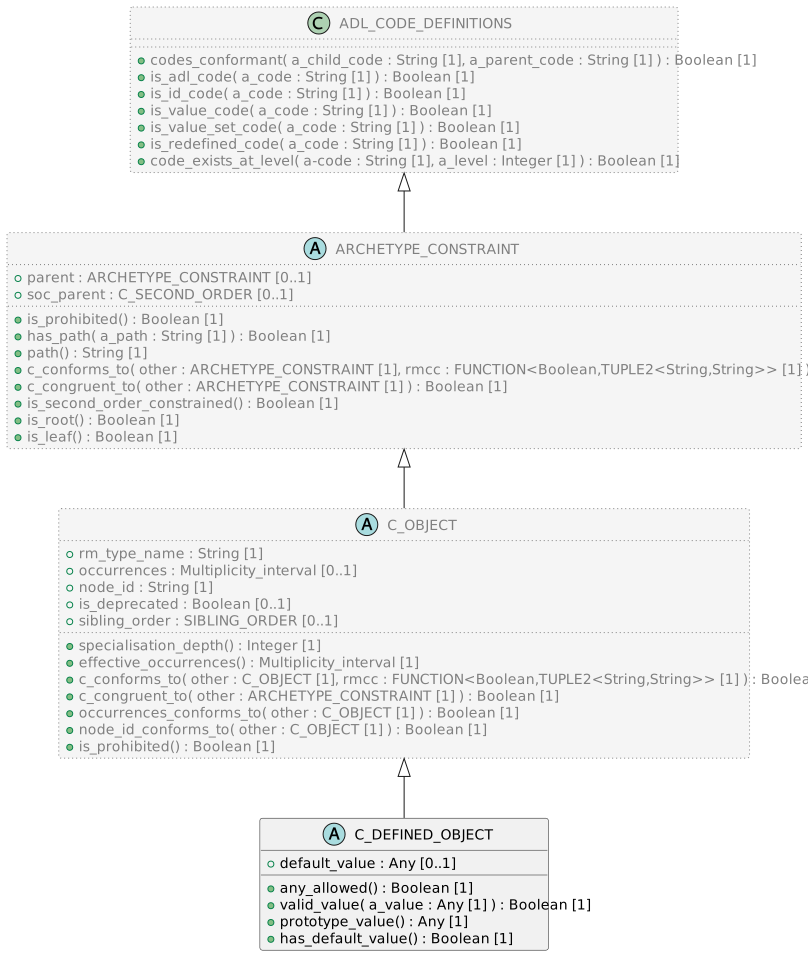
C_COMPLEX_OBJECT Class
-
Definition
-
Effective
-
BMM
-
UML
Class |
C_COMPLEX_OBJECT |
|||
|---|---|---|---|---|
Description |
Constraint on complex objects, i.e. any object that consists of other object constraints. |
|||
Inherit |
||||
Attributes |
Signature |
Meaning |
||
0..1 |
attributes: |
List of constraints on attributes of the reference model type represented by this object. |
||
0..1 |
attribute_tuples: |
List of attribute tuple constraints under this object constraint, if any. |
||
Functions |
Signature |
Meaning |
||
1..1 |
any_allowed (): |
True if any value (i.e. instance) of the reference model type would be allowed. Redefined in descendants. |
||
1..1 |
c_conforms_to ( |
True if constraints represented by this node, ignoring any sub-parts, are narrower or the same as other. Typically used during validation of specialised archetype nodes. Parameters
|
||
1..1 |
c_congruent_to ( |
True if constraints represented by this node contain no further redefinitions with respect to the node Typically used to test if an inherited node locally contains any constraints. |
||
| C_COMPLEX_OBJECT | |||
|---|---|---|---|
Constraint on complex objects, i.e. any object that consists of other object constraints. |
|||
Inherits: ADL_CODE_DEFINITIONS, ARCHETYPE_CONSTRAINT, C_OBJECT, C_DEFINED_OBJECT |
|||
Constants |
|||
Id_code_leader: |
String leader of ‘identifier’ codes, i.e. codes used to identify archetype nodes. |
||
Value_code_leader: |
String leader of ‘value’ codes, i.e. codes used to identify codes values, including value set members. |
||
Value_set_code_leader: |
String leader of ‘value set’ codes, i.e. codes used to identify value sets. |
||
Specialisation_separator: |
Character used to separate numeric parts of codes belonging to different specialisation levels. |
||
Code_regex_pattern: |
Regex used to define the legal numeric part of any archetype code. Corresponds to the simple pattern of dotted numbers, as used in typical multi-level numbering schemes. |
||
Root_code_regex_pattern: |
Regex pattern of the root id code of any archetype. Corresponds to codes of the form |
||
Primitive_node_id: |
Code id used for |
||
Attributes |
|||
parent: |
Parent node, except in the case of the top of a tree, i.e. root |
||
soc_parent: |
+ Inherited from ARCHETYPE_CONSTRAINT |
||
rm_type_name: |
Reference model type that this node corresponds to. |
||
occurrences: |
Occurrences of this object node in the data, under the owning attribute. Upper limit can only be greater than 1 if owning attribute has a cardinality of more than 1.
Only set if it overrides the parent archetype in the case of specialised archetypes, or else the occurrences inferred from the underlying reference model existence and/or cardinality of the containing attribute. |
||
node_id: |
Semantic identifier of this node, used to distinguish sibling nodes. All nodes must have a For |
||
is_deprecated: |
True if this node and by implication all sub-nodes are deprecated for use. |
||
sibling_order: |
Optional indicator of order of this node with respect to another sibling. Only meaningful in a specialised archetype for a |
||
default_value: |
Default value set in a template, and present in an operational template. Generally limited to leaf and near-leaf nodes. |
||
attributes: |
List of constraints on attributes of the reference model type represented by this object. |
||
attribute_tuples: |
List of attribute tuple constraints under this object constraint, if any. |
||
Functions |
|||
codes_conformant ( |
True if |
||
is_adl_code ( |
True if |
||
is_id_code ( |
True if |
||
is_value_code ( |
True if |
||
is_value_set_code ( |
True if |
||
A code has been specialised if there is a non-zero code index anywhere above the last index e.g.
|
|||
code_exists_at_level ( |
Is |
||
is_prohibited (): |
True if this |
||
True if the relative path |
|||
path (): |
Path of this node relative to root of archetype. |
||
c_conforms_to ( |
True if constraints represented by this node, ignoring any sub-parts, are narrower or the same as other. Typically used during validation of specialised archetype nodes. Parameters
|
||
c_congruent_to ( |
True if constraints represented by this node contain no further redefinitions with respect to the node Typically used to test if an inherited node locally contains any constraints. |
||
is_second_order_constrained (): |
True if there is a second order constraint such as a tuple constraint on this node. |
||
is_root (): |
True if this node is the root of the tree. |
||
is_leaf (): |
True if this node is a terminal node in the tree structure, i.e. having no child nodes. |
||
specialisation_depth (): |
Level of specialisation of this archetype node, based on its |
||
effective_occurrences (): |
Compute effective occurrences, where no local occurrences constraint set. If the owning If local |
||
occurrences_conforms_to ( |
True if this node Parameters
|
||
node_id_conforms_to ( |
True if this node id conforms to |
||
any_allowed (): |
True if any value (i.e. instance) of the reference model type would be allowed. Redefined in descendants. |
||
True if |
|||
(abstract) prototype_value (): |
Generate a prototype value from this constraint object. |
||
has_default_value (): |
True if there is an assumed value. |
||
Invariants |
|||
Post: |
|||
Inv_valid_default_value: |
|||
{
    "name": "C_COMPLEX_OBJECT",
    "documentation": "Constraint on complex objects, i.e. any object that consists of other object constraints.",
    "ancestors": [
        "C_DEFINED_OBJECT"
    ],
    "properties": {
        "attributes": {
            "_type": "P_BMM_CONTAINER_PROPERTY",
            "name": "attributes",
            "documentation": "List of constraints on attributes of the reference model type represented by this object.",
            "type_def": {
                "container_type": "List",
                "type": "C_ATTRIBUTE"
            },
            "cardinality": {
                "lower": 0,
                "upper_unbounded": true
            }
        },
        "attribute_tuples": {
            "_type": "P_BMM_CONTAINER_PROPERTY",
            "name": "attribute_tuples",
            "documentation": "List of attribute tuple constraints under this object constraint, if any.",
            "type_def": {
                "container_type": "List",
                "type": "C_ATTRIBUTE_TUPLE"
            },
            "cardinality": {
                "lower": 0,
                "upper_unbounded": true
            }
        }
    },
    "functions": {
        "any_allowed": {
            "name": "any_allowed",
            "documentation": "True if any value (i.e. instance) of the reference model type would be allowed. Redefined in descendants.",
            "post_conditions": {
                "Post": "Result = attributes.is_empty and not is_prohibited"
            },
            "result": {
                "_type": "P_BMM_SIMPLE_TYPE",
                "type": "Boolean"
            }
        },
        "c_conforms_to": {
            "name": "c_conforms_to",
            "documentation": "True if constraints represented by this node, ignoring any sub-parts, are narrower or the same as other. \nTypically used during validation of specialised archetype nodes.",
            "parameters": {
                "other": {
                    "_type": "P_BMM_SINGLE_FUNCTION_PARAMETER",
                    "name": "other",
                    "type": "C_COMPLEX_OBJECT"
                },
                "rmcc": {
                    "_type": "P_BMM_GENERIC_FUNCTION_PARAMETER",
                    "name": "rmcc",
                    "documentation": "Reference Model conformance checker agent (lambda).",
                    "type_def": {
                        "root_type": "FUNCTION",
                        "generic_parameters": [
                            "Boolean",
                            {
                                "_type": "P_BMM_GENERIC_TYPE",
                                "root_type": "TUPLE2",
                                "generic_parameters": [
                                    "String",
                                    "String"
                                ]
                            }
                        ]
                    }
                }
            },
            "result": {
                "_type": "P_BMM_SIMPLE_TYPE",
                "type": "Boolean"
            }
        },
        "c_congruent_to": {
            "name": "c_congruent_to",
            "documentation": "True if constraints represented by this node contain no further redefinitions with respect to the node `_other_`, with the exception of `_node_id_` redefinition in `C_OBJECT` nodes. \n\nTypically used to test if an inherited node locally contains any constraints.",
            "parameters": {
                "other": {
                    "_type": "P_BMM_SINGLE_FUNCTION_PARAMETER",
                    "name": "other",
                    "type": "C_COMPLEX_OBJECT"
                }
            },
            "result": {
                "_type": "P_BMM_SIMPLE_TYPE",
                "type": "Boolean"
            }
        }
    }
}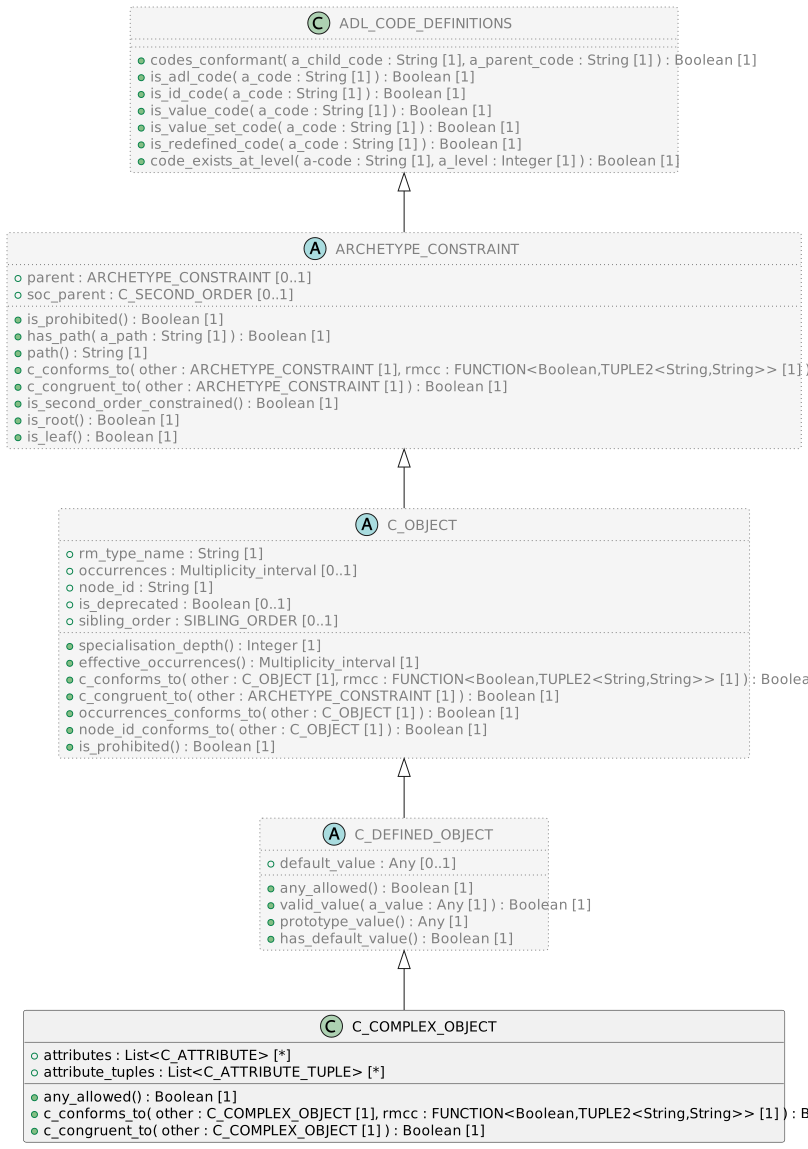
Validity Rules: C_COMPLEX_OBJECT
The validity rules for C_COMPLEX_OBJECTs are as follows:
VCATU attribute uniqueness: sibling attributes occurring within an object node must be uniquely named with respect to each other, in the same way as for class definitions in an object reference model.
C_ARCHETYPE_ROOT Class
-
Definition
-
Effective
-
BMM
-
UML
Class |
C_ARCHETYPE_ROOT |
|
|---|---|---|
Description |
A specialisation of Used in two situations. The first is to represent an 'external reference' to an archetype from within another archetype or template. This supports re-use. The second use is within a template, where it is used as a slot-filler. For a new external reference, the For a slot-filler or a redefined external reference, the In all uses within source archetypes and templates, the In an operational template, the |
|
Inherit |
||
Attributes |
Signature |
Meaning |
1..1 |
archetype_ref: |
Reference to archetype is being used to fill a slot or redefine an external reference. Typically an 'interface' archetype id, i.e. identifier with partial version information. |
| C_ARCHETYPE_ROOT | |||
|---|---|---|---|
A specialisation of Used in two situations. The first is to represent an 'external reference' to an archetype from within another archetype or template. This supports re-use. The second use is within a template, where it is used as a slot-filler. For a new external reference, the For a slot-filler or a redefined external reference, the In all uses within source archetypes and templates, the In an operational template, the |
|||
Inherits: ADL_CODE_DEFINITIONS, ARCHETYPE_CONSTRAINT, C_OBJECT, C_DEFINED_OBJECT, C_COMPLEX_OBJECT |
|||
Constants |
|||
Id_code_leader: |
String leader of ‘identifier’ codes, i.e. codes used to identify archetype nodes. |
||
Value_code_leader: |
String leader of ‘value’ codes, i.e. codes used to identify codes values, including value set members. |
||
Value_set_code_leader: |
String leader of ‘value set’ codes, i.e. codes used to identify value sets. |
||
Specialisation_separator: |
Character used to separate numeric parts of codes belonging to different specialisation levels. |
||
Code_regex_pattern: |
Regex used to define the legal numeric part of any archetype code. Corresponds to the simple pattern of dotted numbers, as used in typical multi-level numbering schemes. |
||
Root_code_regex_pattern: |
Regex pattern of the root id code of any archetype. Corresponds to codes of the form |
||
Primitive_node_id: |
Code id used for |
||
Attributes |
|||
parent: |
Parent node, except in the case of the top of a tree, i.e. root |
||
soc_parent: |
+ Inherited from ARCHETYPE_CONSTRAINT |
||
rm_type_name: |
Reference model type that this node corresponds to. |
||
occurrences: |
Occurrences of this object node in the data, under the owning attribute. Upper limit can only be greater than 1 if owning attribute has a cardinality of more than 1.
Only set if it overrides the parent archetype in the case of specialised archetypes, or else the occurrences inferred from the underlying reference model existence and/or cardinality of the containing attribute. |
||
node_id: |
Semantic identifier of this node, used to distinguish sibling nodes. All nodes must have a For |
||
is_deprecated: |
True if this node and by implication all sub-nodes are deprecated for use. |
||
sibling_order: |
Optional indicator of order of this node with respect to another sibling. Only meaningful in a specialised archetype for a |
||
default_value: |
Default value set in a template, and present in an operational template. Generally limited to leaf and near-leaf nodes. |
||
attributes: |
List of constraints on attributes of the reference model type represented by this object. |
||
attribute_tuples: |
List of attribute tuple constraints under this object constraint, if any. |
||
archetype_ref: |
Reference to archetype is being used to fill a slot or redefine an external reference. Typically an 'interface' archetype id, i.e. identifier with partial version information. |
||
Functions |
|||
codes_conformant ( |
True if |
||
is_adl_code ( |
True if |
||
is_id_code ( |
True if |
||
is_value_code ( |
True if |
||
is_value_set_code ( |
True if |
||
A code has been specialised if there is a non-zero code index anywhere above the last index e.g.
|
|||
code_exists_at_level ( |
Is |
||
is_prohibited (): |
True if this |
||
True if the relative path |
|||
path (): |
Path of this node relative to root of archetype. |
||
c_conforms_to ( |
True if constraints represented by this node, ignoring any sub-parts, are narrower or the same as other.
Typically used during validation of specialised archetype nodes. Parameters
|
||
c_congruent_to ( |
True if constraints represented by this node contain no further redefinitions with respect to the node Typically used to test if an inherited node locally contains any constraints. |
||
is_second_order_constrained (): |
True if there is a second order constraint such as a tuple constraint on this node. |
||
is_root (): |
True if this node is the root of the tree. |
||
is_leaf (): |
True if this node is a terminal node in the tree structure, i.e. having no child nodes. |
||
specialisation_depth (): |
Level of specialisation of this archetype node, based on its |
||
effective_occurrences (): |
Compute effective occurrences, where no local occurrences constraint set. If the owning If local |
||
occurrences_conforms_to ( |
True if this node Parameters
|
||
node_id_conforms_to ( |
True if this node id conforms to |
||
any_allowed (): |
True if any value (i.e. instance) of the reference model type would be allowed. Redefined in descendants. |
||
True if |
|||
(abstract) prototype_value (): |
Generate a prototype value from this constraint object. |
||
has_default_value (): |
True if there is an assumed value. |
||
Invariants |
|||
Post: |
|||
Inv_valid_default_value: |
|||
{
    "name": "C_ARCHETYPE_ROOT",
    "documentation": "A specialisation of `C_COMPLEX_OBJECT` whose node_id attribute is an archetype identifier rather than the normal internal node code (i.e. id-code).\n\nUsed in two situations. The first is to represent an 'external reference' to an archetype from within another archetype or template. This supports re-use. The second use is within a template, where it is used as a slot-filler. \n\nFor a new external reference, the `_node_id_` is set in the normal way, i.e. with a new code at the specialisation level of the archetype.\n\nFor a slot-filler or a redefined external reference, the `_node_id_` is set to a specialised version of the `_node_id_` of the node being specialised, allowing matching to occur during flattening.\n\nIn all uses within source archetypes and templates, the `_children_` attribute is `Void`.\n\nIn an operational template, the `_node_id_` is converted to the `_archetype_ref_`, and the structure contains the result of flattening any template overlay structure and the underlying flat archetype.\n",
    "ancestors": [
        "C_COMPLEX_OBJECT"
    ],
    "properties": {
        "archetype_ref": {
            "_type": "P_BMM_SINGLE_PROPERTY",
            "name": "archetype_ref",
            "documentation": "Reference to archetype is being used to fill a slot or redefine an external reference. Typically an 'interface' archetype id, i.e. identifier with partial version information.",
            "is_mandatory": true,
            "type": "String"
        }
    }
}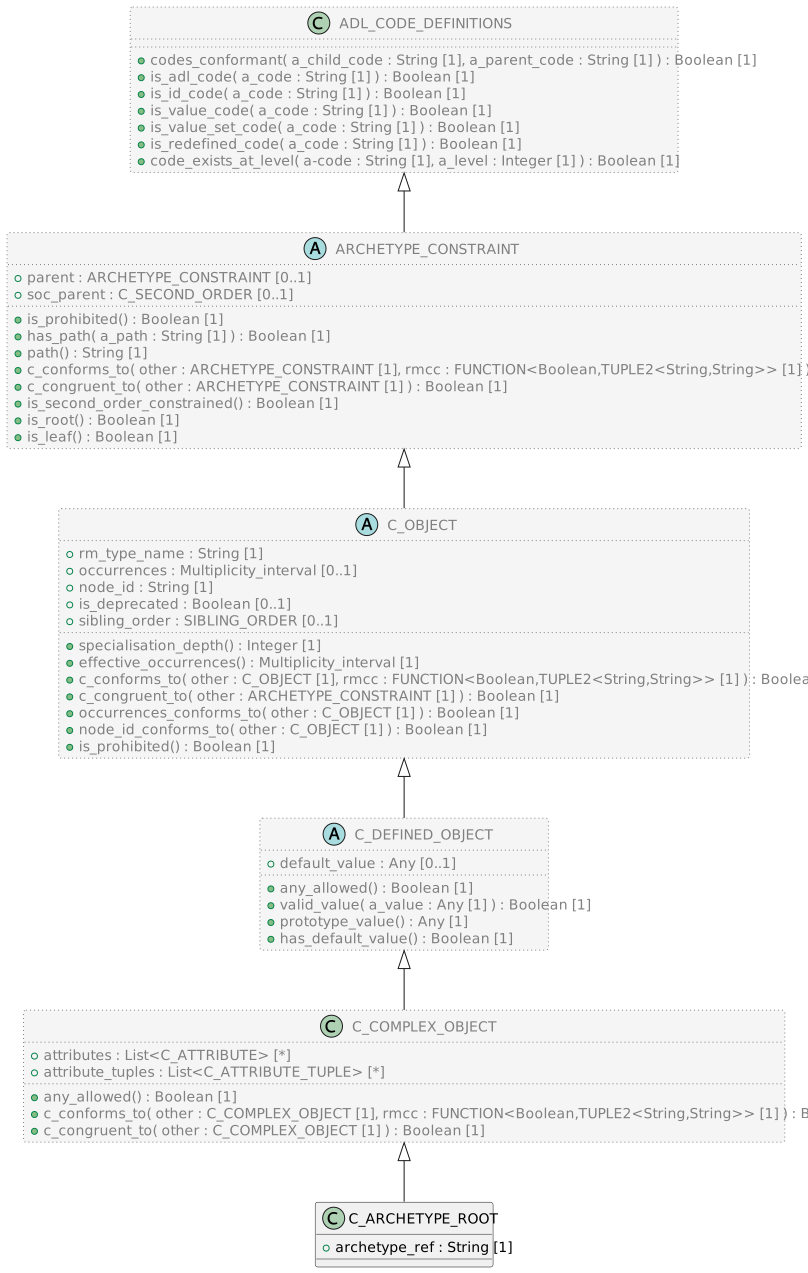
Validity Rules: C_ARCHETYPE_ROOT
The following validity rules apply to C_ARCHETYPE_ROOT objects:
VARXNC external reference node identifier validity: if the external reference object is a redefinition of either a slot node, or another external reference node, the node_id of the object must conform to (i.e. be the same or a child of) the node_id of the corresponding parent node.
VARXAV external reference node archetype reference validity: if the reference object is a redefinition of another external reference node, the archetype_ref of the object must match a real archetype that has as an ancestor the archetype matched by the archetype reference mentioned in the corresponding parent node.
VARXTV external reference type validity: the reference model type of the reference object archetype identifier must be identical, or conform to the type of the slot, if there is one, in the parent archetype, or else to the reference model type of the attribute in the flat parent under which the reference object appears in the child archetype.
VARXR external reference refers to resolvable artefact: the archetype reference must refer to an artefact that can be found in the current repository.
The following validity rules apply to a C_ARCHETYPE_ROOT that specialises a ARCHETYPE_SLOT in the flat parent archetype:
VARXS external reference slot conformance: where an archetype reference redefines an archetype slot in the flat parent, it must conform to the archetype slot node by being of a reference model type from the same reference model as the current archetype.
VARXID external reference slot filling id validity: an external reference node defined as a filler for a slot in the parent archetype must have a node id that is a specialisation of that of the slot.
ARCHETYPE_SLOT Class
-
Definition
-
Effective
-
BMM
-
UML
Class |
ARCHETYPE_SLOT |
|
|---|---|---|
Description |
Constraint describing a 'slot' where another archetype can occur. |
|
Inherit |
||
Attributes |
Signature |
Meaning |
0..1 |
List of constraints defining other archetypes that could be included at this point. Represented as an |
|
0..1 |
List of constraints defining other archetypes that cannot be included at this point. Represented as an |
|
1..1 |
is_closed: |
True if this slot specification in this artefact is closed to further filling either in further specialisations or at runtime. Default value False, i.e. unless explicitly set, a slot remains open. |
Functions |
Signature |
Meaning |
1..1 |
any_allowed (): |
True if no constraints stated, and slot is not closed. |
| ARCHETYPE_SLOT | |||
|---|---|---|---|
Constraint describing a 'slot' where another archetype can occur. |
|||
Inherits: ADL_CODE_DEFINITIONS, ARCHETYPE_CONSTRAINT, C_OBJECT |
|||
Constants |
|||
Id_code_leader: |
String leader of ‘identifier’ codes, i.e. codes used to identify archetype nodes. |
||
Value_code_leader: |
String leader of ‘value’ codes, i.e. codes used to identify codes values, including value set members. |
||
Value_set_code_leader: |
String leader of ‘value set’ codes, i.e. codes used to identify value sets. |
||
Specialisation_separator: |
Character used to separate numeric parts of codes belonging to different specialisation levels. |
||
Code_regex_pattern: |
Regex used to define the legal numeric part of any archetype code. Corresponds to the simple pattern of dotted numbers, as used in typical multi-level numbering schemes. |
||
Root_code_regex_pattern: |
Regex pattern of the root id code of any archetype. Corresponds to codes of the form |
||
Primitive_node_id: |
Code id used for |
||
Attributes |
|||
parent: |
Parent node, except in the case of the top of a tree, i.e. root |
||
soc_parent: |
+ Inherited from ARCHETYPE_CONSTRAINT |
||
rm_type_name: |
Reference model type that this node corresponds to. |
||
occurrences: |
Occurrences of this object node in the data, under the owning attribute. Upper limit can only be greater than 1 if owning attribute has a cardinality of more than 1.
Only set if it overrides the parent archetype in the case of specialised archetypes, or else the occurrences inferred from the underlying reference model existence and/or cardinality of the containing attribute. |
||
node_id: |
Semantic identifier of this node, used to distinguish sibling nodes. All nodes must have a For |
||
is_deprecated: |
True if this node and by implication all sub-nodes are deprecated for use. |
||
sibling_order: |
Optional indicator of order of this node with respect to another sibling. Only meaningful in a specialised archetype for a |
||
List of constraints defining other archetypes that could be included at this point. Represented as an |
|||
List of constraints defining other archetypes that cannot be included at this point. Represented as an |
|||
is_closed: |
True if this slot specification in this artefact is closed to further filling either in further specialisations or at runtime. Default value False, i.e. unless explicitly set, a slot remains open. |
||
Functions |
|||
codes_conformant ( |
True if |
||
is_adl_code ( |
True if |
||
is_id_code ( |
True if |
||
is_value_code ( |
True if |
||
is_value_set_code ( |
True if |
||
A code has been specialised if there is a non-zero code index anywhere above the last index e.g.
|
|||
code_exists_at_level ( |
Is |
||
is_prohibited (): |
True if this |
||
True if the relative path |
|||
path (): |
Path of this node relative to root of archetype. |
||
c_conforms_to ( |
True if constraints represented by this node, ignoring any sub-parts, are narrower or the same as other.
Typically used during validation of specialised archetype nodes. Parameters
|
||
c_congruent_to ( |
True if constraints represented by this node contain no further redefinitions with respect to the node Typically used to test if an inherited node locally contains any constraints. |
||
is_second_order_constrained (): |
True if there is a second order constraint such as a tuple constraint on this node. |
||
is_root (): |
True if this node is the root of the tree. |
||
is_leaf (): |
True if this node is a terminal node in the tree structure, i.e. having no child nodes. |
||
specialisation_depth (): |
Level of specialisation of this archetype node, based on its |
||
effective_occurrences (): |
Compute effective occurrences, where no local occurrences constraint set. If the owning If local |
||
occurrences_conforms_to ( |
True if this node Parameters
|
||
node_id_conforms_to ( |
True if this node id conforms to |
||
any_allowed (): |
True if no constraints stated, and slot is not closed. |
||
Invariants |
|||
Post: |
|||
{
    "name": "ARCHETYPE_SLOT",
    "documentation": "Constraint describing a 'slot' where another archetype can occur. ",
    "ancestors": [
        "C_OBJECT"
    ],
    "properties": {
        "includes": {
            "_type": "P_BMM_CONTAINER_PROPERTY",
            "name": "includes",
            "documentation": "List of constraints defining other archetypes that could be included at this point. Represented as an `ASSERTION` containing an expression of the form  `EXPR_ARCHETYPE_REF matches EXPR_ARCHETYPE_ID_CONSTRAINT`.",
            "type_def": {
                "container_type": "List",
                "type": "ASSERTION"
            },
            "cardinality": {
                "lower": 0,
                "upper_unbounded": true
            }
        },
        "excludes": {
            "_type": "P_BMM_CONTAINER_PROPERTY",
            "name": "excludes",
            "documentation": "List of constraints defining other archetypes that cannot be included at this point. Represented as an `ASSERTION` containing an expression of the form  `EXPR_ARCHETYPE_REF matches EXPR_ARCHETYPE_ID_CONSTRAINT`.",
            "type_def": {
                "container_type": "List",
                "type": "ASSERTION"
            },
            "cardinality": {
                "lower": 0,
                "upper_unbounded": true
            }
        },
        "is_closed": {
            "_type": "P_BMM_SINGLE_PROPERTY",
            "name": "is_closed",
            "documentation": "True if this slot specification in this artefact is closed to further filling either in further specialisations or at runtime. Default value False, i.e. unless explicitly set, a slot remains open.",
            "is_mandatory": true,
            "type": "Boolean"
        }
    },
    "functions": {
        "any_allowed": {
            "name": "any_allowed",
            "documentation": "True if no constraints stated, and slot is not closed.",
            "result": {
                "_type": "P_BMM_SIMPLE_TYPE",
                "type": "Boolean"
            }
        }
    }
}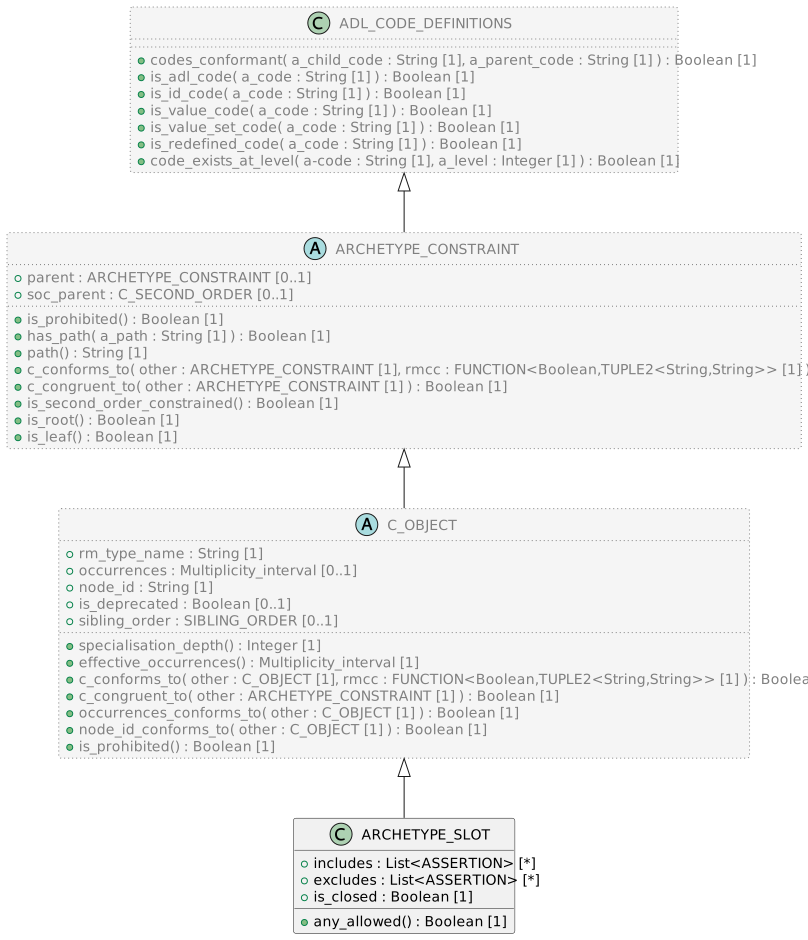
Validity Rules: ARCHETYPE_SLOT
The validity rules for ARCHETYPE_SLOTs are as follows:
VDFAI archetype identifier validity in definition. Any archetype identifier mentioned in an archetype slot in the definition section must conform to the published openEHR specification for archetype identifiers.
VDSIV archetype slot 'include' constraint validity. The 'include' constraint in an archetype slot must conform to the slot constraint validity rules.
VDSEV archetype slot 'exclude' constraint validity. The 'exclude' constraint in an archetype slot must conform to the slot constraint validity rules.
The slot constraint validity rules are as follows:
if includes not empty and = any then
    not (excludes empty or /= any) ==> VDSEV Error
elseif includes not empty and /= any then
    not (excludes empty or = any) ==> VDSEV Error
elseif excludes not empty and = any then
    not (includes empty or /= any) ==> VDSIV Error
elseif excludes not empty and /= any then
    not (includes empty or = any) ==> VDSIV Error
end
The following validity rules apply to ARCHETYPE_SLOTs defined as the specialisation of a slot in the parent archetype:
VDSSID slot redefinition child node id: a slot node in a specialised archetype that redefines a slot node in the flat parent must have an identical node id.
VDSSM specialised archetype slot definition match validity. The set of archetypes matched from a library of archetypes by a specialised archetype slot definition must be a proper subset of the set matched from the same library by the parent slot definition.
VDSSP specialised archetype slot definition parent validity. The flat parent of the specialisation of an archetype slot must be not be closed (is_closed = False).
VDSSC specialised archetype slot definition closed validity. In the specialisation of an archetype slot, either the slot can be specified to be closed (is_closed = True) or the slot can be narrowed, but not both.
C_COMPLEX_OBJECT_PROXY Class
-
Definition
-
Effective
-
BMM
-
UML
Class |
C_COMPLEX_OBJECT_PROXY |
|||
|---|---|---|---|---|
Description |
A constraint defined by proxy, using a reference to an object constraint defined elsewhere in the same archetype. Note that since this object refers to another node, there are two objects with available occurrences values. The local occurrences value on a |
|||
Inherit |
||||
Attributes |
Signature |
Meaning |
||
1..1 |
target_path: |
Reference to an object node using archetype path notation. |
||
Functions |
Signature |
Meaning |
||
1..1 |
use_target_occurrences (): |
True if target occurrences are to be used as the value of occurrences in this object; by the time of runtime use, the target occurrences value has to be set into this object. |
||
1..1 |
True if this node occurrences conforms to If Parameters
|
|||
| C_COMPLEX_OBJECT_PROXY | |||
|---|---|---|---|
A constraint defined by proxy, using a reference to an object constraint defined elsewhere in the same archetype. Note that since this object refers to another node, there are two objects with available occurrences values. The local occurrences value on a |
|||
Inherits: ADL_CODE_DEFINITIONS, ARCHETYPE_CONSTRAINT, C_OBJECT |
|||
Constants |
|||
Id_code_leader: |
String leader of ‘identifier’ codes, i.e. codes used to identify archetype nodes. |
||
Value_code_leader: |
String leader of ‘value’ codes, i.e. codes used to identify codes values, including value set members. |
||
Value_set_code_leader: |
String leader of ‘value set’ codes, i.e. codes used to identify value sets. |
||
Specialisation_separator: |
Character used to separate numeric parts of codes belonging to different specialisation levels. |
||
Code_regex_pattern: |
Regex used to define the legal numeric part of any archetype code. Corresponds to the simple pattern of dotted numbers, as used in typical multi-level numbering schemes. |
||
Root_code_regex_pattern: |
Regex pattern of the root id code of any archetype. Corresponds to codes of the form |
||
Primitive_node_id: |
Code id used for |
||
Attributes |
|||
parent: |
Parent node, except in the case of the top of a tree, i.e. root |
||
soc_parent: |
+ Inherited from ARCHETYPE_CONSTRAINT |
||
rm_type_name: |
Reference model type that this node corresponds to. |
||
occurrences: |
Occurrences of this object node in the data, under the owning attribute. Upper limit can only be greater than 1 if owning attribute has a cardinality of more than 1.
Only set if it overrides the parent archetype in the case of specialised archetypes, or else the occurrences inferred from the underlying reference model existence and/or cardinality of the containing attribute. |
||
node_id: |
Semantic identifier of this node, used to distinguish sibling nodes. All nodes must have a For |
||
is_deprecated: |
True if this node and by implication all sub-nodes are deprecated for use. |
||
sibling_order: |
Optional indicator of order of this node with respect to another sibling. Only meaningful in a specialised archetype for a |
||
target_path: |
Reference to an object node using archetype path notation. |
||
Functions |
|||
codes_conformant ( |
True if |
||
is_adl_code ( |
True if |
||
is_id_code ( |
True if |
||
is_value_code ( |
True if |
||
is_value_set_code ( |
True if |
||
A code has been specialised if there is a non-zero code index anywhere above the last index e.g.
|
|||
code_exists_at_level ( |
Is |
||
is_prohibited (): |
True if this |
||
True if the relative path |
|||
path (): |
Path of this node relative to root of archetype. |
||
c_conforms_to ( |
True if constraints represented by this node, ignoring any sub-parts, are narrower or the same as other.
Typically used during validation of specialised archetype nodes. Parameters
|
||
c_congruent_to ( |
True if constraints represented by this node contain no further redefinitions with respect to the node Typically used to test if an inherited node locally contains any constraints. |
||
is_second_order_constrained (): |
True if there is a second order constraint such as a tuple constraint on this node. |
||
is_root (): |
True if this node is the root of the tree. |
||
is_leaf (): |
True if this node is a terminal node in the tree structure, i.e. having no child nodes. |
||
specialisation_depth (): |
Level of specialisation of this archetype node, based on its |
||
effective_occurrences (): |
Compute effective occurrences, where no local occurrences constraint set. If the owning If local |
||
occurrences_conforms_to ( |
True if this node occurrences conforms to If Parameters
|
||
node_id_conforms_to ( |
True if this node id conforms to |
||
use_target_occurrences (): |
True if target occurrences are to be used as the value of occurrences in this object; by the time of runtime use, the target occurrences value has to be set into this object. |
||
Invariants |
|||
Post: |
|||
{
    "name": "C_COMPLEX_OBJECT_PROXY",
    "documentation": "A constraint defined by proxy, using a reference to an object constraint defined elsewhere in the same archetype. Note that since this object refers to another node, there are two objects with available occurrences values. The local occurrences value on a `COMPLEX_OBJECT_PROXY` should always be used; when setting this from a serialised form, if no occurrences is mentioned, the target occurrences should be used (not the standard default of `{1..1}`); otherwise the locally specified occurrences should be used as normal. When serialising out, if the occurrences is the same as that of the target, it can be left out. ",
    "ancestors": [
        "C_OBJECT"
    ],
    "properties": {
        "target_path": {
            "_type": "P_BMM_SINGLE_PROPERTY",
            "name": "target_path",
            "documentation": "Reference to an object node using archetype path notation.",
            "is_mandatory": true,
            "type": "String"
        }
    },
    "functions": {
        "use_target_occurrences": {
            "name": "use_target_occurrences",
            "documentation": "True if target occurrences are to be used as the value of occurrences in this object; by the time of runtime use, the target occurrences value has to be set into this object.",
            "post_conditions": {
                "Post": "Result = (occurrences = Void)"
            },
            "result": {
                "_type": "P_BMM_SIMPLE_TYPE",
                "type": "Boolean"
            }
        },
        "occurrences_conforms_to": {
            "name": "occurrences_conforms_to",
            "documentation": "True if this node occurrences conforms to `_other.occurrences_`; `_other_` is assumed to be in a flat archetype.\n\nIf `_other_` is a `C_COMPLEX_OBJECT`, then always `True`, since if occurrences defined on proxy node, it is an override of  the occurrences on the target, and it doesn't have to conform to anything except the containing attribute's cardinality. However, if `_other_` is also a `C_COMPLEX_OBJECT` then the override is of another use_node, and normal occurrences apply\n",
            "parameters": {
                "other": {
                    "_type": "P_BMM_SINGLE_FUNCTION_PARAMETER",
                    "name": "other",
                    "documentation": "`C_OBJECT` from a flat parent archetype.",
                    "type": "C_OBJECT"
                }
            },
            "result": {
                "_type": "P_BMM_SIMPLE_TYPE",
                "type": "Boolean"
            }
        }
    }
}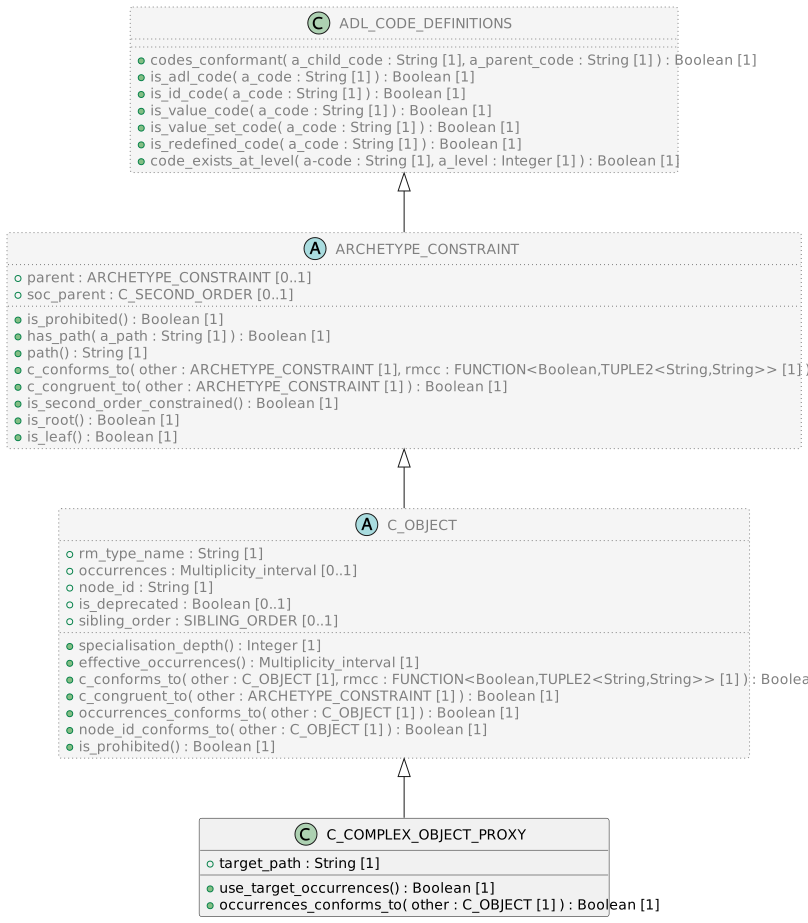
Validity Rules: C_COMPLEX_OBJECT_PROXY
The following validity rules applies to internal references:
VUNT use_node reference model type validity: the reference model type mentioned in an C_COMPLEX_OBJECT_PROXY node must be the same as or a super-type (according to the reference model) of the reference model type of the node referred to.
VUNP use_node path validity: the path mentioned in a use_node statement must refer to an object node defined elsewhere in the same archetype or any of its specialisation parent archetypes, that is not itself an internal reference node, and which carries a node identifier if one is needed at the reference point.
The following validity rule applies to the redefinition of an internal reference in a specialised archetype:
VSUNT use_node specialisation parent validity: a C_COMPLEX_OBJECT_PROXY node may be redefined in a specialised archetype by another C_COMPLEX_OBJECT_PROXY (e.g. in order to redefine occurrences), or by a C_COMPLEX_OBJECT structure that legally redefines the target C_COMPLEX_OBJECT node referred to by the reference.
C_PRIMITIVE_OBJECT Class
-
Definition
-
Effective
-
BMM
-
UML
Class |
C_PRIMITIVE_OBJECT (abstract) |
|||
|---|---|---|---|---|
Description |
Parent of types representing constraints on primitive types. Instances of this type represented in ADL inline form, the |
|||
Inherit |
||||
Attributes |
Signature |
Meaning |
||
0..1 |
assumed_value: |
Value to be assumed if none sent in data. |
||
0..1 |
is_enumerated_type_constraint: |
True if this object represents a constraint on an enumerated type from the reference model, where the latter is assumed to be based on a primitive type, generally Integer or String. |
||
1..1 |
constraint: |
Constraint represented by this object; redefine in descendants. |
||
Functions |
Signature |
Meaning |
||
1..1 |
has_assumed_value (): |
True if there is an assumed value. |
||
1..1 |
constrained_typename (): |
Generate name of native type that is constrained by this |
||
1..1 |
c_conforms_to ( |
True if constraints represented by this node, ignoring any sub-parts, are narrower or the same as other. Typically used during validation of specialised archetype nodes. Parameters
|
||
1..1 |
c_value_conforms_to ( |
True if this node expresses a value constraint that conforms to that of |
||
1..1 |
c_congruent_to ( |
True if constraints represented by this node contain no further redefinitions with respect to the node Typically used to test if an inherited node locally contains any constraints. |
||
1..1 |
c_value_congruent_to ( |
True if this node expresses the same value constraint as |
||
Invariants |
Inv_valid_assumed_value: |
|||
| C_PRIMITIVE_OBJECT (abstract) | |||
|---|---|---|---|
Parent of types representing constraints on primitive types. Instances of this type represented in ADL inline form, the |
|||
Inherits: ADL_CODE_DEFINITIONS, ARCHETYPE_CONSTRAINT, C_OBJECT, C_DEFINED_OBJECT |
|||
Constants |
|||
Id_code_leader: |
String leader of ‘identifier’ codes, i.e. codes used to identify archetype nodes. |
||
Value_code_leader: |
String leader of ‘value’ codes, i.e. codes used to identify codes values, including value set members. |
||
Value_set_code_leader: |
String leader of ‘value set’ codes, i.e. codes used to identify value sets. |
||
Specialisation_separator: |
Character used to separate numeric parts of codes belonging to different specialisation levels. |
||
Code_regex_pattern: |
Regex used to define the legal numeric part of any archetype code. Corresponds to the simple pattern of dotted numbers, as used in typical multi-level numbering schemes. |
||
Root_code_regex_pattern: |
Regex pattern of the root id code of any archetype. Corresponds to codes of the form |
||
Primitive_node_id: |
Code id used for |
||
Attributes |
|||
parent: |
Parent node, except in the case of the top of a tree, i.e. root |
||
soc_parent: |
+ Inherited from ARCHETYPE_CONSTRAINT |
||
rm_type_name: |
Reference model type that this node corresponds to. |
||
occurrences: |
Occurrences of this object node in the data, under the owning attribute. Upper limit can only be greater than 1 if owning attribute has a cardinality of more than 1.
Only set if it overrides the parent archetype in the case of specialised archetypes, or else the occurrences inferred from the underlying reference model existence and/or cardinality of the containing attribute. |
||
node_id: |
Semantic identifier of this node, used to distinguish sibling nodes. All nodes must have a For |
||
is_deprecated: |
True if this node and by implication all sub-nodes are deprecated for use. |
||
sibling_order: |
Optional indicator of order of this node with respect to another sibling. Only meaningful in a specialised archetype for a |
||
default_value: |
Default value set in a template, and present in an operational template. Generally limited to leaf and near-leaf nodes. |
||
assumed_value: |
Value to be assumed if none sent in data. |
||
is_enumerated_type_constraint: |
True if this object represents a constraint on an enumerated type from the reference model, where the latter is assumed to be based on a primitive type, generally Integer or String. |
||
constraint: |
Constraint represented by this object; redefine in descendants. |
||
Functions |
|||
codes_conformant ( |
True if |
||
is_adl_code ( |
True if |
||
is_id_code ( |
True if |
||
is_value_code ( |
True if |
||
is_value_set_code ( |
True if |
||
A code has been specialised if there is a non-zero code index anywhere above the last index e.g.
|
|||
code_exists_at_level ( |
Is |
||
is_prohibited (): |
True if this |
||
True if the relative path |
|||
path (): |
Path of this node relative to root of archetype. |
||
c_conforms_to ( |
True if constraints represented by this node, ignoring any sub-parts, are narrower or the same as other. Typically used during validation of specialised archetype nodes. Parameters
|
||
c_congruent_to ( |
True if constraints represented by this node contain no further redefinitions with respect to the node Typically used to test if an inherited node locally contains any constraints. |
||
is_second_order_constrained (): |
True if there is a second order constraint such as a tuple constraint on this node. |
||
is_root (): |
True if this node is the root of the tree. |
||
is_leaf (): |
True if this node is a terminal node in the tree structure, i.e. having no child nodes. |
||
specialisation_depth (): |
Level of specialisation of this archetype node, based on its |
||
effective_occurrences (): |
Compute effective occurrences, where no local occurrences constraint set. If the owning If local |
||
occurrences_conforms_to ( |
True if this node Parameters
|
||
node_id_conforms_to ( |
True if this node id conforms to |
||
(abstract) any_allowed (): |
True if any value (i.e. instance) of the reference model type would be allowed. Redefined in descendants. |
||
True if |
|||
(abstract) prototype_value (): |
Generate a prototype value from this constraint object. |
||
has_default_value (): |
True if there is an assumed value. |
||
has_assumed_value (): |
True if there is an assumed value. |
||
constrained_typename (): |
Generate name of native type that is constrained by this |
||
(abstract) c_value_conforms_to ( |
True if this node expresses a value constraint that conforms to that of |
||
(abstract) c_value_congruent_to ( |
True if this node expresses the same value constraint as |
||
Invariants |
|||
Post: |
|||
Inv_valid_default_value: |
|||
Inv_valid_assumed_value: |
|||
{
    "name": "C_PRIMITIVE_OBJECT",
    "documentation": "Parent of types representing constraints on primitive types.\n\nInstances of this type represented in ADL inline form, the `_node_id_` attribute will have the special value `Primitive_node_id`; otherwise it will have the node id read during parsing.",
    "is_abstract": true,
    "ancestors": [
        "C_DEFINED_OBJECT"
    ],
    "properties": {
        "assumed_value": {
            "_type": "P_BMM_SINGLE_PROPERTY",
            "name": "assumed_value",
            "documentation": "Value to be assumed if none sent in data.",
            "type": "Any"
        },
        "is_enumerated_type_constraint": {
            "_type": "P_BMM_SINGLE_PROPERTY",
            "name": "is_enumerated_type_constraint",
            "documentation": "True if this object represents a constraint on an enumerated type from the reference model, where the latter is assumed to be based on a primitive type, generally Integer or String.",
            "type": "Boolean"
        },
        "constraint": {
            "_type": "P_BMM_SINGLE_PROPERTY",
            "name": "constraint",
            "documentation": "Constraint represented by this object; redefine in descendants.",
            "is_mandatory": true,
            "type": "Any"
        }
    },
    "functions": {
        "has_assumed_value": {
            "name": "has_assumed_value",
            "documentation": "True if there is an assumed value.\n",
            "result": {
                "_type": "P_BMM_SIMPLE_TYPE",
                "type": "Boolean"
            }
        },
        "constrained_typename": {
            "name": "constrained_typename",
            "documentation": "Generate name of native type that is constrained by this `C_XXX` type. For most types, it is the `C_XXX` typename without the `C_`, i.e. `XXX`. E.g. `C_INTEGER` -> `Integer`. For the date/time types the mapping is different.",
            "result": {
                "_type": "P_BMM_SIMPLE_TYPE",
                "type": "String"
            }
        },
        "c_conforms_to": {
            "name": "c_conforms_to",
            "documentation": "True if constraints represented by this node, ignoring any sub-parts, are narrower or the same as other. \nTypically used during validation of specialised archetype nodes.",
            "parameters": {
                "other": {
                    "_type": "P_BMM_SINGLE_FUNCTION_PARAMETER",
                    "name": "other",
                    "type": "C_PRIMITIVE_OBJECT"
                },
                "rmcc": {
                    "_type": "P_BMM_GENERIC_FUNCTION_PARAMETER",
                    "name": "rmcc",
                    "documentation": "Reference Model conformance checker lambda.",
                    "type_def": {
                        "root_type": "FUNCTION",
                        "generic_parameters": [
                            "Boolean",
                            {
                                "_type": "P_BMM_GENERIC_TYPE",
                                "root_type": "TUPLE2",
                                "generic_parameters": [
                                    "String",
                                    "String"
                                ]
                            }
                        ]
                    }
                }
            },
            "result": {
                "_type": "P_BMM_SIMPLE_TYPE",
                "type": "Boolean"
            }
        },
        "c_value_conforms_to": {
            "name": "c_value_conforms_to",
            "documentation": "True if this node expresses a value constraint that conforms to that of `other`. Effected in descendants.",
            "is_abstract": true,
            "parameters": {
                "other": {
                    "_type": "P_BMM_SINGLE_FUNCTION_PARAMETER",
                    "name": "other",
                    "type": "C_PRIMITIVE_OBJECT"
                }
            },
            "result": {
                "_type": "P_BMM_SIMPLE_TYPE",
                "type": "Boolean"
            }
        },
        "c_congruent_to": {
            "name": "c_congruent_to",
            "documentation": "True if constraints represented by this node contain no further redefinitions with respect to the node `_other_`, with the exception of `_node_id_` redefinition in `C_OBJECT` nodes. \n\nTypically used to test if an inherited node locally contains any constraints.",
            "parameters": {
                "other": {
                    "_type": "P_BMM_SINGLE_FUNCTION_PARAMETER",
                    "name": "other",
                    "type": "C_PRIMITIVE_OBJECT"
                }
            },
            "result": {
                "_type": "P_BMM_SIMPLE_TYPE",
                "type": "Boolean"
            }
        },
        "c_value_congruent_to": {
            "name": "c_value_congruent_to",
            "documentation": "True if this node expresses the same value constraint as `other`. Effected in descendants.",
            "is_abstract": true,
            "parameters": {
                "other": {
                    "_type": "P_BMM_SINGLE_FUNCTION_PARAMETER",
                    "name": "other",
                    "type": "C_PRIMITIVE_OBJECT"
                }
            },
            "result": {
                "_type": "P_BMM_SIMPLE_TYPE",
                "type": "Boolean"
            }
        }
    },
    "invariants": {
        "Inv_valid_assumed_value": "valid_value (assumed_value)"
    }
}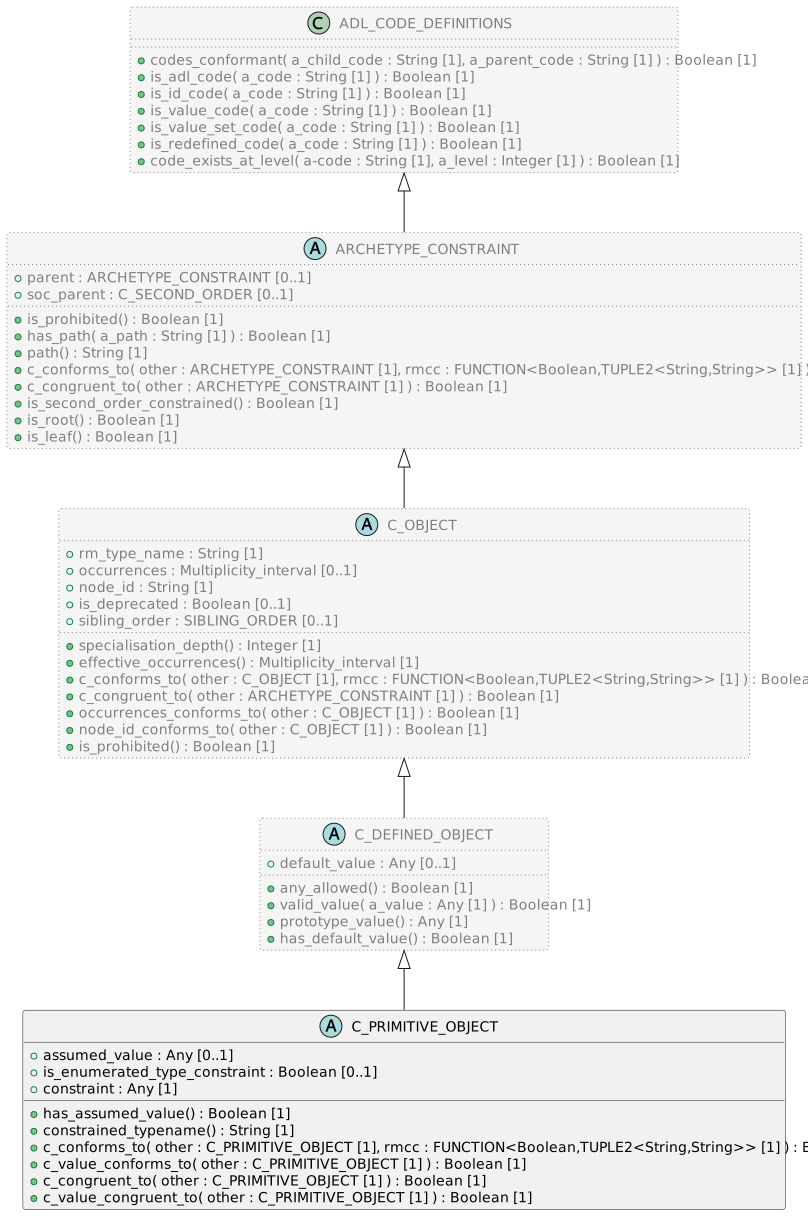
Validity Rules: C_PRIMITIVE_OBJECT
Validity rules applying to all C_PRIMITIVE_OBJECT types are as follows:
VOBAV object node assumed value validity: the value of an assumed value must fall within the value space defined by the constraint to which it is attached.
Conformance Semantics: C_PRIMITIVE_OBJECT
The following functions redefine those of the same names from C_OBJECT, and formally define the conformance of a node of a C_PRIMITIVE_OBJECT descendant type in a specialised archetype to a corresponding node in a parent archetype, where 'corresponding' means a node found at the same or a congruent path and of the same AOM type.
c_conforms_to (other: C_PRIMITIVE_OBJECT; rmcc: FUNCTION<<a_type, other_type: String>, Boolean>): Boolean
        -- True if this node on its own (ignoring any subparts) expresses the same or narrower
        -- constraints
        -- as `other'. Returns True only when the following is True:
        --   * occurrences conforms
        --   * `rm_type_name' is identical to that in `other'
        -- `rmcc' is an agent (lambda) that can test an RM type's conformance to another RM type
    do
        Result := precursor (other, rmcc) and c_value_conforms_to (other)
    end

c_value_conforms_to (other: like Current): Boolean
        -- True if this node expresses a value constraint that conforms to that of `other'
    deferred
    end

c_congruent_to (other: C_PRIMITIVE_OBJECT): Boolean
        -- True if this node on its own (ignoring any subparts) expresses no constraints in
        -- addition to `other'
    do
		Result := constrained_typename.is_case_insensitive_equal (other.constrained_typename) and
            c_value_congruent_to (other)
    end

c_value_congruent_to (other: C_PRIMITIVE_OBJECT): Boolean
        -- True if this node's value constraint is the same as that of `other'
    deferred
    end

constrained_typename: String
        -- the same as the C_XX clas name with the "C_" removed, but for some types e.g. Date/time types
        -- it is not true.
    do
        Result := generating_type.name
        Result.remove_head (2)
    end
C_BOOLEAN Class
-
Definition
-
Effective
-
BMM
-
UML
Class |
C_BOOLEAN |
|
|---|---|---|
Description |
Constraint on instances of |
|
Inherit |
||
Attributes |
Signature |
Meaning |
0..1 |
Boolean constraint - a list of Boolean values. |
|
0..1 |
assumed_value: |
Assumed Boolean value. |
0..1 |
default_value: |
Default Boolean value. |
Functions |
Signature |
Meaning |
1..1 |
prototype_value (): |
Prototype Boolean value. |
1..1 |
any_allowed (): |
True if any value (i.e. instance) of the reference model type would be allowed. Redefined in descendants. |
1..1 |
True if |
|
1..1 |
True if the items in |
|
| C_BOOLEAN | |||
|---|---|---|---|
Constraint on instances of |
|||
Inherits: ADL_CODE_DEFINITIONS, ARCHETYPE_CONSTRAINT, C_OBJECT, C_DEFINED_OBJECT, C_PRIMITIVE_OBJECT |
|||
Constants |
|||
Id_code_leader: |
String leader of ‘identifier’ codes, i.e. codes used to identify archetype nodes. |
||
Value_code_leader: |
String leader of ‘value’ codes, i.e. codes used to identify codes values, including value set members. |
||
Value_set_code_leader: |
String leader of ‘value set’ codes, i.e. codes used to identify value sets. |
||
Specialisation_separator: |
Character used to separate numeric parts of codes belonging to different specialisation levels. |
||
Code_regex_pattern: |
Regex used to define the legal numeric part of any archetype code. Corresponds to the simple pattern of dotted numbers, as used in typical multi-level numbering schemes. |
||
Root_code_regex_pattern: |
Regex pattern of the root id code of any archetype. Corresponds to codes of the form |
||
Primitive_node_id: |
Code id used for |
||
Attributes |
|||
parent: |
Parent node, except in the case of the top of a tree, i.e. root |
||
soc_parent: |
+ Inherited from ARCHETYPE_CONSTRAINT |
||
rm_type_name: |
Reference model type that this node corresponds to. |
||
occurrences: |
Occurrences of this object node in the data, under the owning attribute. Upper limit can only be greater than 1 if owning attribute has a cardinality of more than 1.
Only set if it overrides the parent archetype in the case of specialised archetypes, or else the occurrences inferred from the underlying reference model existence and/or cardinality of the containing attribute. |
||
node_id: |
Semantic identifier of this node, used to distinguish sibling nodes. All nodes must have a For |
||
is_deprecated: |
True if this node and by implication all sub-nodes are deprecated for use. |
||
sibling_order: |
Optional indicator of order of this node with respect to another sibling. Only meaningful in a specialised archetype for a |
||
default_value: |
Default Boolean value. |
||
assumed_value: |
Assumed Boolean value. |
||
is_enumerated_type_constraint: |
True if this object represents a constraint on an enumerated type from the reference model, where the latter is assumed to be based on a primitive type, generally Integer or String. |
||
Boolean constraint - a list of Boolean values. |
|||
Functions |
|||
codes_conformant ( |
True if |
||
is_adl_code ( |
True if |
||
is_id_code ( |
True if |
||
is_value_code ( |
True if |
||
is_value_set_code ( |
True if |
||
A code has been specialised if there is a non-zero code index anywhere above the last index e.g.
|
|||
code_exists_at_level ( |
Is |
||
is_prohibited (): |
True if this |
||
True if the relative path |
|||
path (): |
Path of this node relative to root of archetype. |
||
c_conforms_to ( |
True if constraints represented by this node, ignoring any sub-parts, are narrower or the same as other.
Typically used during validation of specialised archetype nodes. Parameters
|
||
c_congruent_to ( |
True if constraints represented by this node contain no further redefinitions with respect to the node Typically used to test if an inherited node locally contains any constraints. |
||
is_second_order_constrained (): |
True if there is a second order constraint such as a tuple constraint on this node. |
||
is_root (): |
True if this node is the root of the tree. |
||
is_leaf (): |
True if this node is a terminal node in the tree structure, i.e. having no child nodes. |
||
specialisation_depth (): |
Level of specialisation of this archetype node, based on its |
||
effective_occurrences (): |
Compute effective occurrences, where no local occurrences constraint set. If the owning If local |
||
occurrences_conforms_to ( |
True if this node Parameters
|
||
node_id_conforms_to ( |
True if this node id conforms to |
||
any_allowed (): |
True if any value (i.e. instance) of the reference model type would be allowed. Redefined in descendants. |
||
True if |
|||
prototype_value (): |
Prototype Boolean value. |
||
has_default_value (): |
True if there is an assumed value. |
||
has_assumed_value (): |
True if there is an assumed value. |
||
constrained_typename (): |
Generate name of native type that is constrained by this |
||
True if |
|||
c_value_congruent_to ( |
True if the items in |
||
Invariants |
|||
Post: |
|||
Inv_valid_default_value: |
|||
Inv_valid_assumed_value: |
|||
{
    "name": "C_BOOLEAN",
    "documentation": "Constraint on instances of `Boolean`. Both attributes cannot be set to False, since this would mean that the Boolean value being constrained cannot be `True` or `False`.",
    "ancestors": [
        "C_PRIMITIVE_OBJECT"
    ],
    "properties": {
        "constraint": {
            "_type": "P_BMM_CONTAINER_PROPERTY",
            "name": "constraint",
            "documentation": "Boolean constraint - a list of Boolean values.",
            "type_def": {
                "container_type": "List",
                "type": "Boolean"
            },
            "cardinality": {
                "lower": 0,
                "upper_unbounded": true
            }
        },
        "assumed_value": {
            "_type": "P_BMM_SINGLE_PROPERTY",
            "name": "assumed_value",
            "documentation": "Assumed Boolean value.",
            "type": "Boolean"
        },
        "default_value": {
            "_type": "P_BMM_SINGLE_PROPERTY",
            "name": "default_value",
            "documentation": "Default Boolean value.",
            "type": "Boolean"
        }
    },
    "functions": {
        "prototype_value": {
            "name": "prototype_value",
            "documentation": "Prototype Boolean value.",
            "result": {
                "_type": "P_BMM_SIMPLE_TYPE",
                "type": "Boolean"
            }
        },
        "any_allowed": {
            "name": "any_allowed",
            "documentation": "True if any value (i.e. instance) of the reference model type would be allowed. Redefined in descendants.",
            "post_conditions": {
                "Post": "Result = constraint.is_empty"
            },
            "result": {
                "_type": "P_BMM_SIMPLE_TYPE",
                "type": "Boolean"
            }
        },
        "c_value_conforms_to": {
            "name": "c_value_conforms_to",
            "documentation": "True if `_other.any_allowed_` or else every constraint in the `_constraint_` list exists in the `_other.constraint_`.",
            "parameters": {
                "other": {
                    "_type": "P_BMM_SINGLE_FUNCTION_PARAMETER",
                    "name": "other",
                    "type": "C_BOOLEAN"
                }
            },
            "result": {
                "_type": "P_BMM_SIMPLE_TYPE",
                "type": "Boolean"
            }
        },
        "c_value_congruent_to": {
            "name": "c_value_congruent_to",
            "documentation": "True if the items in `_constraint_` are equal in number and identical pair-wise with those in `_other.constraint_`.",
            "parameters": {
                "other": {
                    "_type": "P_BMM_SINGLE_FUNCTION_PARAMETER",
                    "name": "other",
                    "type": "C_BOOLEAN"
                }
            },
            "result": {
                "_type": "P_BMM_SIMPLE_TYPE",
                "type": "Boolean"
            }
        }
    }
}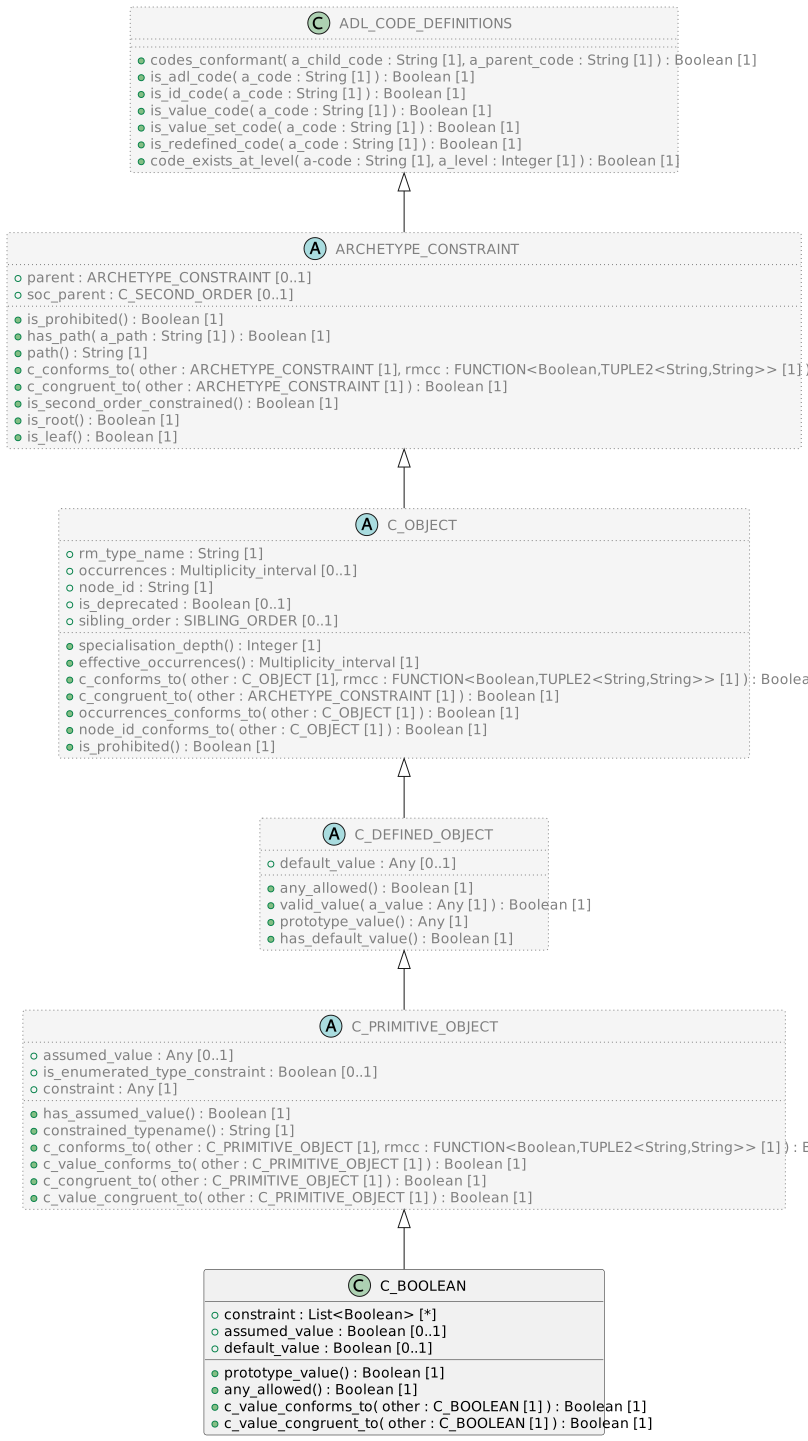
Conformance semantics: C_BOOLEAN
The following functions formally define the conformance of a C_BOOLEAN node in a specialised archetype to a corresponding node in a parent archetype, where 'corresponding' means a node found at the same or a congruent path and of the same AOM type.
c_value_conforms_to (other: C_BOOLEAN): Boolean
        -- True if this node is a strict subset of `other'
    do
        Result := other.any_allowed or
            constraint.count < other.constraint.count and
            for all c in constraint | other.constraint.has (c)
    end

c_value_congruent_to (other: C_BOOLEAN): Boolean
        -- True if this node's value constraint is the same as that of `other'
    do
        Result := constraint.count = other.constraint.count and
            for all c in constraint | other.constraint.has (c)
    end
C_STRING Class
-
Definition
-
Effective
-
BMM
-
UML
Class |
C_STRING |
|
|---|---|---|
Description |
Constraint on instances of |
|
Inherit |
||
Attributes |
Signature |
Meaning |
0..1 |
String constraint - a list of literal strings and / or regular expression strings delimited by the ‘/’ character. To represent no constraint, use an empty list, or alternatively, a regex 'any' pattern, i.e. |
|
0..1 |
default_value: |
Default String value. |
0..1 |
assumed_value: |
Assumed String value. |
Functions |
Signature |
Meaning |
1..1 |
prototype_value (): |
|
1..1 |
True if a_value is valid with respect to constraint expressed in concrete instance of this type. |
|
1..1 |
any_allowed (): |
True if |
1..1 |
True if |
|
1..1 |
True if the items in |
|
| C_STRING | |||
|---|---|---|---|
Constraint on instances of |
|||
Inherits: ADL_CODE_DEFINITIONS, ARCHETYPE_CONSTRAINT, C_OBJECT, C_DEFINED_OBJECT, C_PRIMITIVE_OBJECT |
|||
Constants |
|||
Id_code_leader: |
String leader of ‘identifier’ codes, i.e. codes used to identify archetype nodes. |
||
Value_code_leader: |
String leader of ‘value’ codes, i.e. codes used to identify codes values, including value set members. |
||
Value_set_code_leader: |
String leader of ‘value set’ codes, i.e. codes used to identify value sets. |
||
Specialisation_separator: |
Character used to separate numeric parts of codes belonging to different specialisation levels. |
||
Code_regex_pattern: |
Regex used to define the legal numeric part of any archetype code. Corresponds to the simple pattern of dotted numbers, as used in typical multi-level numbering schemes. |
||
Root_code_regex_pattern: |
Regex pattern of the root id code of any archetype. Corresponds to codes of the form |
||
Primitive_node_id: |
Code id used for |
||
Attributes |
|||
parent: |
Parent node, except in the case of the top of a tree, i.e. root |
||
soc_parent: |
+ Inherited from ARCHETYPE_CONSTRAINT |
||
rm_type_name: |
Reference model type that this node corresponds to. |
||
occurrences: |
Occurrences of this object node in the data, under the owning attribute. Upper limit can only be greater than 1 if owning attribute has a cardinality of more than 1.
Only set if it overrides the parent archetype in the case of specialised archetypes, or else the occurrences inferred from the underlying reference model existence and/or cardinality of the containing attribute. |
||
node_id: |
Semantic identifier of this node, used to distinguish sibling nodes. All nodes must have a For |
||
is_deprecated: |
True if this node and by implication all sub-nodes are deprecated for use. |
||
sibling_order: |
Optional indicator of order of this node with respect to another sibling. Only meaningful in a specialised archetype for a |
||
default_value: |
Default String value. |
||
assumed_value: |
Assumed String value. |
||
is_enumerated_type_constraint: |
True if this object represents a constraint on an enumerated type from the reference model, where the latter is assumed to be based on a primitive type, generally Integer or String. |
||
String constraint - a list of literal strings and / or regular expression strings delimited by the ‘/’ character. To represent no constraint, use an empty list, or alternatively, a regex 'any' pattern, i.e. |
|||
Functions |
|||
codes_conformant ( |
True if |
||
is_adl_code ( |
True if |
||
is_id_code ( |
True if |
||
is_value_code ( |
True if |
||
is_value_set_code ( |
True if |
||
A code has been specialised if there is a non-zero code index anywhere above the last index e.g.
|
|||
code_exists_at_level ( |
Is |
||
is_prohibited (): |
True if this |
||
True if the relative path |
|||
path (): |
Path of this node relative to root of archetype. |
||
c_conforms_to ( |
True if constraints represented by this node, ignoring any sub-parts, are narrower or the same as other.
Typically used during validation of specialised archetype nodes. Parameters
|
||
c_congruent_to ( |
True if constraints represented by this node contain no further redefinitions with respect to the node Typically used to test if an inherited node locally contains any constraints. |
||
is_second_order_constrained (): |
True if there is a second order constraint such as a tuple constraint on this node. |
||
is_root (): |
True if this node is the root of the tree. |
||
is_leaf (): |
True if this node is a terminal node in the tree structure, i.e. having no child nodes. |
||
specialisation_depth (): |
Level of specialisation of this archetype node, based on its |
||
effective_occurrences (): |
Compute effective occurrences, where no local occurrences constraint set. If the owning If local |
||
occurrences_conforms_to ( |
True if this node Parameters
|
||
node_id_conforms_to ( |
True if this node id conforms to |
||
any_allowed (): |
True if |
||
True if a_value is valid with respect to constraint expressed in concrete instance of this type. |
|||
prototype_value (): |
|||
has_default_value (): |
True if there is an assumed value. |
||
has_assumed_value (): |
True if there is an assumed value. |
||
constrained_typename (): |
Generate name of native type that is constrained by this |
||
True if |
|||
True if the items in |
|||
Invariants |
|||
Post: |
|||
Inv_valid_default_value: |
|||
Inv_valid_assumed_value: |
|||
{
    "name": "C_STRING",
    "documentation": "Constraint on instances of `String`. ",
    "ancestors": [
        "C_PRIMITIVE_OBJECT"
    ],
    "properties": {
        "constraint": {
            "_type": "P_BMM_CONTAINER_PROPERTY",
            "name": "constraint",
            "documentation": "String constraint - a list of literal strings and / or regular expression strings delimited by the ‘/’ character.\n\nTo represent no constraint, use an empty list, or alternatively, a regex 'any' pattern, i.e. `/.*/`.",
            "type_def": {
                "container_type": "List",
                "type": "String"
            },
            "cardinality": {
                "lower": 0,
                "upper_unbounded": true
            }
        },
        "default_value": {
            "_type": "P_BMM_SINGLE_PROPERTY",
            "name": "default_value",
            "documentation": "Default String value.",
            "type": "String"
        },
        "assumed_value": {
            "_type": "P_BMM_SINGLE_PROPERTY",
            "name": "assumed_value",
            "documentation": "Assumed String value.",
            "type": "String"
        }
    },
    "functions": {
        "prototype_value": {
            "name": "prototype_value",
            "result": {
                "_type": "P_BMM_SIMPLE_TYPE",
                "type": "String"
            }
        },
        "valid_value": {
            "name": "valid_value",
            "documentation": "True if a_value is valid with respect to constraint expressed in concrete instance of this type. ",
            "parameters": {
                "a_value": {
                    "_type": "P_BMM_SINGLE_FUNCTION_PARAMETER",
                    "name": "a_value",
                    "type": "String"
                }
            },
            "result": {
                "_type": "P_BMM_SIMPLE_TYPE",
                "type": "Boolean"
            }
        },
        "any_allowed": {
            "name": "any_allowed",
            "documentation": "True if `_constraint_` is empty or else contains one String for the regex 'any' pattern.",
            "post_conditions": {
                "Post": "Result = constraint.is_empty or else constraint.count = 1 and constraint.first.is_equal (Regex_any_string)"
            },
            "result": {
                "_type": "P_BMM_SIMPLE_TYPE",
                "type": "Boolean"
            }
        },
        "c_value_conforms_to": {
            "name": "c_value_conforms_to",
            "documentation": "True if `_other.any_allowed_` or else every constraint in the `_constraint_` list exists in the `_other.constraint_`.",
            "parameters": {
                "other": {
                    "_type": "P_BMM_SINGLE_FUNCTION_PARAMETER",
                    "name": "other",
                    "type": "C_STRING"
                }
            },
            "result": {
                "_type": "P_BMM_SIMPLE_TYPE",
                "type": "Boolean"
            }
        },
        "c_value_congruent_to": {
            "name": "c_value_congruent_to",
            "documentation": "True if the items in `_constraint_` are equal in number and identical pair-wise with those in `_other.constraint_`.",
            "parameters": {
                "other": {
                    "_type": "P_BMM_SINGLE_FUNCTION_PARAMETER",
                    "name": "other",
                    "type": "C_STRING"
                }
            },
            "result": {
                "_type": "P_BMM_SIMPLE_TYPE",
                "type": "Boolean"
            }
        }
    }
}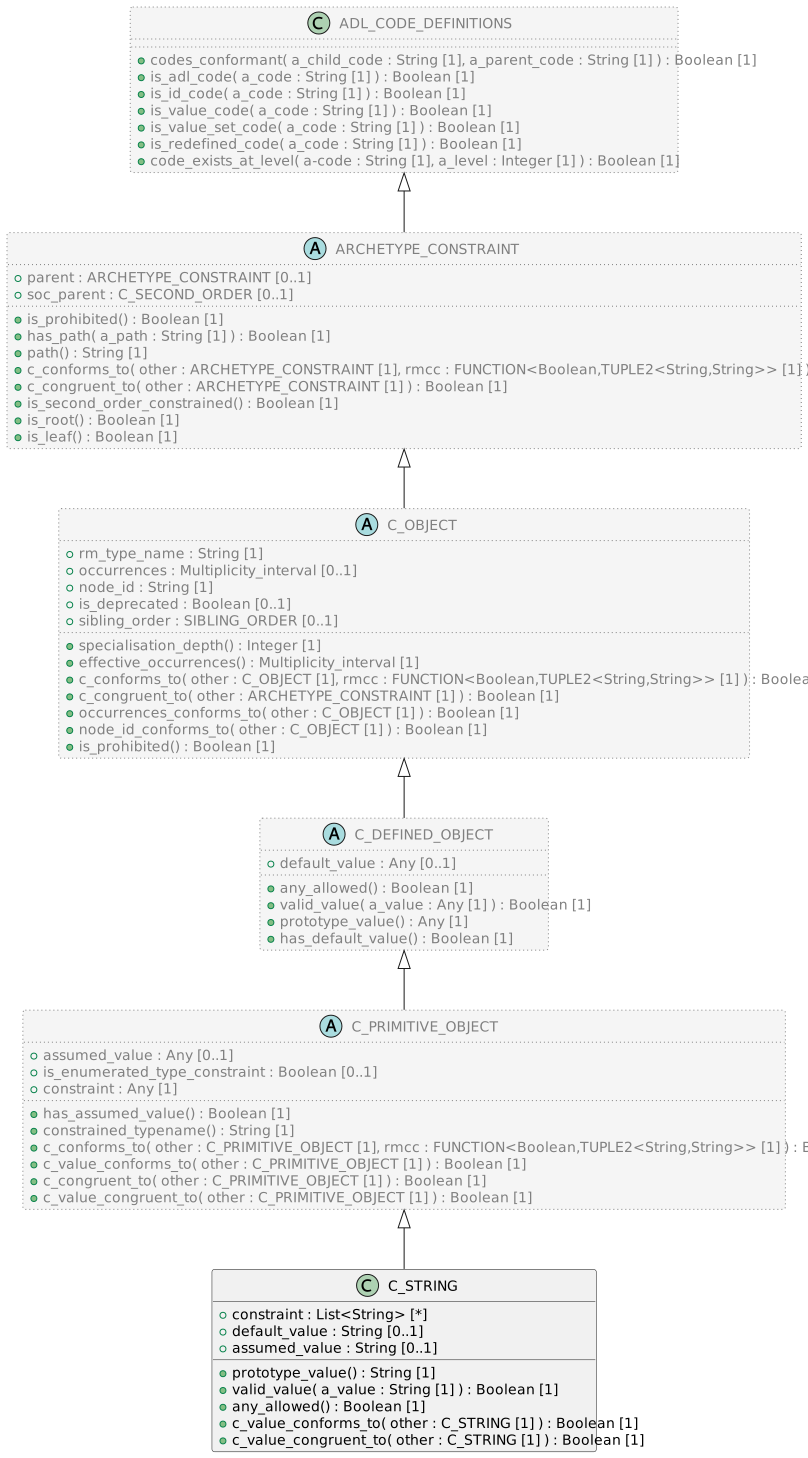
Conformance semantics: C_STRING
The following functions formally define the conformance of a C_STRING node in a specialised archetype to a corresponding node in a parent archetype, where 'corresponding' means a node found at the same or a congruent path and of the same AOM type.
c_value_conforms_to (other: C_STRING): Boolean
        -- True if `constraint' is a strict subset of other.constraint
    do
        Result := other.any_allowed or
            constraint.count < other.constraint.count and
            for all c in constraint | other.constraint.has (c)
    end

c_value_congruent_to (other: C_STRING): Boolean
        -- True if this node's value constraint is the same as that of `other'
    do
        Result := constraint.count = other.constraint.count and then
            across constraint as str_csr all
                other.constraint.i_th (str_csr.cursor_index).is_equal (str_csr.item)
            end
    end
C_ORDERED Class
-
Definition
-
Effective
-
BMM
-
UML
Class |
C_ORDERED<T> (abstract) |
|
|---|---|---|
Description |
Abstract parent of primitive constrainer classes based on In its simplest form, the constraint accessor returns just a single point The next simplest form is a single proper |
|
Inherit |
||
Attributes |
Signature |
Meaning |
0..1 |
Constraint in the form of a List of Intervals of the parameter type T. Concrete types generated in descendants via template binding. |
|
0..1 |
default_value: |
Default value set in a template, and present in an operational template. Generally limited to leaf and near-leaf nodes. |
0..1 |
assumed_value: |
Value to be assumed if none sent in data. |
Functions |
Signature |
Meaning |
1..1 |
any_allowed (): |
True if any value (i.e. instance) of the reference model type would be allowed. Redefined in descendants. |
1..1 |
True if |
|
1..1 |
True if the items in |
|
| C_ORDERED<T> (abstract) | |||
|---|---|---|---|
Abstract parent of primitive constrainer classes based on In its simplest form, the constraint accessor returns just a single point The next simplest form is a single proper |
|||
Inherits: ADL_CODE_DEFINITIONS, ARCHETYPE_CONSTRAINT, C_OBJECT, C_DEFINED_OBJECT, C_PRIMITIVE_OBJECT |
|||
Constants |
|||
Id_code_leader: |
String leader of ‘identifier’ codes, i.e. codes used to identify archetype nodes. |
||
Value_code_leader: |
String leader of ‘value’ codes, i.e. codes used to identify codes values, including value set members. |
||
Value_set_code_leader: |
String leader of ‘value set’ codes, i.e. codes used to identify value sets. |
||
Specialisation_separator: |
Character used to separate numeric parts of codes belonging to different specialisation levels. |
||
Code_regex_pattern: |
Regex used to define the legal numeric part of any archetype code. Corresponds to the simple pattern of dotted numbers, as used in typical multi-level numbering schemes. |
||
Root_code_regex_pattern: |
Regex pattern of the root id code of any archetype. Corresponds to codes of the form |
||
Primitive_node_id: |
Code id used for |
||
Attributes |
|||
parent: |
Parent node, except in the case of the top of a tree, i.e. root |
||
soc_parent: |
+ Inherited from ARCHETYPE_CONSTRAINT |
||
rm_type_name: |
Reference model type that this node corresponds to. |
||
occurrences: |
Occurrences of this object node in the data, under the owning attribute. Upper limit can only be greater than 1 if owning attribute has a cardinality of more than 1.
Only set if it overrides the parent archetype in the case of specialised archetypes, or else the occurrences inferred from the underlying reference model existence and/or cardinality of the containing attribute. |
||
node_id: |
Semantic identifier of this node, used to distinguish sibling nodes. All nodes must have a For |
||
is_deprecated: |
True if this node and by implication all sub-nodes are deprecated for use. |
||
sibling_order: |
Optional indicator of order of this node with respect to another sibling. Only meaningful in a specialised archetype for a |
||
default_value: |
Default value set in a template, and present in an operational template. Generally limited to leaf and near-leaf nodes. |
||
assumed_value: |
Value to be assumed if none sent in data. |
||
is_enumerated_type_constraint: |
True if this object represents a constraint on an enumerated type from the reference model, where the latter is assumed to be based on a primitive type, generally Integer or String. |
||
Constraint in the form of a List of Intervals of the parameter type T. Concrete types generated in descendants via template binding. |
|||
Functions |
|||
codes_conformant ( |
True if |
||
is_adl_code ( |
True if |
||
is_id_code ( |
True if |
||
is_value_code ( |
True if |
||
is_value_set_code ( |
True if |
||
A code has been specialised if there is a non-zero code index anywhere above the last index e.g.
|
|||
code_exists_at_level ( |
Is |
||
is_prohibited (): |
True if this |
||
True if the relative path |
|||
path (): |
Path of this node relative to root of archetype. |
||
c_conforms_to ( |
True if constraints represented by this node, ignoring any sub-parts, are narrower or the same as other.
Typically used during validation of specialised archetype nodes. Parameters
|
||
c_congruent_to ( |
True if constraints represented by this node contain no further redefinitions with respect to the node Typically used to test if an inherited node locally contains any constraints. |
||
is_second_order_constrained (): |
True if there is a second order constraint such as a tuple constraint on this node. |
||
is_root (): |
True if this node is the root of the tree. |
||
is_leaf (): |
True if this node is a terminal node in the tree structure, i.e. having no child nodes. |
||
specialisation_depth (): |
Level of specialisation of this archetype node, based on its |
||
effective_occurrences (): |
Compute effective occurrences, where no local occurrences constraint set. If the owning If local |
||
occurrences_conforms_to ( |
True if this node Parameters
|
||
node_id_conforms_to ( |
True if this node id conforms to |
||
any_allowed (): |
True if any value (i.e. instance) of the reference model type would be allowed. Redefined in descendants. |
||
True if |
|||
(abstract) prototype_value (): |
Generate a prototype value from this constraint object. |
||
has_default_value (): |
True if there is an assumed value. |
||
has_assumed_value (): |
True if there is an assumed value. |
||
constrained_typename (): |
Generate name of native type that is constrained by this |
||
True if |
|||
c_value_congruent_to ( |
True if the items in |
||
Invariants |
|||
Post: |
|||
Inv_valid_default_value: |
|||
Inv_valid_assumed_value: |
|||
{
    "name": "C_ORDERED",
    "documentation": "Abstract parent of primitive constrainer classes based on `Ordered` base types, i.e. types like `Integer`, `Real`, and the Date/Time types. The model constraint is a List of Intervals, which may include point Intervals, and acts as a efficient and formally tractable representation of any number of point values and/or contiguous intervals of an ordered value domain.\n\nIn its simplest form, the constraint accessor returns just a single point `Interval<T>` object, representing a single value.\n\nThe next simplest form is a single proper `Interval <T>` (i.e. normal two-sided or half-open interval). The most complex form is a list of any combination of point and proper intervals.",
    "is_abstract": true,
    "ancestors": [
        "C_PRIMITIVE_OBJECT"
    ],
    "generic_parameter_defs": {
        "T": {
            "name": "T",
            "conforms_to_type": "Ordered"
        }
    },
    "properties": {
        "constraint": {
            "_type": "P_BMM_CONTAINER_PROPERTY",
            "name": "constraint",
            "documentation": "Constraint in the form of a List of Intervals of the parameter type T. Concrete types generated in descendants via template binding.",
            "type_def": {
                "container_type": "List",
                "type_def": {
                    "_type": "P_BMM_GENERIC_TYPE",
                    "root_type": "Interval",
                    "generic_parameters": [
                        "T"
                    ]
                }
            },
            "cardinality": {
                "lower": 0,
                "upper_unbounded": true
            }
        },
        "default_value": {
            "_type": "P_BMM_SINGLE_PROPERTY_OPEN",
            "name": "default_value",
            "documentation": "Default value set in a template, and present in an operational template. Generally limited to leaf and near-leaf nodes.",
            "type": "T"
        },
        "assumed_value": {
            "_type": "P_BMM_SINGLE_PROPERTY_OPEN",
            "name": "assumed_value",
            "documentation": "Value to be assumed if none sent in data.",
            "type": "T"
        }
    },
    "functions": {
        "any_allowed": {
            "name": "any_allowed",
            "documentation": "True if any value (i.e. instance) of the reference model type would be allowed. Redefined in descendants.",
            "post_conditions": {
                "Post": "Result = constraint.is_empty"
            },
            "result": {
                "_type": "P_BMM_SIMPLE_TYPE",
                "type": "Boolean"
            }
        },
        "c_value_conforms_to": {
            "name": "c_value_conforms_to",
            "documentation": "True if `_other.any_allowed_` or else for every constraint in the `_constraint_` list there is a constraint in `_other.constraint_` that contains it.",
            "parameters": {
                "other": {
                    "_type": "P_BMM_SINGLE_FUNCTION_PARAMETER",
                    "name": "other",
                    "type": "C_ORDERED"
                }
            },
            "result": {
                "_type": "P_BMM_SIMPLE_TYPE",
                "type": "Boolean"
            }
        },
        "c_value_congruent_to": {
            "name": "c_value_congruent_to",
            "documentation": "True if the items in `_constraint_` are equal in number and identical pair-wise with those in `_other.constraint_`.",
            "parameters": {
                "other": {
                    "_type": "P_BMM_SINGLE_FUNCTION_PARAMETER",
                    "name": "other",
                    "type": "C_ORDERED"
                }
            },
            "result": {
                "_type": "P_BMM_SIMPLE_TYPE",
                "type": "Boolean"
            }
        }
    }
}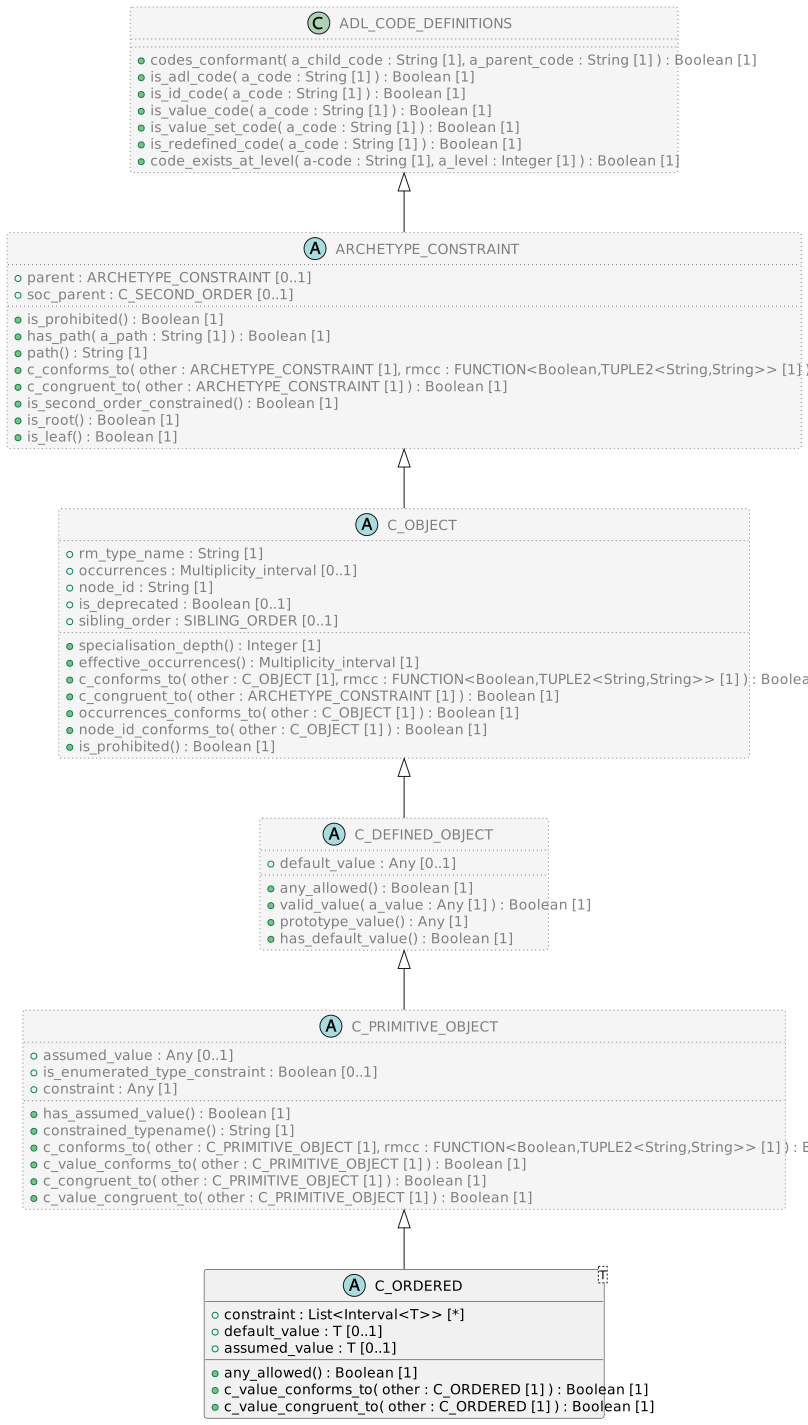
Conformance semantics: C_ORDERED
The following functions implement those of the same names in C_PRIMITIVE_OBJECT and formally define the conformance of a node of a C_ORDERED descendant type in a specialised archetype to a corresponding node in a parent archetype, where 'corresponding' means a node found at the same or a congruent path and of the same AOM type.
c_value_conforms_to (other: C_ORDERED): Boolean
        -- True if this node is a strict subset of `other`
    do
        Result := other.any_allowed or
            for_all c:constraint |
                there_exists oc:other.constraint | oc.contains (c)
            end
    end

c_value_congruent_to (C_ORDERED): Boolean
        -- True if this node is the same as `other`
    do
        Result := constraint.count = other.constraint.count and
            for_all c:constraint |
                c.is_equal (other.constraint.i_th (constraint.index_of(c)))
            end
    end
C_INTEGER Class
-
Definition
-
Effective
-
BMM
-
UML
Class |
C_INTEGER |
|
|---|---|---|
Description |
Constraint on instances of Integer. |
|
Inherit |
||
Attributes |
Signature |
Meaning |
0..1 |
Formal constraint on To represent no constraint, use an empty list. |
|
0..1 |
default_value: |
Default value set in a template, and present in an operational template. Generally limited to leaf and near-leaf nodes. |
0..1 |
assumed_value: |
Value to be assumed if none sent in data. |
| C_INTEGER | |||
|---|---|---|---|
Constraint on instances of Integer. |
|||
Inherits: ADL_CODE_DEFINITIONS, ARCHETYPE_CONSTRAINT, C_OBJECT, C_DEFINED_OBJECT, C_PRIMITIVE_OBJECT, C_ORDERED |
|||
Constants |
|||
Id_code_leader: |
String leader of ‘identifier’ codes, i.e. codes used to identify archetype nodes. |
||
Value_code_leader: |
String leader of ‘value’ codes, i.e. codes used to identify codes values, including value set members. |
||
Value_set_code_leader: |
String leader of ‘value set’ codes, i.e. codes used to identify value sets. |
||
Specialisation_separator: |
Character used to separate numeric parts of codes belonging to different specialisation levels. |
||
Code_regex_pattern: |
Regex used to define the legal numeric part of any archetype code. Corresponds to the simple pattern of dotted numbers, as used in typical multi-level numbering schemes. |
||
Root_code_regex_pattern: |
Regex pattern of the root id code of any archetype. Corresponds to codes of the form |
||
Primitive_node_id: |
Code id used for |
||
Attributes |
|||
parent: |
Parent node, except in the case of the top of a tree, i.e. root |
||
soc_parent: |
+ Inherited from ARCHETYPE_CONSTRAINT |
||
rm_type_name: |
Reference model type that this node corresponds to. |
||
occurrences: |
Occurrences of this object node in the data, under the owning attribute. Upper limit can only be greater than 1 if owning attribute has a cardinality of more than 1.
Only set if it overrides the parent archetype in the case of specialised archetypes, or else the occurrences inferred from the underlying reference model existence and/or cardinality of the containing attribute. |
||
node_id: |
Semantic identifier of this node, used to distinguish sibling nodes. All nodes must have a For |
||
is_deprecated: |
True if this node and by implication all sub-nodes are deprecated for use. |
||
sibling_order: |
Optional indicator of order of this node with respect to another sibling. Only meaningful in a specialised archetype for a |
||
default_value: |
Default value set in a template, and present in an operational template. Generally limited to leaf and near-leaf nodes. |
||
assumed_value: |
Value to be assumed if none sent in data. |
||
is_enumerated_type_constraint: |
True if this object represents a constraint on an enumerated type from the reference model, where the latter is assumed to be based on a primitive type, generally Integer or String. |
||
Formal constraint on To represent no constraint, use an empty list. |
|||
Functions |
|||
codes_conformant ( |
True if |
||
is_adl_code ( |
True if |
||
is_id_code ( |
True if |
||
is_value_code ( |
True if |
||
is_value_set_code ( |
True if |
||
A code has been specialised if there is a non-zero code index anywhere above the last index e.g.
|
|||
code_exists_at_level ( |
Is |
||
is_prohibited (): |
True if this |
||
True if the relative path |
|||
path (): |
Path of this node relative to root of archetype. |
||
c_conforms_to ( |
True if constraints represented by this node, ignoring any sub-parts, are narrower or the same as other.
Typically used during validation of specialised archetype nodes. Parameters
|
||
c_congruent_to ( |
True if constraints represented by this node contain no further redefinitions with respect to the node Typically used to test if an inherited node locally contains any constraints. |
||
is_second_order_constrained (): |
True if there is a second order constraint such as a tuple constraint on this node. |
||
is_root (): |
True if this node is the root of the tree. |
||
is_leaf (): |
True if this node is a terminal node in the tree structure, i.e. having no child nodes. |
||
specialisation_depth (): |
Level of specialisation of this archetype node, based on its |
||
effective_occurrences (): |
Compute effective occurrences, where no local occurrences constraint set. If the owning If local |
||
occurrences_conforms_to ( |
True if this node Parameters
|
||
node_id_conforms_to ( |
True if this node id conforms to |
||
any_allowed (): |
True if any value (i.e. instance) of the reference model type would be allowed. Redefined in descendants. |
||
True if |
|||
(abstract) prototype_value (): |
Generate a prototype value from this constraint object. |
||
has_default_value (): |
True if there is an assumed value. |
||
has_assumed_value (): |
True if there is an assumed value. |
||
constrained_typename (): |
Generate name of native type that is constrained by this |
||
True if |
|||
c_value_congruent_to ( |
True if the items in |
||
Invariants |
|||
Post: |
|||
Inv_valid_default_value: |
|||
Inv_valid_assumed_value: |
|||
{
    "name": "C_INTEGER",
    "documentation": "Constraint on instances of Integer.",
    "ancestors": [
        "C_ORDERED"
    ],
    "properties": {
        "constraint": {
            "_type": "P_BMM_CONTAINER_PROPERTY",
            "name": "constraint",
            "documentation": "Formal constraint on `Integer`, in the form of one or more `Interval<Integer>`.\n\nTo represent no constraint, use an empty list.",
            "type_def": {
                "container_type": "List",
                "type_def": {
                    "_type": "P_BMM_GENERIC_TYPE",
                    "root_type": "Interval",
                    "generic_parameters": [
                        "Integer"
                    ]
                }
            },
            "cardinality": {
                "lower": 0,
                "upper_unbounded": true
            }
        },
        "default_value": {
            "_type": "P_BMM_SINGLE_PROPERTY",
            "name": "default_value",
            "documentation": "Default value set in a template, and present in an operational template. Generally limited to leaf and near-leaf nodes.",
            "type": "Integer"
        },
        "assumed_value": {
            "_type": "P_BMM_SINGLE_PROPERTY",
            "name": "assumed_value",
            "documentation": "Value to be assumed if none sent in data.",
            "type": "Real"
        }
    }
}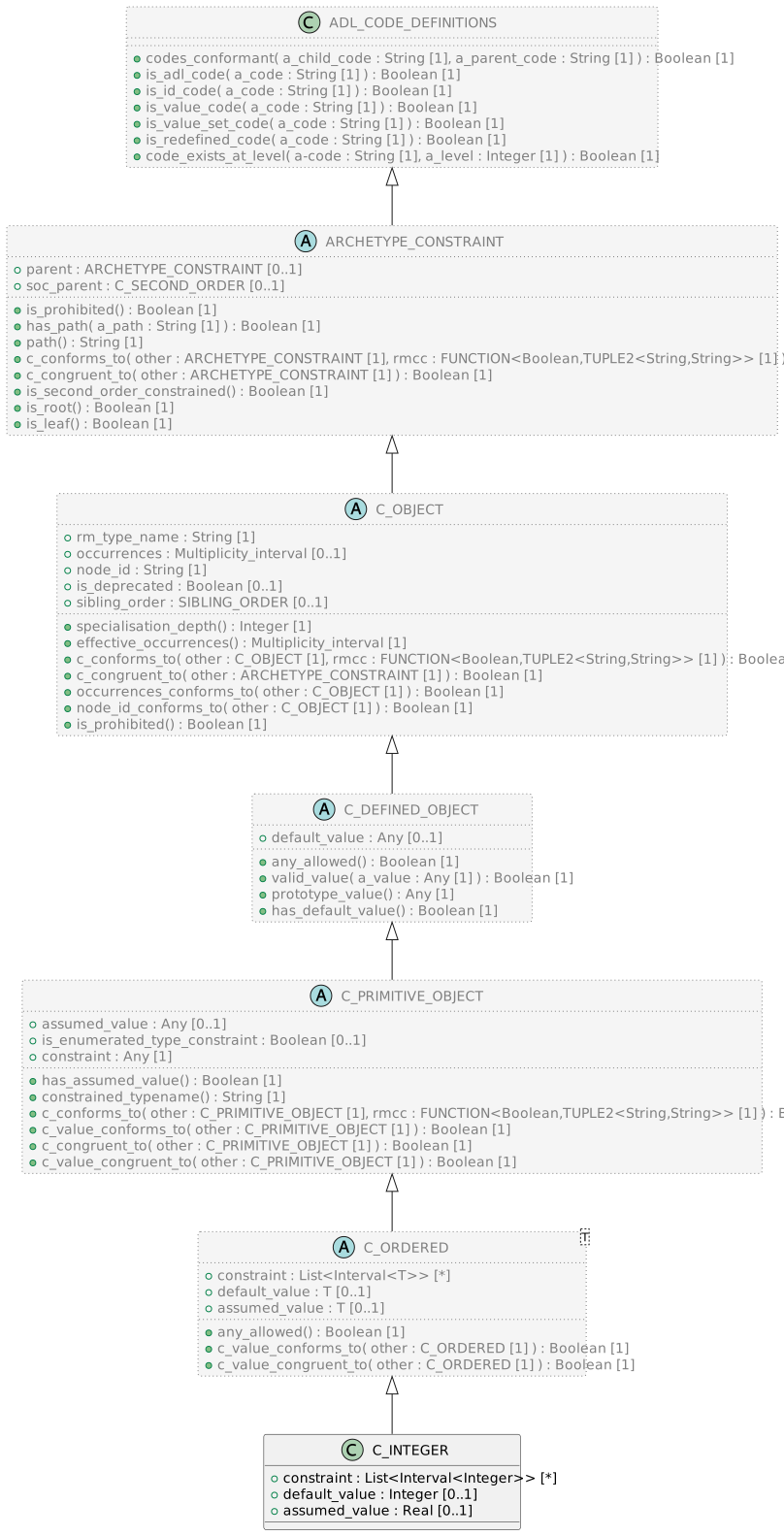
C_REAL Class
-
Definition
-
Effective
-
BMM
-
UML
Class |
C_REAL |
|
|---|---|---|
Description |
Constraint on instances of Real. |
|
Inherit |
||
Attributes |
Signature |
Meaning |
0..1 |
Formal constraint on To represent no constraint, use an empty list. |
|
0..1 |
default_value: |
Default value set in a template, and present in an operational template. Generally limited to leaf and near-leaf nodes. |
0..1 |
assumed_value: |
Value to be assumed if none sent in data. |
| C_REAL | |||
|---|---|---|---|
Constraint on instances of Real. |
|||
Inherits: ADL_CODE_DEFINITIONS, ARCHETYPE_CONSTRAINT, C_OBJECT, C_DEFINED_OBJECT, C_PRIMITIVE_OBJECT, C_ORDERED |
|||
Constants |
|||
Id_code_leader: |
String leader of ‘identifier’ codes, i.e. codes used to identify archetype nodes. |
||
Value_code_leader: |
String leader of ‘value’ codes, i.e. codes used to identify codes values, including value set members. |
||
Value_set_code_leader: |
String leader of ‘value set’ codes, i.e. codes used to identify value sets. |
||
Specialisation_separator: |
Character used to separate numeric parts of codes belonging to different specialisation levels. |
||
Code_regex_pattern: |
Regex used to define the legal numeric part of any archetype code. Corresponds to the simple pattern of dotted numbers, as used in typical multi-level numbering schemes. |
||
Root_code_regex_pattern: |
Regex pattern of the root id code of any archetype. Corresponds to codes of the form |
||
Primitive_node_id: |
Code id used for |
||
Attributes |
|||
parent: |
Parent node, except in the case of the top of a tree, i.e. root |
||
soc_parent: |
+ Inherited from ARCHETYPE_CONSTRAINT |
||
rm_type_name: |
Reference model type that this node corresponds to. |
||
occurrences: |
Occurrences of this object node in the data, under the owning attribute. Upper limit can only be greater than 1 if owning attribute has a cardinality of more than 1.
Only set if it overrides the parent archetype in the case of specialised archetypes, or else the occurrences inferred from the underlying reference model existence and/or cardinality of the containing attribute. |
||
node_id: |
Semantic identifier of this node, used to distinguish sibling nodes. All nodes must have a For |
||
is_deprecated: |
True if this node and by implication all sub-nodes are deprecated for use. |
||
sibling_order: |
Optional indicator of order of this node with respect to another sibling. Only meaningful in a specialised archetype for a |
||
default_value: |
Default value set in a template, and present in an operational template. Generally limited to leaf and near-leaf nodes. |
||
assumed_value: |
Value to be assumed if none sent in data. |
||
is_enumerated_type_constraint: |
True if this object represents a constraint on an enumerated type from the reference model, where the latter is assumed to be based on a primitive type, generally Integer or String. |
||
Formal constraint on To represent no constraint, use an empty list. |
|||
Functions |
|||
codes_conformant ( |
True if |
||
is_adl_code ( |
True if |
||
is_id_code ( |
True if |
||
is_value_code ( |
True if |
||
is_value_set_code ( |
True if |
||
A code has been specialised if there is a non-zero code index anywhere above the last index e.g.
|
|||
code_exists_at_level ( |
Is |
||
is_prohibited (): |
True if this |
||
True if the relative path |
|||
path (): |
Path of this node relative to root of archetype. |
||
c_conforms_to ( |
True if constraints represented by this node, ignoring any sub-parts, are narrower or the same as other.
Typically used during validation of specialised archetype nodes. Parameters
|
||
c_congruent_to ( |
True if constraints represented by this node contain no further redefinitions with respect to the node Typically used to test if an inherited node locally contains any constraints. |
||
is_second_order_constrained (): |
True if there is a second order constraint such as a tuple constraint on this node. |
||
is_root (): |
True if this node is the root of the tree. |
||
is_leaf (): |
True if this node is a terminal node in the tree structure, i.e. having no child nodes. |
||
specialisation_depth (): |
Level of specialisation of this archetype node, based on its |
||
effective_occurrences (): |
Compute effective occurrences, where no local occurrences constraint set. If the owning If local |
||
occurrences_conforms_to ( |
True if this node Parameters
|
||
node_id_conforms_to ( |
True if this node id conforms to |
||
any_allowed (): |
True if any value (i.e. instance) of the reference model type would be allowed. Redefined in descendants. |
||
True if |
|||
(abstract) prototype_value (): |
Generate a prototype value from this constraint object. |
||
has_default_value (): |
True if there is an assumed value. |
||
has_assumed_value (): |
True if there is an assumed value. |
||
constrained_typename (): |
Generate name of native type that is constrained by this |
||
True if |
|||
c_value_congruent_to ( |
True if the items in |
||
Invariants |
|||
Post: |
|||
Inv_valid_default_value: |
|||
Inv_valid_assumed_value: |
|||
{
    "name": "C_REAL",
    "documentation": "Constraint on instances of Real.",
    "ancestors": [
        "C_ORDERED"
    ],
    "properties": {
        "constraint": {
            "_type": "P_BMM_CONTAINER_PROPERTY",
            "name": "constraint",
            "documentation": "Formal constraint on `Real`, in the form of one or more `Interval<Real>`.\n\nTo represent no constraint, use an empty list.",
            "type_def": {
                "container_type": "List",
                "type_def": {
                    "_type": "P_BMM_GENERIC_TYPE",
                    "root_type": "Interval",
                    "generic_parameters": [
                        "Real"
                    ]
                }
            },
            "cardinality": {
                "lower": 0,
                "upper_unbounded": true
            }
        },
        "default_value": {
            "_type": "P_BMM_SINGLE_PROPERTY",
            "name": "default_value",
            "documentation": "Default value set in a template, and present in an operational template. Generally limited to leaf and near-leaf nodes.",
            "type": "Real"
        },
        "assumed_value": {
            "_type": "P_BMM_SINGLE_PROPERTY",
            "name": "assumed_value",
            "documentation": "Value to be assumed if none sent in data.",
            "type": "Real"
        }
    }
}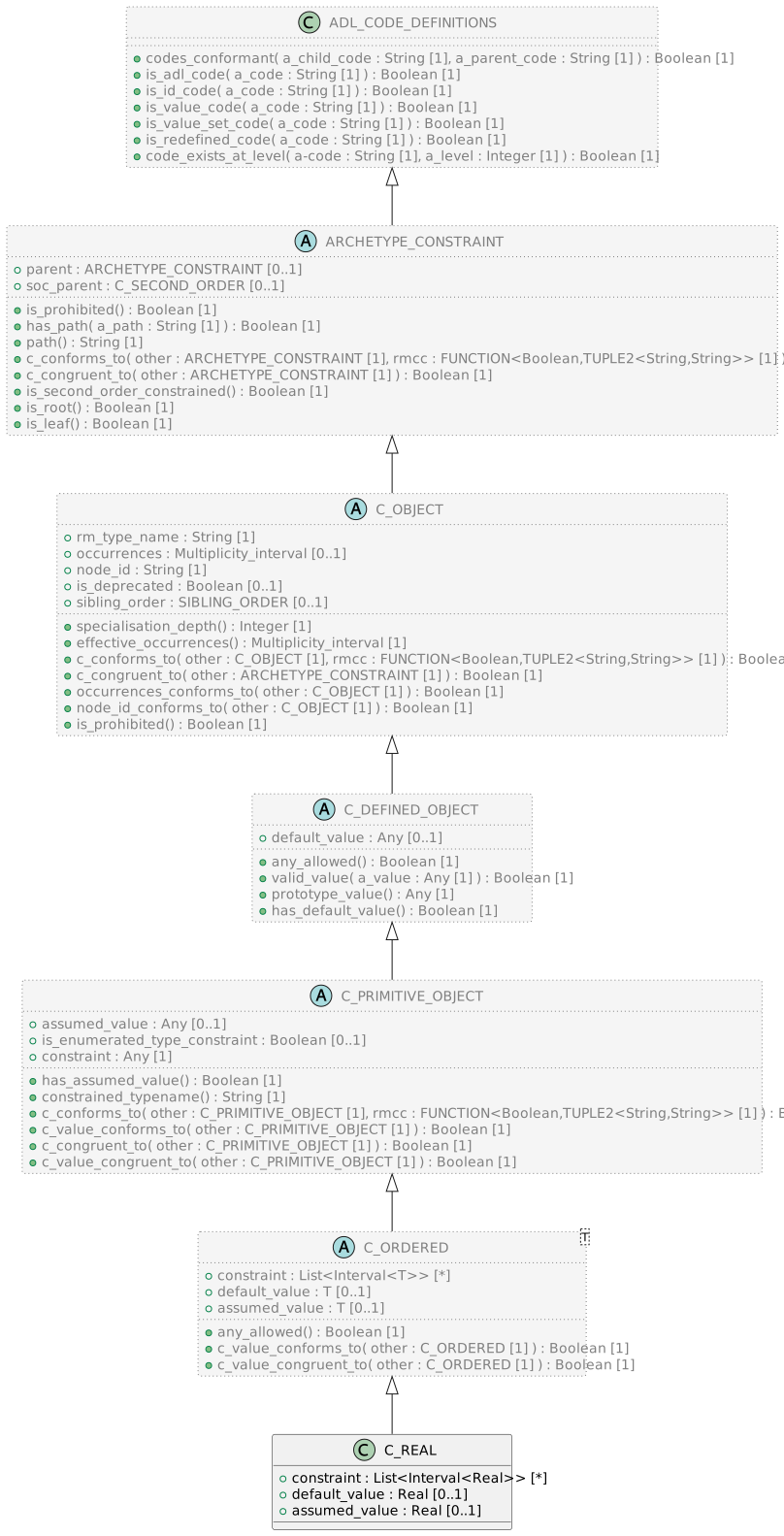
C_TEMPORAL Class
-
Definition
-
Effective
-
BMM
-
UML
Class |
C_TEMPORAL<T> (abstract) |
|
|---|---|---|
Description |
Purpose Abstract parent of |
|
Inherit |
||
Attributes |
Signature |
Meaning |
0..1 |
pattern_constraint: |
Optional alternative constraint in the form of a pattern based on ISO8601. See descendants for details. |
Functions |
Signature |
Meaning |
1..1 |
True if |
|
1..1 |
valid_pattern_constraint_replacement ( |
Return True if |
1..1 |
any_allowed (): |
True if any value (i.e. instance) of the reference model type would be allowed. Redefined in descendants. |
1..1 |
True if |
|
1..1 |
True if |
|
| C_TEMPORAL<T> (abstract) | |||
|---|---|---|---|
Purpose Abstract parent of |
|||
Inherits: ADL_CODE_DEFINITIONS, ARCHETYPE_CONSTRAINT, C_OBJECT, C_DEFINED_OBJECT, C_PRIMITIVE_OBJECT, C_ORDERED |
|||
Constants |
|||
Id_code_leader: |
String leader of ‘identifier’ codes, i.e. codes used to identify archetype nodes. |
||
Value_code_leader: |
String leader of ‘value’ codes, i.e. codes used to identify codes values, including value set members. |
||
Value_set_code_leader: |
String leader of ‘value set’ codes, i.e. codes used to identify value sets. |
||
Specialisation_separator: |
Character used to separate numeric parts of codes belonging to different specialisation levels. |
||
Code_regex_pattern: |
Regex used to define the legal numeric part of any archetype code. Corresponds to the simple pattern of dotted numbers, as used in typical multi-level numbering schemes. |
||
Root_code_regex_pattern: |
Regex pattern of the root id code of any archetype. Corresponds to codes of the form |
||
Primitive_node_id: |
Code id used for |
||
Attributes |
|||
parent: |
Parent node, except in the case of the top of a tree, i.e. root |
||
soc_parent: |
+ Inherited from ARCHETYPE_CONSTRAINT |
||
rm_type_name: |
Reference model type that this node corresponds to. |
||
occurrences: |
Occurrences of this object node in the data, under the owning attribute. Upper limit can only be greater than 1 if owning attribute has a cardinality of more than 1.
Only set if it overrides the parent archetype in the case of specialised archetypes, or else the occurrences inferred from the underlying reference model existence and/or cardinality of the containing attribute. |
||
node_id: |
Semantic identifier of this node, used to distinguish sibling nodes. All nodes must have a For |
||
is_deprecated: |
True if this node and by implication all sub-nodes are deprecated for use. |
||
sibling_order: |
Optional indicator of order of this node with respect to another sibling. Only meaningful in a specialised archetype for a |
||
default_value: |
Default value set in a template, and present in an operational template. Generally limited to leaf and near-leaf nodes. |
||
assumed_value: |
Value to be assumed if none sent in data. |
||
is_enumerated_type_constraint: |
True if this object represents a constraint on an enumerated type from the reference model, where the latter is assumed to be based on a primitive type, generally Integer or String. |
||
Constraint in the form of a List of Intervals of the parameter type T. Concrete types generated in descendants via template binding. |
|||
pattern_constraint: |
Optional alternative constraint in the form of a pattern based on ISO8601. See descendants for details. |
||
Functions |
|||
codes_conformant ( |
True if |
||
is_adl_code ( |
True if |
||
is_id_code ( |
True if |
||
is_value_code ( |
True if |
||
is_value_set_code ( |
True if |
||
A code has been specialised if there is a non-zero code index anywhere above the last index e.g.
|
|||
code_exists_at_level ( |
Is |
||
is_prohibited (): |
True if this |
||
True if the relative path |
|||
path (): |
Path of this node relative to root of archetype. |
||
c_conforms_to ( |
True if constraints represented by this node, ignoring any sub-parts, are narrower or the same as other.
Typically used during validation of specialised archetype nodes. Parameters
|
||
c_congruent_to ( |
True if constraints represented by this node contain no further redefinitions with respect to the node Typically used to test if an inherited node locally contains any constraints. |
||
is_second_order_constrained (): |
True if there is a second order constraint such as a tuple constraint on this node. |
||
is_root (): |
True if this node is the root of the tree. |
||
is_leaf (): |
True if this node is a terminal node in the tree structure, i.e. having no child nodes. |
||
specialisation_depth (): |
Level of specialisation of this archetype node, based on its |
||
effective_occurrences (): |
Compute effective occurrences, where no local occurrences constraint set. If the owning If local |
||
occurrences_conforms_to ( |
True if this node Parameters
|
||
node_id_conforms_to ( |
True if this node id conforms to |
||
any_allowed (): |
True if any value (i.e. instance) of the reference model type would be allowed. Redefined in descendants. |
||
True if |
|||
(abstract) prototype_value (): |
Generate a prototype value from this constraint object. |
||
has_default_value (): |
True if there is an assumed value. |
||
has_assumed_value (): |
True if there is an assumed value. |
||
constrained_typename (): |
Generate name of native type that is constrained by this |
||
True if |
|||
c_value_congruent_to ( |
True if |
||
(abstract) valid_pattern_constraint ( |
True if |
||
(abstract) valid_pattern_constraint_replacement ( |
Return True if |
||
Invariants |
|||
Post: |
|||
Inv_valid_default_value: |
|||
Inv_valid_assumed_value: |
|||
{
    "name": "C_TEMPORAL",
    "documentation": "Purpose Abstract parent of `C_ORDERED` types whose base type is an ISO date/time type.",
    "is_abstract": true,
    "ancestors": [
        "C_ORDERED"
    ],
    "generic_parameter_defs": {
        "T": {
            "name": "T",
            "conforms_to_type": "Temporal"
        }
    },
    "properties": {
        "pattern_constraint": {
            "_type": "P_BMM_SINGLE_PROPERTY",
            "name": "pattern_constraint",
            "documentation": "Optional alternative constraint in the form of a pattern based on ISO8601. See descendants for details.",
            "type": "String"
        }
    },
    "functions": {
        "valid_pattern_constraint": {
            "name": "valid_pattern_constraint",
            "documentation": "True if `_a_pattern_` is a valid constraint. Define in concrete descendants.",
            "is_abstract": true,
            "parameters": {
                "a_pattern": {
                    "_type": "P_BMM_SINGLE_FUNCTION_PARAMETER",
                    "name": "a_pattern",
                    "type": "String"
                }
            },
            "result": {
                "_type": "P_BMM_SIMPLE_TYPE",
                "type": "Boolean"
            }
        },
        "valid_pattern_constraint_replacement": {
            "name": "valid_pattern_constraint_replacement",
            "documentation": "Return True if `_a_pattern_` can be replaced by `_an_other_pattern_` in a specialised constraint. Define in concrete subtypes.",
            "is_abstract": true,
            "parameters": {
                "a_pattern": {
                    "_type": "P_BMM_SINGLE_FUNCTION_PARAMETER",
                    "name": "a_pattern",
                    "type": "String"
                },
                "an_other_pattern": {
                    "_type": "P_BMM_SINGLE_FUNCTION_PARAMETER",
                    "name": "an_other_pattern",
                    "type": "String"
                }
            },
            "result": {
                "_type": "P_BMM_SIMPLE_TYPE",
                "type": "Boolean"
            }
        },
        "any_allowed": {
            "name": "any_allowed",
            "documentation": "True if any value (i.e. instance) of the reference model type would be allowed. Redefined in descendants.",
            "post_conditions": {
                "Post": "Result = precursor and pattern_constraint.is_empty"
            },
            "result": {
                "_type": "P_BMM_SIMPLE_TYPE",
                "type": "Boolean"
            }
        },
        "c_value_conforms_to": {
            "name": "c_value_conforms_to",
            "documentation": "True if `precursor()` or else `_other.pattern_constraint_` is empty, or else `_pattern_constraint_` is a valid (narrower) replacement for `_other.pattern_constraint_`.",
            "parameters": {
                "other": {
                    "_type": "P_BMM_SINGLE_FUNCTION_PARAMETER",
                    "name": "other",
                    "type": "C_ORDERED"
                }
            },
            "result": {
                "_type": "P_BMM_SIMPLE_TYPE",
                "type": "Boolean"
            }
        },
        "c_value_congruent_to": {
            "name": "c_value_congruent_to",
            "documentation": "True if `precursor (other)` and `_pattern_constraint_ ~ _other.pattern_constraint_`, i.e. either both `Void` or else both non-`Void` and identical.",
            "parameters": {
                "other": {
                    "_type": "P_BMM_SINGLE_FUNCTION_PARAMETER",
                    "name": "other",
                    "type": "C_ORDERED"
                }
            },
            "result": {
                "_type": "P_BMM_SIMPLE_TYPE",
                "type": "Boolean"
            }
        }
    }
}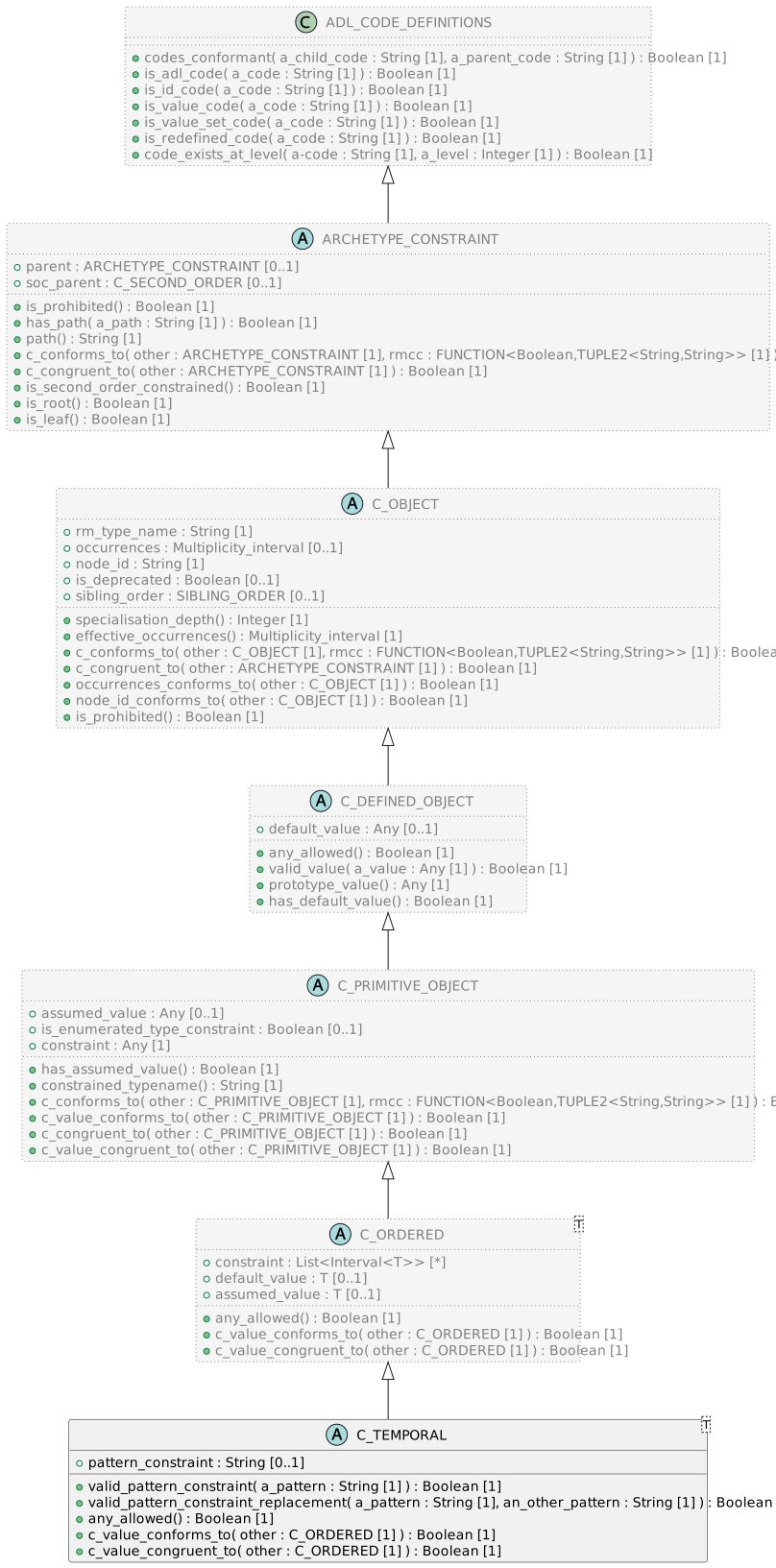
C_TEMPORAL_DEFINITIONS Class
-
Definition
-
Effective
-
BMM
-
UML
Class |
C_TEMPORAL_DEFINITIONS |
|
|---|---|---|
Description |
Definitions related to |
|
Attributes |
Signature |
Meaning |
1..1 |
List of allowed date constraints. Contains the values: |
|
1..1 |
valid_date_constraint_replacements: |
List of allowed date constraint replacements e.g. in specialised archetype. Contains the values: "YYYY-MM-DD": [],
"YYYY-MM-??": ["YYYY-MM-DD",
"YYYY-MM-XX"],
"YYYY-MM-XX": [],
"YYYY-??-??": ["YYYY-MM-??",
"YYYY-MM-DD",
"YYYY-MM-XX",
"YYYY-??-XX",
"YYYY-XX-XX"],
"YYYY-??-XX": ["YYYY-MM-XX",
"YYYY-XX-XX"],
"YYYY-XX-XX": []
In the above, an empty list value indicates no replacements possible. |
1..1 |
List of allowed time constraints. Contains the values: |
|
1..1 |
valid_time_constraint_replacements: |
List of allowed time constraint replacements e.g. in specialised archetype. Contains the values: "HH:MM:SS": [],
"HH:MM:??": ["HH:MM:SS",
"HH:MM:XX"],
"HH:MM:XX": [],
"HH-??-??": ["HH:MM:??",
"HH:MM:SS",
"HH:MM:XX",
"HH:??:XX"],
"HH-??-XX": ["HH:MM:XX"]
In the above, an empty list value indicates no replacements possible. |
1..1 |
List of allowed date/time constraints. Contains the values: |
|
1..1 |
valid_date_time_constraint_replacements: |
List of allowed date/time constraint replacements e.g. in specialised archetype. Contains the values: "YYYY-MM-DDTHH:MM:SS": [],
"YYYY-MM-DDTHH:MM:??": ["YYYY-MM-DDTHH:MM:SS",
"YYYY-MM-DDTHH:MM:XX"],
"YYYY-MM-DDTHH:MM:XX": [],
"YYYY-MM-DDTHH:??:??": ["YYYY-MM-DDTHH:??:XX",
"YYYY-MM-DDTHH:MM:SS",
"YYYY-MM-DDTHH:MM:??",
"YYYY-MM-DDTHH:MM:XX"],
"YYYY-MM-DDTHH:??:XX": ["YYYY-MM-DDTHH:MM:XX"],
"YYYY-??-??T??:??:??": ["YYYY-MM-DDTHH:MM:SS",
"YYYY-MM-DDTHH:MM:??",
"YYYY-MM-DDTHH:MM:XX",
"YYYY-MM-DDTHH:??:??",
"YYYY-MM-DDTHH:??:XX"]
|
Functions |
Signature |
Meaning |
1..1 |
valid_duration_constraint_replacement ( |
True if ISO8601 duration string |
1..1 |
valid_iso8601_date_constraint_pattern ( |
True if string literal like |
1..1 |
valid_iso8601_time_constraint_pattern ( |
True if string literal like |
1..1 |
valid_iso8601_date_time_constraint_pattern ( |
True if string literal in form |
1..1 |
valid_iso8601_duration_constraint_pattern ( |
True if string in form |
| C_TEMPORAL_DEFINITIONS | |
|---|---|
Definitions related to |
|
Attributes |
|
List of allowed date constraints. Contains the values: |
|
valid_date_constraint_replacements: |
List of allowed date constraint replacements e.g. in specialised archetype. Contains the values: "YYYY-MM-DD": [],
"YYYY-MM-??": ["YYYY-MM-DD",
"YYYY-MM-XX"],
"YYYY-MM-XX": [],
"YYYY-??-??": ["YYYY-MM-??",
"YYYY-MM-DD",
"YYYY-MM-XX",
"YYYY-??-XX",
"YYYY-XX-XX"],
"YYYY-??-XX": ["YYYY-MM-XX",
"YYYY-XX-XX"],
"YYYY-XX-XX": []
In the above, an empty list value indicates no replacements possible. |
List of allowed time constraints. Contains the values: |
|
valid_time_constraint_replacements: |
List of allowed time constraint replacements e.g. in specialised archetype. Contains the values: "HH:MM:SS": [],
"HH:MM:??": ["HH:MM:SS",
"HH:MM:XX"],
"HH:MM:XX": [],
"HH-??-??": ["HH:MM:??",
"HH:MM:SS",
"HH:MM:XX",
"HH:??:XX"],
"HH-??-XX": ["HH:MM:XX"]
In the above, an empty list value indicates no replacements possible. |
List of allowed date/time constraints. Contains the values: |
|
valid_date_time_constraint_replacements: |
List of allowed date/time constraint replacements e.g. in specialised archetype. Contains the values: "YYYY-MM-DDTHH:MM:SS": [],
"YYYY-MM-DDTHH:MM:??": ["YYYY-MM-DDTHH:MM:SS",
"YYYY-MM-DDTHH:MM:XX"],
"YYYY-MM-DDTHH:MM:XX": [],
"YYYY-MM-DDTHH:??:??": ["YYYY-MM-DDTHH:??:XX",
"YYYY-MM-DDTHH:MM:SS",
"YYYY-MM-DDTHH:MM:??",
"YYYY-MM-DDTHH:MM:XX"],
"YYYY-MM-DDTHH:??:XX": ["YYYY-MM-DDTHH:MM:XX"],
"YYYY-??-??T??:??:??": ["YYYY-MM-DDTHH:MM:SS",
"YYYY-MM-DDTHH:MM:??",
"YYYY-MM-DDTHH:MM:XX",
"YYYY-MM-DDTHH:??:??",
"YYYY-MM-DDTHH:??:XX"]
|
Functions |
|
valid_duration_constraint_replacement ( |
True if ISO8601 duration string |
valid_iso8601_date_constraint_pattern ( |
True if string literal like |
valid_iso8601_time_constraint_pattern ( |
True if string literal like |
valid_iso8601_date_time_constraint_pattern ( |
True if string literal in form |
valid_iso8601_duration_constraint_pattern ( |
True if string in form |
{
    "name": "C_TEMPORAL_DEFINITIONS",
    "documentation": "Definitions related to `C_TEMPORAL` constraints.",
    "properties": {
        "valid_date_constraint_patterns": {
            "_type": "P_BMM_CONTAINER_PROPERTY",
            "name": "valid_date_constraint_patterns",
            "documentation": "List of allowed date constraints. Contains the values:\n\n```\n\"YYYY-MM-DD\"    -- full date required\n\"YYYY-MM-??\"    -- day optional\n\"YYYY-MM-XX\"    -- day prohibited\n\"YYYY-??-??\"    -- any partial or full date\n\"YYYY-??-XX\"    -- day prohibited\n\"YYYY-XX-XX\"    -- only prohibited\n```",
            "is_mandatory": true,
            "type_def": {
                "container_type": "List",
                "type": "String"
            },
            "cardinality": {
                "lower": 1,
                "upper_unbounded": true
            }
        },
        "valid_date_constraint_replacements": {
            "_type": "P_BMM_GENERIC_PROPERTY",
            "name": "valid_date_constraint_replacements",
            "documentation": "List of allowed date constraint replacements e.g. in specialised archetype. Contains the values:\n\n----\n\"YYYY-MM-DD\": [],\n\n\"YYYY-MM-??\": [\"YYYY-MM-DD\", \n               \"YYYY-MM-XX\"],\n\n\"YYYY-MM-XX\": [],\n\n\"YYYY-??-??\": [\"YYYY-MM-??\",\n               \"YYYY-MM-DD\",\n               \"YYYY-MM-XX\",\n               \"YYYY-??-XX\",\n               \"YYYY-XX-XX\"],\n\n\"YYYY-??-XX\": [\"YYYY-MM-XX\", \n              \"YYYY-XX-XX\"],\n\n\"YYYY-XX-XX\": []\n----\n\nIn the above, an empty list value indicates no replacements possible.",
            "is_mandatory": true,
            "type_def": {
                "root_type": "Hash",
                "generic_parameter_defs": {
                    "K": {
                        "_type": "P_BMM_SIMPLE_TYPE",
                        "type": "String"
                    },
                    "V": {
                        "_type": "P_BMM_GENERIC_TYPE",
                        "root_type": "List",
                        "generic_parameters": [
                            "String"
                        ]
                    }
                }
            }
        },
        "valid_time_constraint_patterns": {
            "_type": "P_BMM_CONTAINER_PROPERTY",
            "name": "valid_time_constraint_patterns",
            "documentation": "List of allowed time constraints. Contains the values:\n\n```\n\"HH:MM:SS\"    -- full time required\n\"HH:MM:??\"    -- seconds optional\n\"HH:MM:XX\"    -- minutes required, seconds prohibited\n\"HH:??:??\"    -- minutes and seconds optional\n\"HH:??:XX\"    -- minutes optional, seconds prohibited\n```",
            "is_mandatory": true,
            "type_def": {
                "container_type": "List",
                "type": "String"
            },
            "cardinality": {
                "lower": 1,
                "upper_unbounded": true
            }
        },
        "valid_time_constraint_replacements": {
            "_type": "P_BMM_GENERIC_PROPERTY",
            "name": "valid_time_constraint_replacements",
            "documentation": "List of allowed time constraint replacements e.g. in specialised archetype. Contains the values:\n\n----\n\"HH:MM:SS\": [],\n\n\"HH:MM:??\": [\"HH:MM:SS\",\n             \"HH:MM:XX\"],\n\n\"HH:MM:XX\": [],\n\n\"HH-??-??\": [\"HH:MM:??\",\n             \"HH:MM:SS\",\n             \"HH:MM:XX\",\n             \"HH:??:XX\"],\n\n\"HH-??-XX\": [\"HH:MM:XX\"]\n----\n\nIn the above, an empty list value indicates no replacements possible.",
            "is_mandatory": true,
            "type_def": {
                "root_type": "Hash",
                "generic_parameter_defs": {
                    "K": {
                        "_type": "P_BMM_SIMPLE_TYPE",
                        "type": "String"
                    },
                    "V": {
                        "_type": "P_BMM_GENERIC_TYPE",
                        "root_type": "List",
                        "generic_parameters": [
                            "String"
                        ]
                    }
                }
            }
        },
        "valid_date_time_constraint_patterns": {
            "_type": "P_BMM_CONTAINER_PROPERTY",
            "name": "valid_date_time_constraint_patterns",
            "documentation": "List of allowed date/time constraints. Contains the values:\n\n```\n\"YYYY-MM-DDTHH:MM:SS\"    -- full date/time required\n\"YYYY-MM-DDTHH:MM:??\"    -- seconds optional\n\"YYYY-MM-DDTHH:MM:XX\"    -- seconds prohibited\n\"YYYY-MM-DDTHH:??:??\"    -- minutes and seconds optional\n\"YYYY-MM-DDTHH:??:XX\"    -- minutes optional, seconds prohibited\n\"YYYY-??-??T??:??:??\"    -- any date/time ok\n```",
            "is_mandatory": true,
            "type_def": {
                "container_type": "List",
                "type": "String"
            },
            "cardinality": {
                "lower": 1,
                "upper_unbounded": true
            }
        },
        "valid_date_time_constraint_replacements": {
            "_type": "P_BMM_GENERIC_PROPERTY",
            "name": "valid_date_time_constraint_replacements",
            "documentation": "List of allowed date/time constraint replacements e.g. in specialised archetype. Contains the values:\n\n----\n\"YYYY-MM-DDTHH:MM:SS\": [],\n\n\"YYYY-MM-DDTHH:MM:??\": [\"YYYY-MM-DDTHH:MM:SS\",\n                        \"YYYY-MM-DDTHH:MM:XX\"],\n\n\"YYYY-MM-DDTHH:MM:XX\": [],\n\n\"YYYY-MM-DDTHH:??:??\": [\"YYYY-MM-DDTHH:??:XX\",\n                        \"YYYY-MM-DDTHH:MM:SS\",\n                        \"YYYY-MM-DDTHH:MM:??\",\n                        \"YYYY-MM-DDTHH:MM:XX\"],\n\n\"YYYY-MM-DDTHH:??:XX\": [\"YYYY-MM-DDTHH:MM:XX\"],\n\n\"YYYY-??-??T??:??:??\": [\"YYYY-MM-DDTHH:MM:SS\",\n                        \"YYYY-MM-DDTHH:MM:??\",\n                        \"YYYY-MM-DDTHH:MM:XX\",\n                        \"YYYY-MM-DDTHH:??:??\",\n                        \"YYYY-MM-DDTHH:??:XX\"]\n----",
            "is_mandatory": true,
            "type_def": {
                "root_type": "Hash",
                "generic_parameter_defs": {
                    "K": {
                        "_type": "P_BMM_SIMPLE_TYPE",
                        "type": "String"
                    },
                    "V": {
                        "_type": "P_BMM_GENERIC_TYPE",
                        "root_type": "List",
                        "generic_parameters": [
                            "String"
                        ]
                    }
                }
            }
        }
    },
    "functions": {
        "valid_duration_constraint_replacement": {
            "name": "valid_duration_constraint_replacement",
            "documentation": "True if ISO8601 duration string `_other_dur_` contains every character element in `_a_dur_`. For example: 'PYD' (period with year and days only) conforms to 'PYMD', but doesn't conform to 'PY'.",
            "parameters": {
                "a_dur": {
                    "_type": "P_BMM_SINGLE_FUNCTION_PARAMETER",
                    "name": "a_dur",
                    "type": "String"
                },
                "other_dur": {
                    "_type": "P_BMM_SINGLE_FUNCTION_PARAMETER",
                    "name": "other_dur",
                    "type": "String"
                }
            },
            "result": {
                "_type": "P_BMM_SIMPLE_TYPE",
                "type": "Boolean"
            }
        },
        "valid_iso8601_date_constraint_pattern": {
            "name": "valid_iso8601_date_constraint_pattern",
            "documentation": "True if string literal like `\"yyyy-MM-dd\"` containing `\"XX\"` or `\"??\"` in `MM` or `dd` slots in pattern constraint is in `_valid_date_constraint_patterns_`.",
            "parameters": {
                "s": {
                    "_type": "P_BMM_SINGLE_FUNCTION_PARAMETER",
                    "name": "s",
                    "type": "String"
                }
            },
            "result": {
                "_type": "P_BMM_SIMPLE_TYPE",
                "type": "Boolean"
            }
        },
        "valid_iso8601_time_constraint_pattern": {
            "name": "valid_iso8601_time_constraint_pattern",
            "documentation": "True if string literal like `\"hh:mm:ss[.ssss]\"` containing `\"XX\"` or `\"??\"` in `mm` or `ss` slots in pattern constraint is in `_valid_time_constraint_patterns_`.",
            "parameters": {
                "s": {
                    "_type": "P_BMM_SINGLE_FUNCTION_PARAMETER",
                    "name": "s",
                    "type": "String"
                }
            },
            "result": {
                "_type": "P_BMM_SIMPLE_TYPE",
                "type": "Boolean"
            }
        },
        "valid_iso8601_date_time_constraint_pattern": {
            "name": "valid_iso8601_date_time_constraint_pattern",
            "documentation": "True if string literal in form `\"yyyy-MM-dd hh:mm:ss[.ssss]\"` containing `\"XX\"` or `\"??\"` in variable slots in pattern constraint is in `_valid_date_time_constraint_patterns_`.",
            "parameters": {
                "s": {
                    "_type": "P_BMM_SINGLE_FUNCTION_PARAMETER",
                    "name": "s",
                    "type": "String"
                }
            },
            "result": {
                "_type": "P_BMM_SIMPLE_TYPE",
                "type": "Boolean"
            }
        },
        "valid_iso8601_duration_constraint_pattern": {
            "name": "valid_iso8601_duration_constraint_pattern",
            "documentation": "True if string in form `P[Y|y][M|m][W|w][D|d][T[H|h][M|m][S|s]]` (note: allowing 'W' to be mixed in is an openEHR deviation of ISO 8601).",
            "parameters": {
                "s": {
                    "_type": "P_BMM_SINGLE_FUNCTION_PARAMETER",
                    "name": "s",
                    "type": "String"
                }
            },
            "result": {
                "_type": "P_BMM_SIMPLE_TYPE",
                "type": "Boolean"
            }
        }
    }
}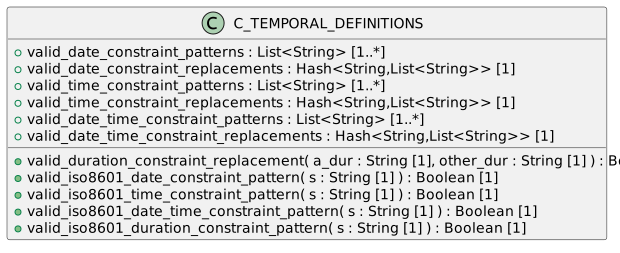
Conformance semantics: C_TEMPORAL
The following functions redefine those of the same names in C_ORDERED and formally define the conformance of a node of a C_TEMPORAL descendant type in a specialised archetype to a corresponding node in a parent archetype, where 'corresponding' means a node found at the same or a congruent path and of the same AOM type.
c_value_conforms_to (other: C_TEMPORAL): Boolean
        -- True if this node is a strict subset of `other`
    do
        Result := precursor (other) and
            other.pattern_constraint.is_empty or
                not pattern_constraint.is_empty and then
                valid_pattern_constraint_replacement (pattern_constraint, other.pattern_constraint)
    end

c_value_congruent_to (other: C_TEMPORAL): Boolean
        -- True if this node's value constraint is the same as that of `other`
    do
        Result := precursor (other) and
            pattern_constraint ~ other.pattern_constraint
    end
C_DATE Class
-
Definition
-
Effective
-
BMM
-
UML
Class |
C_DATE |
|
|---|---|---|
Description |
Constraint on instances representing dates in the form either of a set of validity values, or else date ranges based on the There is no validity flag for |
|
Inherit |
||
Attributes |
Signature |
Meaning |
0..1 |
constraint: |
Formal constraint on the assumed primitive For a pattern constraint or no constraint, use an empty list. |
0..1 |
default_value: |
Default value set in a template, and present in an operational template. Generally limited to leaf and near-leaf nodes. |
0..1 |
assumed_value: |
Value to be assumed if none sent in data. |
Functions |
Signature |
Meaning |
1..1 |
month_validity (): |
Validity of month in constrained date. |
1..1 |
day_validity (): |
Validity of day in constrained date. |
1..1 |
Return |
|
1..1 |
valid_pattern_constraint_replacement ( |
Return |
Invariants |
Pattern_validity: |
|
| C_DATE | |||
|---|---|---|---|
Constraint on instances representing dates in the form either of a set of validity values, or else date ranges based on the There is no validity flag for |
|||
Inherits: ADL_CODE_DEFINITIONS, ARCHETYPE_CONSTRAINT, C_OBJECT, C_DEFINED_OBJECT, C_PRIMITIVE_OBJECT, C_ORDERED, C_TEMPORAL |
|||
Constants |
|||
Id_code_leader: |
String leader of ‘identifier’ codes, i.e. codes used to identify archetype nodes. |
||
Value_code_leader: |
String leader of ‘value’ codes, i.e. codes used to identify codes values, including value set members. |
||
Value_set_code_leader: |
String leader of ‘value set’ codes, i.e. codes used to identify value sets. |
||
Specialisation_separator: |
Character used to separate numeric parts of codes belonging to different specialisation levels. |
||
Code_regex_pattern: |
Regex used to define the legal numeric part of any archetype code. Corresponds to the simple pattern of dotted numbers, as used in typical multi-level numbering schemes. |
||
Root_code_regex_pattern: |
Regex pattern of the root id code of any archetype. Corresponds to codes of the form |
||
Primitive_node_id: |
Code id used for |
||
Attributes |
|||
parent: |
Parent node, except in the case of the top of a tree, i.e. root |
||
soc_parent: |
+ Inherited from ARCHETYPE_CONSTRAINT |
||
rm_type_name: |
Reference model type that this node corresponds to. |
||
occurrences: |
Occurrences of this object node in the data, under the owning attribute. Upper limit can only be greater than 1 if owning attribute has a cardinality of more than 1.
Only set if it overrides the parent archetype in the case of specialised archetypes, or else the occurrences inferred from the underlying reference model existence and/or cardinality of the containing attribute. |
||
node_id: |
Semantic identifier of this node, used to distinguish sibling nodes. All nodes must have a For |
||
is_deprecated: |
True if this node and by implication all sub-nodes are deprecated for use. |
||
sibling_order: |
Optional indicator of order of this node with respect to another sibling. Only meaningful in a specialised archetype for a |
||
default_value: |
Default value set in a template, and present in an operational template. Generally limited to leaf and near-leaf nodes. |
||
assumed_value: |
Value to be assumed if none sent in data. |
||
is_enumerated_type_constraint: |
True if this object represents a constraint on an enumerated type from the reference model, where the latter is assumed to be based on a primitive type, generally Integer or String. |
||
constraint: |
Formal constraint on the assumed primitive For a pattern constraint or no constraint, use an empty list. |
||
pattern_constraint: |
Optional alternative constraint in the form of a pattern based on ISO8601. See descendants for details. |
||
Functions |
|||
codes_conformant ( |
True if |
||
is_adl_code ( |
True if |
||
is_id_code ( |
True if |
||
is_value_code ( |
True if |
||
is_value_set_code ( |
True if |
||
A code has been specialised if there is a non-zero code index anywhere above the last index e.g.
|
|||
code_exists_at_level ( |
Is |
||
is_prohibited (): |
True if this |
||
True if the relative path |
|||
path (): |
Path of this node relative to root of archetype. |
||
c_conforms_to ( |
True if constraints represented by this node, ignoring any sub-parts, are narrower or the same as other.
Typically used during validation of specialised archetype nodes. Parameters
|
||
c_congruent_to ( |
True if constraints represented by this node contain no further redefinitions with respect to the node Typically used to test if an inherited node locally contains any constraints. |
||
is_second_order_constrained (): |
True if there is a second order constraint such as a tuple constraint on this node. |
||
is_root (): |
True if this node is the root of the tree. |
||
is_leaf (): |
True if this node is a terminal node in the tree structure, i.e. having no child nodes. |
||
specialisation_depth (): |
Level of specialisation of this archetype node, based on its |
||
effective_occurrences (): |
Compute effective occurrences, where no local occurrences constraint set. If the owning If local |
||
occurrences_conforms_to ( |
True if this node Parameters
|
||
node_id_conforms_to ( |
True if this node id conforms to |
||
any_allowed (): |
True if any value (i.e. instance) of the reference model type would be allowed. Redefined in descendants. |
||
True if |
|||
(abstract) prototype_value (): |
Generate a prototype value from this constraint object. |
||
has_default_value (): |
True if there is an assumed value. |
||
has_assumed_value (): |
True if there is an assumed value. |
||
constrained_typename (): |
Generate name of native type that is constrained by this |
||
True if |
|||
c_value_congruent_to ( |
True if |
||
valid_pattern_constraint ( |
Return |
||
valid_pattern_constraint_replacement ( |
Return |
||
month_validity (): |
Validity of month in constrained date. |
||
day_validity (): |
Validity of day in constrained date. |
||
Invariants |
|||
Post: |
|||
Inv_valid_default_value: |
|||
Inv_valid_assumed_value: |
|||
Pattern_validity: |
|||
{
    "name": "C_DATE",
    "documentation": "Constraint on instances representing dates in the form either of a set of validity values, or else date ranges based on the `C_ORDERED` list constraint. \n\nThere is no validity flag for `_year_`, since it must always be by definition mandatory in order to have a sensible date at all. Syntax expressions of instances of this class include `\"YYYY-??-??\"` (date with optional month and day).",
    "ancestors": [
        "C_TEMPORAL"
    ],
    "properties": {
        "constraint": {
            "_type": "P_BMM_CONTAINER_PROPERTY",
            "name": "constraint",
            "documentation": "Formal constraint on the assumed primitive `Iso8601_date` type, in the form of one or more `Interval<Iso8601_date>`.\n\nFor a pattern constraint or no constraint, use an empty list.",
            "type_def": {
                "container_type": "List",
                "type_def": {
                    "_type": "P_BMM_GENERIC_TYPE",
                    "root_type": "Interval",
                    "generic_parameters": [
                        "Iso8601_date"
                    ]
                }
            },
            "cardinality": {
                "lower": 0,
                "upper_unbounded": true
            }
        },
        "default_value": {
            "_type": "P_BMM_SINGLE_PROPERTY",
            "name": "default_value",
            "documentation": "Default value set in a template, and present in an operational template. Generally limited to leaf and near-leaf nodes.",
            "type": "Iso8601_date"
        },
        "assumed_value": {
            "_type": "P_BMM_SINGLE_PROPERTY",
            "name": "assumed_value",
            "documentation": "Value to be assumed if none sent in data.",
            "type": "Iso8601_date"
        }
    },
    "functions": {
        "month_validity": {
            "name": "month_validity",
            "documentation": "Validity of month in constrained date.",
            "result": {
                "_type": "P_BMM_SIMPLE_TYPE",
                "type": "VALIDITY_KIND"
            }
        },
        "day_validity": {
            "name": "day_validity",
            "documentation": "Validity of day in constrained date.",
            "result": {
                "_type": "P_BMM_SIMPLE_TYPE",
                "type": "VALIDITY_KIND"
            }
        },
        "valid_pattern_constraint": {
            "name": "valid_pattern_constraint",
            "documentation": "Return `valid_iso8601_date_constraint_pattern (a_pattern)` ",
            "parameters": {
                "a_pattern": {
                    "_type": "P_BMM_SINGLE_FUNCTION_PARAMETER",
                    "name": "a_pattern",
                    "type": "String"
                }
            },
            "result": {
                "_type": "P_BMM_SIMPLE_TYPE",
                "type": "Boolean"
            }
        },
        "valid_pattern_constraint_replacement": {
            "name": "valid_pattern_constraint_replacement",
            "documentation": "Return `valid_date_constraint_replacements.has(an_other_pattern.as_upper) and then \nvalid_date_constraint_replacements.item (an_other_pattern.as_upper).has (a_pattern.as_upper)`.",
            "parameters": {
                "a_pattern": {
                    "_type": "P_BMM_SINGLE_FUNCTION_PARAMETER",
                    "name": "a_pattern",
                    "type": "String"
                },
                "an_other_pattern": {
                    "_type": "P_BMM_SINGLE_FUNCTION_PARAMETER",
                    "name": "an_other_pattern",
                    "type": "String"
                }
            },
            "result": {
                "_type": "P_BMM_SIMPLE_TYPE",
                "type": "Boolean"
            }
        }
    },
    "invariants": {
        "Pattern_validity": "pattern /= Void implies valid_iso8601_date_constraint_pattern(pattern)"
    }
}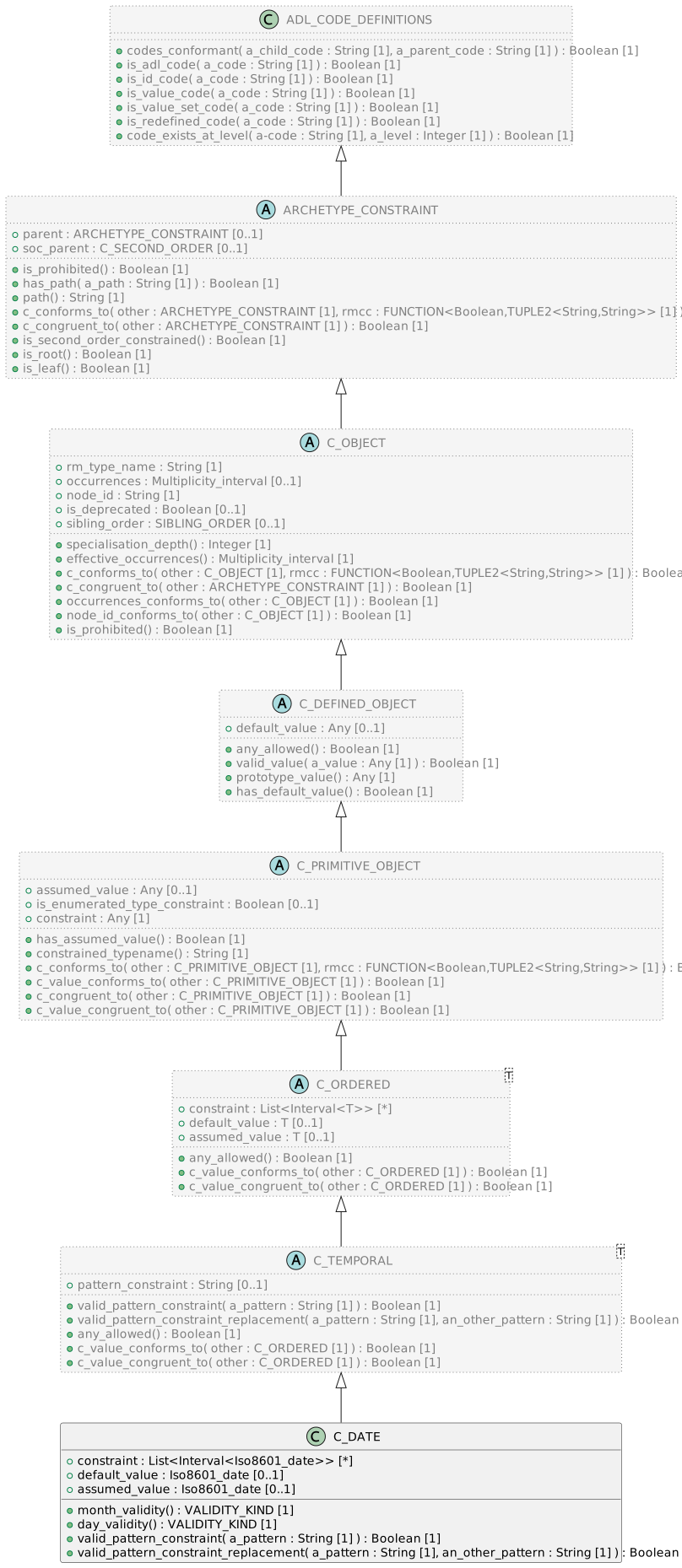
C_TIME Class
-
Definition
-
Effective
-
BMM
-
UML
Class |
C_TIME |
|
|---|---|---|
Description |
Constraint on instances representing times in the form either of a set of validity values, or else time ranges based on the There is no validity flag for |
|
Inherit |
||
Attributes |
Signature |
Meaning |
0..1 |
constraint: |
Formal constraint on the assumed primitive For a pattern constraint or no constraint, use an empty list. |
0..1 |
default_value: |
Default value set in a template, and present in an operational template. Generally limited to leaf and near-leaf nodes. |
0..1 |
assumed_value: |
Value to be assumed if none sent in data. |
Functions |
Signature |
Meaning |
1..1 |
minute_validity (): |
Validity of minute in constrained time. |
1..1 |
second_validity (): |
Validity of second in constrained time. |
1..1 |
millisecond_validity (): |
Validity of millisecond in constrained time. |
1..1 |
timezone_validity (): |
Validity of timezone in constrained time. |
1..1 |
Return |
|
1..1 |
valid_pattern_constraint_replacement ( |
Return |
Invariants |
Pattern_validity: |
|
| C_TIME | |||
|---|---|---|---|
Constraint on instances representing times in the form either of a set of validity values, or else time ranges based on the There is no validity flag for |
|||
Inherits: ADL_CODE_DEFINITIONS, ARCHETYPE_CONSTRAINT, C_OBJECT, C_DEFINED_OBJECT, C_PRIMITIVE_OBJECT, C_ORDERED, C_TEMPORAL |
|||
Constants |
|||
Id_code_leader: |
String leader of ‘identifier’ codes, i.e. codes used to identify archetype nodes. |
||
Value_code_leader: |
String leader of ‘value’ codes, i.e. codes used to identify codes values, including value set members. |
||
Value_set_code_leader: |
String leader of ‘value set’ codes, i.e. codes used to identify value sets. |
||
Specialisation_separator: |
Character used to separate numeric parts of codes belonging to different specialisation levels. |
||
Code_regex_pattern: |
Regex used to define the legal numeric part of any archetype code. Corresponds to the simple pattern of dotted numbers, as used in typical multi-level numbering schemes. |
||
Root_code_regex_pattern: |
Regex pattern of the root id code of any archetype. Corresponds to codes of the form |
||
Primitive_node_id: |
Code id used for |
||
Attributes |
|||
parent: |
Parent node, except in the case of the top of a tree, i.e. root |
||
soc_parent: |
+ Inherited from ARCHETYPE_CONSTRAINT |
||
rm_type_name: |
Reference model type that this node corresponds to. |
||
occurrences: |
Occurrences of this object node in the data, under the owning attribute. Upper limit can only be greater than 1 if owning attribute has a cardinality of more than 1.
Only set if it overrides the parent archetype in the case of specialised archetypes, or else the occurrences inferred from the underlying reference model existence and/or cardinality of the containing attribute. |
||
node_id: |
Semantic identifier of this node, used to distinguish sibling nodes. All nodes must have a For |
||
is_deprecated: |
True if this node and by implication all sub-nodes are deprecated for use. |
||
sibling_order: |
Optional indicator of order of this node with respect to another sibling. Only meaningful in a specialised archetype for a |
||
default_value: |
Default value set in a template, and present in an operational template. Generally limited to leaf and near-leaf nodes. |
||
assumed_value: |
Value to be assumed if none sent in data. |
||
is_enumerated_type_constraint: |
True if this object represents a constraint on an enumerated type from the reference model, where the latter is assumed to be based on a primitive type, generally Integer or String. |
||
constraint: |
Formal constraint on the assumed primitive For a pattern constraint or no constraint, use an empty list. |
||
pattern_constraint: |
Optional alternative constraint in the form of a pattern based on ISO8601. See descendants for details. |
||
Functions |
|||
codes_conformant ( |
True if |
||
is_adl_code ( |
True if |
||
is_id_code ( |
True if |
||
is_value_code ( |
True if |
||
is_value_set_code ( |
True if |
||
A code has been specialised if there is a non-zero code index anywhere above the last index e.g.
|
|||
code_exists_at_level ( |
Is |
||
is_prohibited (): |
True if this |
||
True if the relative path |
|||
path (): |
Path of this node relative to root of archetype. |
||
c_conforms_to ( |
True if constraints represented by this node, ignoring any sub-parts, are narrower or the same as other.
Typically used during validation of specialised archetype nodes. Parameters
|
||
c_congruent_to ( |
True if constraints represented by this node contain no further redefinitions with respect to the node Typically used to test if an inherited node locally contains any constraints. |
||
is_second_order_constrained (): |
True if there is a second order constraint such as a tuple constraint on this node. |
||
is_root (): |
True if this node is the root of the tree. |
||
is_leaf (): |
True if this node is a terminal node in the tree structure, i.e. having no child nodes. |
||
specialisation_depth (): |
Level of specialisation of this archetype node, based on its |
||
effective_occurrences (): |
Compute effective occurrences, where no local occurrences constraint set. If the owning If local |
||
occurrences_conforms_to ( |
True if this node Parameters
|
||
node_id_conforms_to ( |
True if this node id conforms to |
||
any_allowed (): |
True if any value (i.e. instance) of the reference model type would be allowed. Redefined in descendants. |
||
True if |
|||
(abstract) prototype_value (): |
Generate a prototype value from this constraint object. |
||
has_default_value (): |
True if there is an assumed value. |
||
has_assumed_value (): |
True if there is an assumed value. |
||
constrained_typename (): |
Generate name of native type that is constrained by this |
||
True if |
|||
c_value_congruent_to ( |
True if |
||
valid_pattern_constraint ( |
Return |
||
valid_pattern_constraint_replacement ( |
Return |
||
minute_validity (): |
Validity of minute in constrained time. |
||
second_validity (): |
Validity of second in constrained time. |
||
millisecond_validity (): |
Validity of millisecond in constrained time. |
||
timezone_validity (): |
Validity of timezone in constrained time. |
||
Invariants |
|||
Post: |
|||
Inv_valid_default_value: |
|||
Inv_valid_assumed_value: |
|||
Pattern_validity: |
|||
{
    "name": "C_TIME",
    "documentation": "Constraint on instances representing times in the form either of a set of validity values, or else time ranges based on the `C_ORDERED` list constraint. \n\nThere is no validity flag for `_hour_`, since it must always be by definition mandatory in order to have a sensible time at all. Syntax expressions of instances of this class include `\"HH:??:xx\"` (time with optional minutes and seconds not allowed).",
    "ancestors": [
        "C_TEMPORAL"
    ],
    "properties": {
        "constraint": {
            "_type": "P_BMM_CONTAINER_PROPERTY",
            "name": "constraint",
            "documentation": "Formal constraint on the assumed primitive `Iso8601_time` type, in the form of one or more `Interval<Iso8601_time>`.\n\nFor a pattern constraint or no constraint, use an empty list.",
            "type_def": {
                "container_type": "List",
                "type_def": {
                    "_type": "P_BMM_GENERIC_TYPE",
                    "root_type": "Interval",
                    "generic_parameters": [
                        "Iso8601_time"
                    ]
                }
            },
            "cardinality": {
                "lower": 0,
                "upper_unbounded": true
            }
        },
        "default_value": {
            "_type": "P_BMM_SINGLE_PROPERTY",
            "name": "default_value",
            "documentation": "Default value set in a template, and present in an operational template. Generally limited to leaf and near-leaf nodes.",
            "type": "Iso8601_time"
        },
        "assumed_value": {
            "_type": "P_BMM_SINGLE_PROPERTY",
            "name": "assumed_value",
            "documentation": "Value to be assumed if none sent in data.",
            "type": "Iso8601_time"
        }
    },
    "functions": {
        "minute_validity": {
            "name": "minute_validity",
            "documentation": "Validity of minute in constrained time.",
            "result": {
                "_type": "P_BMM_SIMPLE_TYPE",
                "type": "VALIDITY_KIND"
            }
        },
        "second_validity": {
            "name": "second_validity",
            "documentation": "Validity of second in constrained time.",
            "result": {
                "_type": "P_BMM_SIMPLE_TYPE",
                "type": "VALIDITY_KIND"
            }
        },
        "millisecond_validity": {
            "name": "millisecond_validity",
            "documentation": "Validity of millisecond in constrained time.",
            "result": {
                "_type": "P_BMM_SIMPLE_TYPE",
                "type": "VALIDITY_KIND"
            }
        },
        "timezone_validity": {
            "name": "timezone_validity",
            "documentation": "Validity of timezone in constrained time.",
            "result": {
                "_type": "P_BMM_SIMPLE_TYPE",
                "type": "VALIDITY_KIND"
            }
        },
        "valid_pattern_constraint": {
            "name": "valid_pattern_constraint",
            "documentation": "Return `valid_iso8601_time_constraint_pattern (a_pattern)` ",
            "parameters": {
                "a_pattern": {
                    "_type": "P_BMM_SINGLE_FUNCTION_PARAMETER",
                    "name": "a_pattern",
                    "type": "String"
                }
            },
            "result": {
                "_type": "P_BMM_SIMPLE_TYPE",
                "type": "Boolean"
            }
        },
        "valid_pattern_constraint_replacement": {
            "name": "valid_pattern_constraint_replacement",
            "documentation": "Return `valid_time_constraint_replacements.has(an_other_pattern.as_upper) and then \nvalid_time_constraint_replacements.item (an_other_pattern.as_upper).has (a_pattern.as_upper)`.",
            "parameters": {
                "a_pattern": {
                    "_type": "P_BMM_SINGLE_FUNCTION_PARAMETER",
                    "name": "a_pattern",
                    "type": "String"
                },
                "an_other_pattern": {
                    "_type": "P_BMM_SINGLE_FUNCTION_PARAMETER",
                    "name": "an_other_pattern",
                    "type": "String"
                }
            },
            "result": {
                "_type": "P_BMM_SIMPLE_TYPE",
                "type": "Boolean"
            }
        }
    },
    "invariants": {
        "Pattern_validity": "pattern /= Void implies valid_iso8601_time_constraint_pattern (pattern)"
    }
}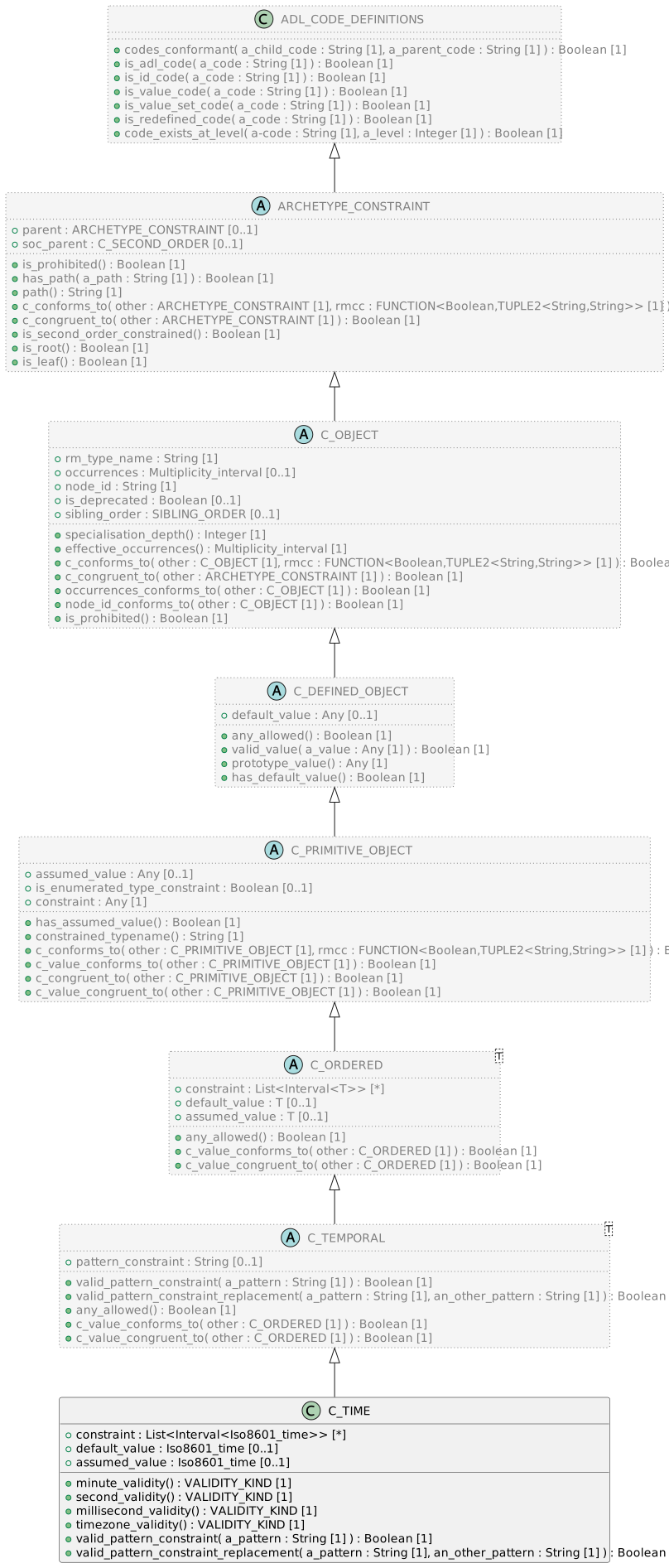
C_DATE_TIME Class
-
Definition
-
Effective
-
BMM
-
UML
Class |
C_DATE_TIME |
|
|---|---|---|
Description |
Constraint on instances representing date/times, i.e. instants in time. There is no validity flag for |
|
Inherit |
||
Attributes |
Signature |
Meaning |
0..1 |
constraint: |
Formal constraint on the assumed primitive For a pattern constraint or no constraint, use an empty list. |
0..1 |
default_value: |
Default value set in a template, and present in an operational template. Generally limited to leaf and near-leaf nodes. |
0..1 |
assumed_value: |
Value to be assumed if none sent in data. |
Functions |
Signature |
Meaning |
1..1 |
Return |
|
1..1 |
valid_pattern_constraint_replacement ( |
Return |
1..1 |
month_validity (): |
Validity of month in constrained date. |
1..1 |
day_validity (): |
Validity of day in constrained date. |
1..1 |
minute_validity (): |
Validity of minute in constrained time. |
1..1 |
second_validity (): |
Validity of second in constrained time. |
1..1 |
millisecond_validity (): |
Validity of millisecond in constrained time. |
1..1 |
timezone_validity (): |
Validity of timezone in constrained date/time. |
Invariants |
Pattern_validity: |
|
| C_DATE_TIME | |||
|---|---|---|---|
Constraint on instances representing date/times, i.e. instants in time. There is no validity flag for |
|||
Inherits: ADL_CODE_DEFINITIONS, ARCHETYPE_CONSTRAINT, C_OBJECT, C_DEFINED_OBJECT, C_PRIMITIVE_OBJECT, C_ORDERED, C_TEMPORAL |
|||
Constants |
|||
Id_code_leader: |
String leader of ‘identifier’ codes, i.e. codes used to identify archetype nodes. |
||
Value_code_leader: |
String leader of ‘value’ codes, i.e. codes used to identify codes values, including value set members. |
||
Value_set_code_leader: |
String leader of ‘value set’ codes, i.e. codes used to identify value sets. |
||
Specialisation_separator: |
Character used to separate numeric parts of codes belonging to different specialisation levels. |
||
Code_regex_pattern: |
Regex used to define the legal numeric part of any archetype code. Corresponds to the simple pattern of dotted numbers, as used in typical multi-level numbering schemes. |
||
Root_code_regex_pattern: |
Regex pattern of the root id code of any archetype. Corresponds to codes of the form |
||
Primitive_node_id: |
Code id used for |
||
Attributes |
|||
parent: |
Parent node, except in the case of the top of a tree, i.e. root |
||
soc_parent: |
+ Inherited from ARCHETYPE_CONSTRAINT |
||
rm_type_name: |
Reference model type that this node corresponds to. |
||
occurrences: |
Occurrences of this object node in the data, under the owning attribute. Upper limit can only be greater than 1 if owning attribute has a cardinality of more than 1.
Only set if it overrides the parent archetype in the case of specialised archetypes, or else the occurrences inferred from the underlying reference model existence and/or cardinality of the containing attribute. |
||
node_id: |
Semantic identifier of this node, used to distinguish sibling nodes. All nodes must have a For |
||
is_deprecated: |
True if this node and by implication all sub-nodes are deprecated for use. |
||
sibling_order: |
Optional indicator of order of this node with respect to another sibling. Only meaningful in a specialised archetype for a |
||
default_value: |
Default value set in a template, and present in an operational template. Generally limited to leaf and near-leaf nodes. |
||
assumed_value: |
Value to be assumed if none sent in data. |
||
is_enumerated_type_constraint: |
True if this object represents a constraint on an enumerated type from the reference model, where the latter is assumed to be based on a primitive type, generally Integer or String. |
||
constraint: |
Formal constraint on the assumed primitive For a pattern constraint or no constraint, use an empty list. |
||
pattern_constraint: |
Optional alternative constraint in the form of a pattern based on ISO8601. See descendants for details. |
||
Functions |
|||
codes_conformant ( |
True if |
||
is_adl_code ( |
True if |
||
is_id_code ( |
True if |
||
is_value_code ( |
True if |
||
is_value_set_code ( |
True if |
||
A code has been specialised if there is a non-zero code index anywhere above the last index e.g.
|
|||
code_exists_at_level ( |
Is |
||
is_prohibited (): |
True if this |
||
True if the relative path |
|||
path (): |
Path of this node relative to root of archetype. |
||
c_conforms_to ( |
True if constraints represented by this node, ignoring any sub-parts, are narrower or the same as other.
Typically used during validation of specialised archetype nodes. Parameters
|
||
c_congruent_to ( |
True if constraints represented by this node contain no further redefinitions with respect to the node Typically used to test if an inherited node locally contains any constraints. |
||
is_second_order_constrained (): |
True if there is a second order constraint such as a tuple constraint on this node. |
||
is_root (): |
True if this node is the root of the tree. |
||
is_leaf (): |
True if this node is a terminal node in the tree structure, i.e. having no child nodes. |
||
specialisation_depth (): |
Level of specialisation of this archetype node, based on its |
||
effective_occurrences (): |
Compute effective occurrences, where no local occurrences constraint set. If the owning If local |
||
occurrences_conforms_to ( |
True if this node Parameters
|
||
node_id_conforms_to ( |
True if this node id conforms to |
||
any_allowed (): |
True if any value (i.e. instance) of the reference model type would be allowed. Redefined in descendants. |
||
True if |
|||
(abstract) prototype_value (): |
Generate a prototype value from this constraint object. |
||
has_default_value (): |
True if there is an assumed value. |
||
has_assumed_value (): |
True if there is an assumed value. |
||
constrained_typename (): |
Generate name of native type that is constrained by this |
||
True if |
|||
c_value_congruent_to ( |
True if |
||
valid_pattern_constraint ( |
Return |
||
valid_pattern_constraint_replacement ( |
Return |
||
month_validity (): |
Validity of month in constrained date. |
||
day_validity (): |
Validity of day in constrained date. |
||
minute_validity (): |
Validity of minute in constrained time. |
||
second_validity (): |
Validity of second in constrained time. |
||
millisecond_validity (): |
Validity of millisecond in constrained time. |
||
timezone_validity (): |
Validity of timezone in constrained date/time. |
||
Invariants |
|||
Post: |
|||
Inv_valid_default_value: |
|||
Inv_valid_assumed_value: |
|||
Pattern_validity: |
|||
{
    "name": "C_DATE_TIME",
    "documentation": "Constraint on instances representing date/times, i.e. instants in time.\n\nThere is no validity flag for `_year_`, since it must always be by definition mandatory in order to have a sensible date/time at all. Syntax expressions of instances of this class include `\"YYYY-MM-DDT??:??:??\"` (date/time with optional time) and `\"YYYY-MMDDTHH:MM:xx\"` (date/time, seconds not allowed).",
    "ancestors": [
        "C_TEMPORAL"
    ],
    "properties": {
        "constraint": {
            "_type": "P_BMM_CONTAINER_PROPERTY",
            "name": "constraint",
            "documentation": "Formal constraint on the assumed primitive `Iso8601_date_time` type, in the form of one or more `Interval<Iso8601_date_time>`.\n\nFor a pattern constraint or no constraint, use an empty list.",
            "type_def": {
                "container_type": "List",
                "type_def": {
                    "_type": "P_BMM_GENERIC_TYPE",
                    "root_type": "Interval",
                    "generic_parameters": [
                        "Iso8601_date_time"
                    ]
                }
            },
            "cardinality": {
                "lower": 0,
                "upper_unbounded": true
            }
        },
        "default_value": {
            "_type": "P_BMM_SINGLE_PROPERTY",
            "name": "default_value",
            "documentation": "Default value set in a template, and present in an operational template. Generally limited to leaf and near-leaf nodes.",
            "type": "Iso8601_date_time"
        },
        "assumed_value": {
            "_type": "P_BMM_SINGLE_PROPERTY",
            "name": "assumed_value",
            "documentation": "Value to be assumed if none sent in data.",
            "type": "Iso8601_date_time"
        }
    },
    "functions": {
        "valid_pattern_constraint": {
            "name": "valid_pattern_constraint",
            "documentation": "Return `valid_iso8601_date_time_constraint_pattern (a_pattern)` ",
            "parameters": {
                "a_pattern": {
                    "_type": "P_BMM_SINGLE_FUNCTION_PARAMETER",
                    "name": "a_pattern",
                    "type": "String"
                }
            },
            "result": {
                "_type": "P_BMM_SIMPLE_TYPE",
                "type": "Boolean"
            }
        },
        "valid_pattern_constraint_replacement": {
            "name": "valid_pattern_constraint_replacement",
            "documentation": "Return `valid_date_time_constraint_replacements.has(an_other_pattern.as_upper) and then \nvalid_date_time_constraint_replacements.item (an_other_pattern.as_upper).has (a_pattern.as_upper)`.",
            "parameters": {
                "a_pattern": {
                    "_type": "P_BMM_SINGLE_FUNCTION_PARAMETER",
                    "name": "a_pattern",
                    "type": "String"
                },
                "an_other_pattern": {
                    "_type": "P_BMM_SINGLE_FUNCTION_PARAMETER",
                    "name": "an_other_pattern",
                    "type": "String"
                }
            },
            "result": {
                "_type": "P_BMM_SIMPLE_TYPE",
                "type": "Boolean"
            }
        },
        "month_validity": {
            "name": "month_validity",
            "documentation": "Validity of month in constrained date.",
            "result": {
                "_type": "P_BMM_SIMPLE_TYPE",
                "type": "VALIDITY_KIND"
            }
        },
        "day_validity": {
            "name": "day_validity",
            "documentation": "Validity of day in constrained date.",
            "result": {
                "_type": "P_BMM_SIMPLE_TYPE",
                "type": "VALIDITY_KIND"
            }
        },
        "minute_validity": {
            "name": "minute_validity",
            "documentation": "Validity of minute in constrained time.",
            "result": {
                "_type": "P_BMM_SIMPLE_TYPE",
                "type": "VALIDITY_KIND"
            }
        },
        "second_validity": {
            "name": "second_validity",
            "documentation": "Validity of second in constrained time.",
            "result": {
                "_type": "P_BMM_SIMPLE_TYPE",
                "type": "VALIDITY_KIND"
            }
        },
        "millisecond_validity": {
            "name": "millisecond_validity",
            "documentation": "Validity of millisecond in constrained time.",
            "result": {
                "_type": "P_BMM_SIMPLE_TYPE",
                "type": "VALIDITY_KIND"
            }
        },
        "timezone_validity": {
            "name": "timezone_validity",
            "documentation": "Validity of timezone in constrained date/time.",
            "result": {
                "_type": "P_BMM_SIMPLE_TYPE",
                "type": "VALIDITY_KIND"
            }
        }
    },
    "invariants": {
        "Pattern_validity": "pattern /= Void implies valid_iso8601_date_time_constraint_pattern(pattern)"
    }
}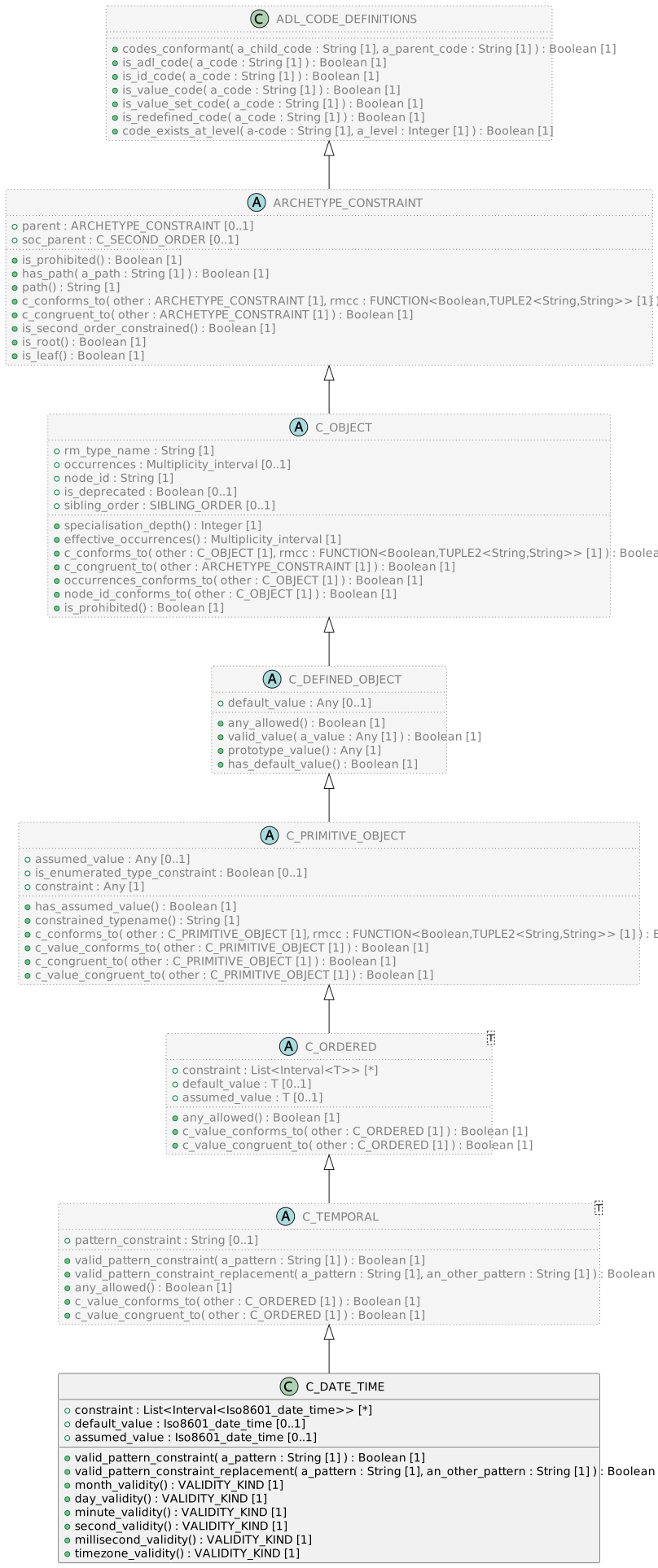
C_DURATION Class
-
Definition
-
Effective
-
BMM
-
UML
Class |
C_DURATION |
|
|---|---|---|
Description |
Constraint on instances representing duration, which is assumed to have the same parts as the ISO 8601 duration string. Thus, constraints are of the form Both range and the constraint pattern can be set at the same time, corresponding to the ADL constraint As for all of openEHR, two ISO 8601 exceptions are allowed:
|
|
Inherit |
||
Attributes |
Signature |
Meaning |
0..1 |
constraint: |
Formal constraint on the assumed primitive For a pattern constraint or no constraint, use an empty list. |
0..1 |
default_value: |
Default value set in a template, and present in an operational template. Generally limited to leaf and near-leaf nodes. |
0..1 |
assumed_value: |
Value to be assumed if none sent in data. |
Functions |
Signature |
Meaning |
1..1 |
years_allowed (): |
True if years are allowed in the constrained Duration. |
1..1 |
months_allowed (): |
True if months are allowed in the constrained Duration. |
1..1 |
weeks_allowed (): |
True if weeks are allowed in the constrained Duration. |
1..1 |
days_allowed (): |
True if days are allowed in the constrained Duration. |
1..1 |
hours_allowed (): |
True if hours are allowed in the constrained Duration. |
1..1 |
minutes_allowed (): |
True if minutes are allowed in the constrained Duration. |
1..1 |
seconds_allowed (): |
True if seconds are allowed in the constrained Duration. |
1..1 |
Return |
|
1..1 |
valid_pattern_constraint_replacement ( |
Return |
| C_DURATION | |||
|---|---|---|---|
Constraint on instances representing duration, which is assumed to have the same parts as the ISO 8601 duration string. Thus, constraints are of the form Both range and the constraint pattern can be set at the same time, corresponding to the ADL constraint As for all of openEHR, two ISO 8601 exceptions are allowed:
|
|||
Inherits: ADL_CODE_DEFINITIONS, ARCHETYPE_CONSTRAINT, C_OBJECT, C_DEFINED_OBJECT, C_PRIMITIVE_OBJECT, C_ORDERED, C_TEMPORAL |
|||
Constants |
|||
Id_code_leader: |
String leader of ‘identifier’ codes, i.e. codes used to identify archetype nodes. |
||
Value_code_leader: |
String leader of ‘value’ codes, i.e. codes used to identify codes values, including value set members. |
||
Value_set_code_leader: |
String leader of ‘value set’ codes, i.e. codes used to identify value sets. |
||
Specialisation_separator: |
Character used to separate numeric parts of codes belonging to different specialisation levels. |
||
Code_regex_pattern: |
Regex used to define the legal numeric part of any archetype code. Corresponds to the simple pattern of dotted numbers, as used in typical multi-level numbering schemes. |
||
Root_code_regex_pattern: |
Regex pattern of the root id code of any archetype. Corresponds to codes of the form |
||
Primitive_node_id: |
Code id used for |
||
Attributes |
|||
parent: |
Parent node, except in the case of the top of a tree, i.e. root |
||
soc_parent: |
+ Inherited from ARCHETYPE_CONSTRAINT |
||
rm_type_name: |
Reference model type that this node corresponds to. |
||
occurrences: |
Occurrences of this object node in the data, under the owning attribute. Upper limit can only be greater than 1 if owning attribute has a cardinality of more than 1.
Only set if it overrides the parent archetype in the case of specialised archetypes, or else the occurrences inferred from the underlying reference model existence and/or cardinality of the containing attribute. |
||
node_id: |
Semantic identifier of this node, used to distinguish sibling nodes. All nodes must have a For |
||
is_deprecated: |
True if this node and by implication all sub-nodes are deprecated for use. |
||
sibling_order: |
Optional indicator of order of this node with respect to another sibling. Only meaningful in a specialised archetype for a |
||
default_value: |
Default value set in a template, and present in an operational template. Generally limited to leaf and near-leaf nodes. |
||
assumed_value: |
Value to be assumed if none sent in data. |
||
is_enumerated_type_constraint: |
True if this object represents a constraint on an enumerated type from the reference model, where the latter is assumed to be based on a primitive type, generally Integer or String. |
||
constraint: |
Formal constraint on the assumed primitive For a pattern constraint or no constraint, use an empty list. |
||
pattern_constraint: |
Optional alternative constraint in the form of a pattern based on ISO8601. See descendants for details. |
||
Functions |
|||
codes_conformant ( |
True if |
||
is_adl_code ( |
True if |
||
is_id_code ( |
True if |
||
is_value_code ( |
True if |
||
is_value_set_code ( |
True if |
||
A code has been specialised if there is a non-zero code index anywhere above the last index e.g.
|
|||
code_exists_at_level ( |
Is |
||
is_prohibited (): |
True if this |
||
True if the relative path |
|||
path (): |
Path of this node relative to root of archetype. |
||
c_conforms_to ( |
True if constraints represented by this node, ignoring any sub-parts, are narrower or the same as other.
Typically used during validation of specialised archetype nodes. Parameters
|
||
c_congruent_to ( |
True if constraints represented by this node contain no further redefinitions with respect to the node Typically used to test if an inherited node locally contains any constraints. |
||
is_second_order_constrained (): |
True if there is a second order constraint such as a tuple constraint on this node. |
||
is_root (): |
True if this node is the root of the tree. |
||
is_leaf (): |
True if this node is a terminal node in the tree structure, i.e. having no child nodes. |
||
specialisation_depth (): |
Level of specialisation of this archetype node, based on its |
||
effective_occurrences (): |
Compute effective occurrences, where no local occurrences constraint set. If the owning If local |
||
occurrences_conforms_to ( |
True if this node Parameters
|
||
node_id_conforms_to ( |
True if this node id conforms to |
||
any_allowed (): |
True if any value (i.e. instance) of the reference model type would be allowed. Redefined in descendants. |
||
True if |
|||
(abstract) prototype_value (): |
Generate a prototype value from this constraint object. |
||
has_default_value (): |
True if there is an assumed value. |
||
has_assumed_value (): |
True if there is an assumed value. |
||
constrained_typename (): |
Generate name of native type that is constrained by this |
||
True if |
|||
c_value_congruent_to ( |
True if |
||
valid_pattern_constraint ( |
Return |
||
valid_pattern_constraint_replacement ( |
Return |
||
years_allowed (): |
True if years are allowed in the constrained Duration. |
||
months_allowed (): |
True if months are allowed in the constrained Duration. |
||
weeks_allowed (): |
True if weeks are allowed in the constrained Duration. |
||
days_allowed (): |
True if days are allowed in the constrained Duration. |
||
hours_allowed (): |
True if hours are allowed in the constrained Duration. |
||
minutes_allowed (): |
True if minutes are allowed in the constrained Duration. |
||
seconds_allowed (): |
True if seconds are allowed in the constrained Duration. |
||
Invariants |
|||
Post: |
|||
Inv_valid_default_value: |
|||
Inv_valid_assumed_value: |
|||
{
    "name": "C_DURATION",
    "documentation": "Constraint on instances representing duration, which is assumed to have the same parts as the ISO 8601 duration string. Thus, constraints are of the form `\"PWD\"` (weeks and/or days), `\"PDTHMS\"` (days, hours, minutes, seconds) and so on.\n\nBoth range and the constraint pattern can be set at the same time, corresponding to the ADL constraint `\"PWD/|P0W..P50W|\"`.\n\nAs for all of openEHR, two ISO 8601 exceptions are allowed: \n\n* the ‘W’ (week) designator can be mixed in - the allowed patterns are: `P[Y|y][M|m][D|d][T[H|h][M|m][S|s]]` and `P[W|w]`;\n* the values used in an interval constraint may be negated, i.e. a leading minus (`'-'`) sign may be used.\n\n",
    "ancestors": [
        "C_TEMPORAL"
    ],
    "properties": {
        "constraint": {
            "_type": "P_BMM_CONTAINER_PROPERTY",
            "name": "constraint",
            "documentation": "Formal constraint on the assumed primitive `Iso8601_duration` type, in the form of one or more `Interval<Iso8601_duration>`.\n\nFor a pattern constraint or no constraint, use an empty list.",
            "type_def": {
                "container_type": "List",
                "type_def": {
                    "_type": "P_BMM_GENERIC_TYPE",
                    "root_type": "Interval",
                    "generic_parameters": [
                        "Iso8601_duration"
                    ]
                }
            },
            "cardinality": {
                "lower": 0,
                "upper_unbounded": true
            }
        },
        "default_value": {
            "_type": "P_BMM_SINGLE_PROPERTY",
            "name": "default_value",
            "documentation": "Default value set in a template, and present in an operational template. Generally limited to leaf and near-leaf nodes.",
            "type": "Iso8601_duration"
        },
        "assumed_value": {
            "_type": "P_BMM_SINGLE_PROPERTY",
            "name": "assumed_value",
            "documentation": "Value to be assumed if none sent in data.",
            "type": "Iso8601_duration"
        }
    },
    "functions": {
        "years_allowed": {
            "name": "years_allowed",
            "documentation": "True if years are allowed in the constrained Duration.",
            "result": {
                "_type": "P_BMM_SIMPLE_TYPE",
                "type": "Boolean"
            }
        },
        "months_allowed": {
            "name": "months_allowed",
            "documentation": "True if months are allowed in the constrained Duration.",
            "result": {
                "_type": "P_BMM_SIMPLE_TYPE",
                "type": "Boolean"
            }
        },
        "weeks_allowed": {
            "name": "weeks_allowed",
            "documentation": "True if weeks are allowed in the constrained Duration.",
            "result": {
                "_type": "P_BMM_SIMPLE_TYPE",
                "type": "Boolean"
            }
        },
        "days_allowed": {
            "name": "days_allowed",
            "documentation": "True if days are allowed in the constrained Duration.",
            "result": {
                "_type": "P_BMM_SIMPLE_TYPE",
                "type": "Boolean"
            }
        },
        "hours_allowed": {
            "name": "hours_allowed",
            "documentation": "True if hours are allowed in the constrained Duration.",
            "result": {
                "_type": "P_BMM_SIMPLE_TYPE",
                "type": "Boolean"
            }
        },
        "minutes_allowed": {
            "name": "minutes_allowed",
            "documentation": "True if minutes are allowed in the constrained Duration.",
            "result": {
                "_type": "P_BMM_SIMPLE_TYPE",
                "type": "Boolean"
            }
        },
        "seconds_allowed": {
            "name": "seconds_allowed",
            "documentation": "True if seconds are allowed in the constrained Duration.",
            "result": {
                "_type": "P_BMM_SIMPLE_TYPE",
                "type": "Boolean"
            }
        },
        "valid_pattern_constraint": {
            "name": "valid_pattern_constraint",
            "documentation": "Return `valid_iso8601_duration_constraint_pattern (a_pattern)` ",
            "parameters": {
                "a_pattern": {
                    "_type": "P_BMM_SINGLE_FUNCTION_PARAMETER",
                    "name": "a_pattern",
                    "type": "String"
                }
            },
            "result": {
                "_type": "P_BMM_SIMPLE_TYPE",
                "type": "Boolean"
            }
        },
        "valid_pattern_constraint_replacement": {
            "name": "valid_pattern_constraint_replacement",
            "documentation": "Return `valid_duration_constraint_replacement (a_pattern, an_other_pattern)`.",
            "parameters": {
                "a_pattern": {
                    "_type": "P_BMM_SINGLE_FUNCTION_PARAMETER",
                    "name": "a_pattern",
                    "type": "String"
                },
                "an_other_pattern": {
                    "_type": "P_BMM_SINGLE_FUNCTION_PARAMETER",
                    "name": "an_other_pattern",
                    "type": "String"
                }
            },
            "result": {
                "_type": "P_BMM_SIMPLE_TYPE",
                "type": "Boolean"
            }
        }
    }
}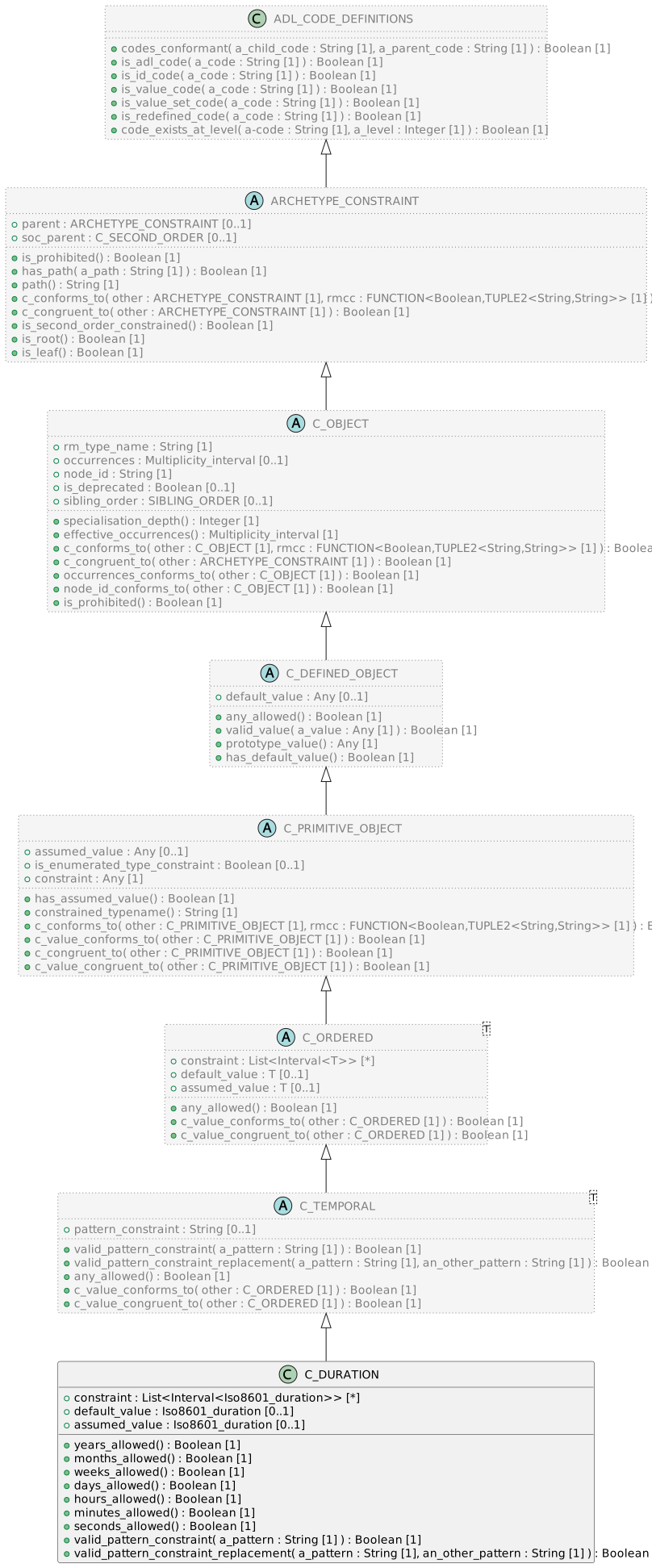
C_TERMINOLOGY_CODE Class
-
Definition
-
Effective
-
BMM
-
UML
Class |
C_TERMINOLOGY_CODE |
|||
|---|---|---|---|---|
Description |
Constrainer type for instances of
If there is an assumed value for the ac-code case above, the The |
|||
Inherit |
||||
Attributes |
Signature |
Meaning |
||
1..1 |
constraint: |
Type of individual constraint - a single string that can either be a local at-code, or a local ac-code signifying a locally defined value set. If an ac-code, assumed_value may contain an at-code from the value set of the ac-code. Use an empty string for no constraint. |
||
0..1 |
assumed_value: |
Assumed Terminology code value. |
||
0..1 |
default_value: |
|||
0..1 |
constraint_status: |
Constraint status of this terminology constraint. If Void, the meaning is as follows:
In the case of a specialised archetype generated by flattening, the value of this field will be:
|
||
Functions |
Signature |
Meaning |
||
1..1 |
constraint_required (): |
True if |
||
1..1 |
effective_constraint_status (): |
Return the effective integer value of the
|
||
0..1 |
Effective set of at-code values corresponding to an ac-code for a locally defined value set. Not defined for ac-codes that have no local value set. |
|||
0..1 |
For locally defined value sets within individual code bindings: return the term URI(s) substituted from bindings for local at-codes in |
|||
0..1 |
value_set_resolved (): |
For locally defined value sets within individual code bindings: final set of external codes to which value set is resolved. |
||
1..1 |
valid_value ( |
True if a |
||
1..1 |
prototype_value (): |
A generated prototype value from this constraint object. |
||
1..1 |
any_allowed (): |
True if |
||
1..1 |
c_value_conforms_to ( |
True if |
||
1..1 |
c_value_congruent_to ( |
True if |
||
| C_TERMINOLOGY_CODE | |||
|---|---|---|---|
Constrainer type for instances of
If there is an assumed value for the ac-code case above, the The |
|||
Inherits: ADL_CODE_DEFINITIONS, ARCHETYPE_CONSTRAINT, C_OBJECT, C_DEFINED_OBJECT, C_PRIMITIVE_OBJECT |
|||
Constants |
|||
Id_code_leader: |
String leader of ‘identifier’ codes, i.e. codes used to identify archetype nodes. |
||
Value_code_leader: |
String leader of ‘value’ codes, i.e. codes used to identify codes values, including value set members. |
||
Value_set_code_leader: |
String leader of ‘value set’ codes, i.e. codes used to identify value sets. |
||
Specialisation_separator: |
Character used to separate numeric parts of codes belonging to different specialisation levels. |
||
Code_regex_pattern: |
Regex used to define the legal numeric part of any archetype code. Corresponds to the simple pattern of dotted numbers, as used in typical multi-level numbering schemes. |
||
Root_code_regex_pattern: |
Regex pattern of the root id code of any archetype. Corresponds to codes of the form |
||
Primitive_node_id: |
Code id used for |
||
Attributes |
|||
parent: |
Parent node, except in the case of the top of a tree, i.e. root |
||
soc_parent: |
+ Inherited from ARCHETYPE_CONSTRAINT |
||
rm_type_name: |
Reference model type that this node corresponds to. |
||
occurrences: |
Occurrences of this object node in the data, under the owning attribute. Upper limit can only be greater than 1 if owning attribute has a cardinality of more than 1.
Only set if it overrides the parent archetype in the case of specialised archetypes, or else the occurrences inferred from the underlying reference model existence and/or cardinality of the containing attribute. |
||
node_id: |
Semantic identifier of this node, used to distinguish sibling nodes. All nodes must have a For |
||
is_deprecated: |
True if this node and by implication all sub-nodes are deprecated for use. |
||
sibling_order: |
Optional indicator of order of this node with respect to another sibling. Only meaningful in a specialised archetype for a |
||
default_value: |
|||
assumed_value: |
Assumed Terminology code value. |
||
is_enumerated_type_constraint: |
True if this object represents a constraint on an enumerated type from the reference model, where the latter is assumed to be based on a primitive type, generally Integer or String. |
||
constraint: |
Type of individual constraint - a single string that can either be a local at-code, or a local ac-code signifying a locally defined value set. If an ac-code, assumed_value may contain an at-code from the value set of the ac-code. Use an empty string for no constraint. |
||
constraint_status: |
Constraint status of this terminology constraint. If Void, the meaning is as follows:
In the case of a specialised archetype generated by flattening, the value of this field will be:
|
||
Functions |
|||
codes_conformant ( |
True if |
||
is_adl_code ( |
True if |
||
is_id_code ( |
True if |
||
is_value_code ( |
True if |
||
is_value_set_code ( |
True if |
||
A code has been specialised if there is a non-zero code index anywhere above the last index e.g.
|
|||
code_exists_at_level ( |
Is |
||
is_prohibited (): |
True if this |
||
True if the relative path |
|||
path (): |
Path of this node relative to root of archetype. |
||
c_conforms_to ( |
True if constraints represented by this node, ignoring any sub-parts, are narrower or the same as other.
Typically used during validation of specialised archetype nodes. Parameters
|
||
c_congruent_to ( |
True if constraints represented by this node contain no further redefinitions with respect to the node Typically used to test if an inherited node locally contains any constraints. |
||
is_second_order_constrained (): |
True if there is a second order constraint such as a tuple constraint on this node. |
||
is_root (): |
True if this node is the root of the tree. |
||
is_leaf (): |
True if this node is a terminal node in the tree structure, i.e. having no child nodes. |
||
specialisation_depth (): |
Level of specialisation of this archetype node, based on its |
||
effective_occurrences (): |
Compute effective occurrences, where no local occurrences constraint set. If the owning If local |
||
occurrences_conforms_to ( |
True if this node Parameters
|
||
node_id_conforms_to ( |
True if this node id conforms to |
||
any_allowed (): |
True if |
||
valid_value ( |
True if a |
||
prototype_value (): |
A generated prototype value from this constraint object. |
||
has_default_value (): |
True if there is an assumed value. |
||
has_assumed_value (): |
True if there is an assumed value. |
||
constrained_typename (): |
Generate name of native type that is constrained by this |
||
c_value_conforms_to ( |
True if |
||
c_value_congruent_to ( |
True if |
||
constraint_required (): |
True if |
||
effective_constraint_status (): |
Return the effective integer value of the
|
||
Effective set of at-code values corresponding to an ac-code for a locally defined value set. Not defined for ac-codes that have no local value set. |
|||
For locally defined value sets within individual code bindings: return the term URI(s) substituted from bindings for local at-codes in |
|||
value_set_resolved (): |
For locally defined value sets within individual code bindings: final set of external codes to which value set is resolved. |
||
Invariants |
|||
Post: |
|||
Inv_valid_default_value: |
|||
Inv_valid_assumed_value: |
|||
{
    "name": "C_TERMINOLOGY_CODE",
    "documentation": "Constrainer type for instances of `Terminology_code`. The constraint attribute can contain:\n\n* a single at-code\n* a single ac-code, representing a value-set that is defined in the archetype terminology\n\nIf there is an assumed value for the ac-code case above, the `_assumed_value_` attribute contains a single at-code, which must come from the list of at-codes defined as the internal value set for the ac-code.\n\nThe `_constraint_status_` attribute and `_constraint_required_()` function together define whether the `_constraint_` is considered formal ('required') or not. In the non-required cases, a data-item matched to this constraint may be any coded term.",
    "ancestors": [
        "C_PRIMITIVE_OBJECT"
    ],
    "properties": {
        "constraint": {
            "_type": "P_BMM_SINGLE_PROPERTY",
            "name": "constraint",
            "documentation": "Type of individual constraint - a single string that can either be a local at-code, or a local ac-code signifying a locally defined value set. If an ac-code, assumed_value may contain an at-code from the value set of the ac-code.\n\nUse an empty string for no constraint.",
            "is_mandatory": true,
            "type": "String"
        },
        "assumed_value": {
            "_type": "P_BMM_SINGLE_PROPERTY",
            "name": "assumed_value",
            "documentation": "Assumed Terminology code value.",
            "type": "Terminology_code"
        },
        "default_value": {
            "_type": "P_BMM_SINGLE_PROPERTY",
            "name": "default_value",
            "type": "Terminology_code"
        },
        "constraint_status": {
            "_type": "P_BMM_SINGLE_PROPERTY",
            "name": "constraint_status",
            "documentation": "Constraint status of this terminology constraint. If Void, the meaning is as follows:\n\n* in a top-level  archetype, equivalent to `required`;\n* in a specialised (source) archetype, the meaning is to inherit the value from the corresponding node in the parent.\n\nIn the case of a specialised archetype generated by flattening, the value of this field will be:\n\n* Void if it was Void in the parent;\n* otherwise, it will carry the same value as in the parent.",
            "type": "CONSTRAINT_STATUS"
        }
    },
    "functions": {
        "constraint_required": {
            "name": "constraint_required",
            "documentation": "True if `_constraint_status_` is defined and equals `required` OR if Void. I.e. in archetypes where `C_TERMINOLOGY_CODE` instances have no `_constraint_status_`, the `required` status is assumed, which applies to all legacy archetypes.",
            "result": {
                "_type": "P_BMM_SIMPLE_TYPE",
                "type": "Boolean"
            }
        },
        "effective_constraint_status": {
            "name": "effective_constraint_status",
            "documentation": "Return the effective integer value of the `_constraint_status_` field if it exists. If it is null, return 0, i.e. `required`.\n\nNOTE: the above logic applies to any `C_TERMINOLOGY_NODE` instance in a specialised archetype that redefines another such instance in the flat parent. I.e. no stated `_constraint_status_` means `required`.",
            "result": {
                "_type": "P_BMM_SIMPLE_TYPE",
                "type": "Integer"
            }
        },
        "value_set_expanded": {
            "name": "value_set_expanded",
            "documentation": "Effective set of at-code values corresponding to an ac-code for a locally defined value set. Not defined for ac-codes that have no local value set.",
            "result": {
                "_type": "P_BMM_CONTAINER_TYPE",
                "container_type": "List",
                "type": "String"
            },
            "is_nullable": true
        },
        "value_set_substituted": {
            "name": "value_set_substituted",
            "documentation": "For locally defined value sets within individual code bindings: return the term URI(s) substituted from bindings for local at-codes in `_value_set_expanded_`.",
            "result": {
                "_type": "P_BMM_CONTAINER_TYPE",
                "container_type": "List",
                "type": "Uri"
            },
            "is_nullable": true
        },
        "value_set_resolved": {
            "name": "value_set_resolved",
            "documentation": "For locally defined value sets within individual code bindings: final set of external codes to which value set is resolved.",
            "result": {
                "_type": "P_BMM_CONTAINER_TYPE",
                "container_type": "List",
                "type": "Terminology_code"
            },
            "is_nullable": true
        },
        "valid_value": {
            "name": "valid_value",
            "documentation": "True if a `_value_` is valid with respect to constraint expressed in concrete instance of this type. ",
            "parameters": {
                "a_value": {
                    "_type": "P_BMM_SINGLE_FUNCTION_PARAMETER",
                    "name": "a_value",
                    "type": "Terminology_code"
                }
            },
            "result": {
                "_type": "P_BMM_SIMPLE_TYPE",
                "type": "Boolean"
            }
        },
        "prototype_value": {
            "name": "prototype_value",
            "documentation": "A generated prototype value from this constraint object.",
            "result": {
                "_type": "P_BMM_SIMPLE_TYPE",
                "type": "Terminology_code"
            }
        },
        "any_allowed": {
            "name": "any_allowed",
            "documentation": "True if `_constraint_` is empty.",
            "post_conditions": {
                "Post": "Result := constraint.is_empty"
            },
            "result": {
                "_type": "P_BMM_SIMPLE_TYPE",
                "type": "Boolean"
            }
        },
        "c_value_conforms_to": {
            "name": "c_value_conforms_to",
            "documentation": "True if `_other.any_allowed_` or else every constraint in the `_constraint_` list exists in the `_other.constraint_`, and `_effective_constraint_status()_` is <= `_other.effective_constraint_status()_`.",
            "parameters": {
                "other": {
                    "_type": "P_BMM_SINGLE_FUNCTION_PARAMETER",
                    "name": "other",
                    "type": "C_TERMINOLOGY_CODE"
                }
            },
            "result": {
                "_type": "P_BMM_SIMPLE_TYPE",
                "type": "Boolean"
            }
        },
        "c_value_congruent_to": {
            "name": "c_value_congruent_to",
            "documentation": "True if `_constraint_` and `_other.constraint_` are both value-set ids, and expand to identical value sets, or else are identical value codes; and `_effective_constraint_status()_` = `_other.effective_constraint_status()_`.",
            "parameters": {
                "other": {
                    "_type": "P_BMM_SINGLE_FUNCTION_PARAMETER",
                    "name": "other",
                    "type": "C_TERMINOLOGY_CODE"
                }
            },
            "result": {
                "_type": "P_BMM_SIMPLE_TYPE",
                "type": "Boolean"
            }
        }
    }
}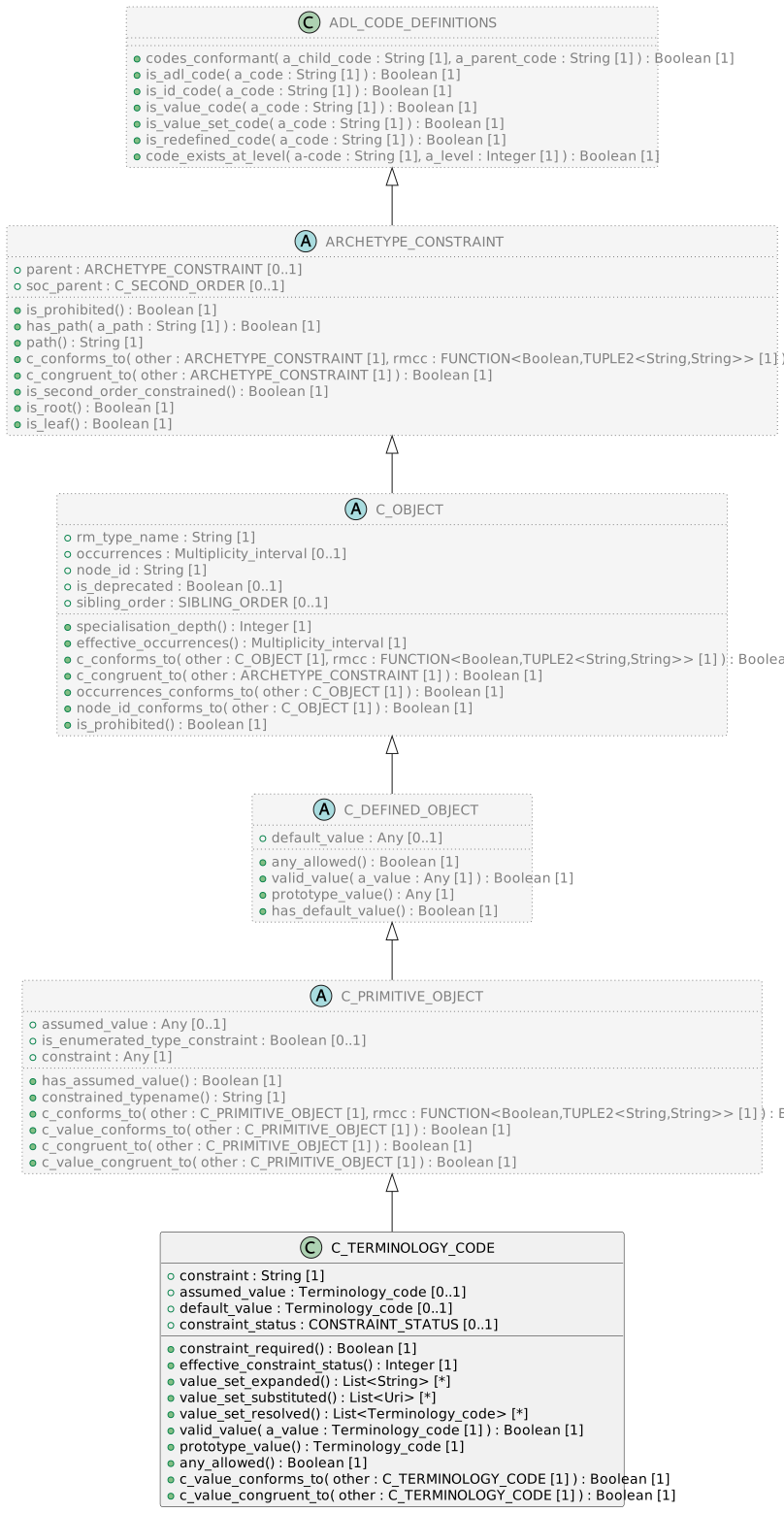
CONSTRAINT_STATUS Enumeration
-
Definition
-
Effective
-
BMM
-
UML
Enumeration |
CONSTRAINT_STATUS |
|
|---|---|---|
Description |
Status of |
|
Constants |
Signature |
Meaning |
required: |
Data item is required to formally satisfy Enumeration value = 0. |
|
extensible: |
Data item value should satisfy Enumeration value = 1. |
|
preferred: |
Data item value is by preference one of the codes defined by Enumeration value = 2. |
|
example: |
The |
|
| CONSTRAINT_STATUS | |
|---|---|
Status of |
|
Inherits: Any, Any, Ordered, Numeric, Ordered_Numeric, Integer |
|
Constants |
|
required: |
Data item is required to formally satisfy Enumeration value = 0. |
extensible: |
Data item value should satisfy Enumeration value = 1. |
preferred: |
Data item value is by preference one of the codes defined by Enumeration value = 2. |
example: |
The |
Functions |
|
Value equality: return True if |
|
Reference equality for reference types, value equality for value types. |
|
Create new instance of a type. |
|
Type name of an object as a string. May include generic parameters, as in |
|
not_equal alias "!=", "≠" ( |
True if current object not equal to |
Returns True if current Integer is less than |
|
less_than_or_equal alias "⇐", "≤" ( |
True if current object less than or equal to |
greater_than alias ">" ( |
True if current object greater than |
greater_than_or_equal alias ">=", "≥" ( |
True if current object greater than or equal to |
Integer addition. |
|
Integer subtraction. |
|
Integer multiplication. |
|
Integer division. |
|
Integer exponentiation. |
|
negative alias "-" (): |
Generate negative of current Integer value. |
modulo alias "mod", "\\" ( |
Return self modulo other. |
{
    "_type": "P_BMM_ENUMERATION_INTEGER",
    "name": "CONSTRAINT_STATUS",
    "documentation": "Status of `_constraint_`, with values allowing for 'soft' constraints, which are effectively different kinds of suggestions.",
    "ancestors": [
        "Integer"
    ],
    "item_names": [
        "required",
        "extensible",
        "preferred",
        "example"
    ],
    "item_values": [
        0,
        1,
        2,
        3
    ],
    "item_documentations": [
        "Data item is required to formally satisfy `_constraint_`.\n\nEnumeration value = 0.",
        "Data item value should satisfy `_constraint_`, i.e. a term in `_constraint_` is to be used if it covers the data item meaning (including more generally); if not, another code may be used, including from another terminology.\n\nEnumeration value = 1.",
        "Data item value is by preference one of the codes defined by `_constraint_`, but for local reasons may be another code, including from another terminology.\n\nEnumeration value = 2.",
        "The `_constraint_` code or value-set is considered purely as an example, and the data item may have any value."
    ]
}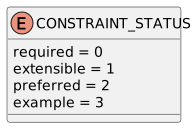
Conformance semantics: C_TERMINOLOGY_NODE
The following functions implement those of the same names in C_PRIMITIVE_OBJECT and formally define the conformance of a C_TERMINOLOGY_CODE node in a specialised archetype to a corresponding node in a parent archetype, where 'corresponding' means a node found at the same or a congruent path and of the same AOM type.
c_value_conforms_to (other: C_TERMINOLOGY_CODE): Boolean
        -- True if this node expresses a value constraint that conforms to that of `other'
    local
        this_vset, other_vset: List<String>
    do
        if other.any_allowed then
            Result := True

        -- check that constraint_status is valid. The following order hold down the specialisation
        -- lineage, from lowest to highest: example (3) → preferred (2) → exensible (1) → required (0);
        -- numerically, specialisation child must be <= parent
        elseif effective_constraint_status > other.effective_constraint_status then
            Result := False

        -- if parent's constraint status is not 'required', then child automatically conforms
        elseif other.effective_constraint_status > 0 then
            Result := True

        -- if we get here, we know that parent and child terminology constraint strengths are both `required`
        -- so perform the value-set conformance check
        elseif is_valid_value_set_code (constraint) and is_valid_value_set_code (other.constraint) then
            -- firstly, check if the other value-set is empty, which means there is no value-set,
            -- i.e. no constraint, which means that this object's value set automatically conforms.
            other_vset := other.value_set_expanded
            if not other_vset.is_empty then
                this_vset := value_set_expanded
                Result := codes_conformant (constraint, other.constraint) and then
                    for_all v: this_vset | other_vset.has (v)
            else
                Result := True
            end

        -- otherwise it's at-codes, so we just check lexical conformance
        else
            Result := codes_conformant (constraint, other.constraint)
        end
    end

c_value_congruent_to (other: C_TERMINOLOGY_CODE): Boolean
        -- True if this node's value constraint is the same as that of `other'
    local
        this_vset, other_vset: List<String>
    do
        -- if both constraints are ac-codes, compare the value-set expansions
        if is_valid_value_set_code (constraint) and is_valid_value_set_code (other.constraint) then
            this_vset := value_set_expanded
            other_vset := other.value_set_expanded
            Result := constraint.is_equal (other.constraint) and then
                this_vset.count = other_vset.count and then
                    for_all v: this_vset | other_vset.has (v)

        -- otherwise it's at-codes, so we just compare them literally
        else
            Result := constraint.is_equal (other.constraint)
        end

        -- make sure constraint status is identical
        Result := Result and effective_constraint_status = other.effective_constraint_status
    end
C_SECOND_ORDER Class
-
Definition
-
Effective
-
BMM
-
UML
Class |
C_SECOND_ORDER (abstract) |
|||
|---|---|---|---|---|
Description |
Abstract parent of classes defining second order constraints. |
|||
Attributes |
Signature |
Meaning |
||
0..1 |
members: |
Members of this second order constrainer. Normally redefined in descendants. |
||
Functions |
Signature |
Meaning |
||
1..1 |
c_conforms_to ( |
True if constraints represented by this node, ignoring any sub-parts, are narrower or the same as other. Typically used during validation of specialised archetype nodes. Parameters
|
||
1..1 |
c_congruent_to ( |
True if constraints represented by this node contain no further redefinitions with respect to the node other. Typically used to test if an inherited node locally contains any constraints. |
||
| C_SECOND_ORDER (abstract) | |||
|---|---|---|---|
Abstract parent of classes defining second order constraints. |
|||
Attributes |
|||
members: |
Members of this second order constrainer. Normally redefined in descendants. |
||
Functions |
|||
(abstract) c_conforms_to ( |
True if constraints represented by this node, ignoring any sub-parts, are narrower or the same as other. Typically used during validation of specialised archetype nodes. Parameters
|
||
(abstract) c_congruent_to ( |
True if constraints represented by this node contain no further redefinitions with respect to the node other. Typically used to test if an inherited node locally contains any constraints. |
||
{
    "name": "C_SECOND_ORDER",
    "documentation": "Abstract parent of classes defining second order constraints.",
    "is_abstract": true,
    "properties": {
        "members": {
            "_type": "P_BMM_CONTAINER_PROPERTY",
            "name": "members",
            "documentation": "Members of this second order constrainer. Normally redefined in descendants.",
            "type_def": {
                "container_type": "List",
                "type": "ARCHETYPE_CONSTRAINT"
            },
            "cardinality": {
                "lower": 0,
                "upper_unbounded": true
            }
        }
    },
    "functions": {
        "c_conforms_to": {
            "name": "c_conforms_to",
            "documentation": "True if constraints represented by this node, ignoring any sub-parts, are narrower or the same as other. Typically used during validation of specialised archetype nodes.",
            "is_abstract": true,
            "parameters": {
                "other": {
                    "_type": "P_BMM_SINGLE_FUNCTION_PARAMETER",
                    "name": "other",
                    "type": "C_SECOND_ORDER"
                },
                "rmcc": {
                    "_type": "P_BMM_GENERIC_FUNCTION_PARAMETER",
                    "name": "rmcc",
                    "documentation": "RM conformance checker agent - a lambda (i.e. function object) that can compute conformance of type-names within the  Reference Model on which the current archetype is based. The signature provides two arguments representing respectively, the `_rm_type_name_` of the current node and the `_rm_type_name_` of the node being redefined in a specialisation parent archetype.",
                    "type_def": {
                        "root_type": "FUNCTION",
                        "generic_parameters": [
                            "Boolean",
                            {
                                "_type": "P_BMM_GENERIC_TYPE",
                                "root_type": "TUPLE2",
                                "generic_parameters": [
                                    "String",
                                    "String"
                                ]
                            }
                        ]
                    }
                }
            },
            "result": {
                "_type": "P_BMM_SIMPLE_TYPE",
                "type": "Boolean"
            }
        },
        "c_congruent_to": {
            "name": "c_congruent_to",
            "documentation": "True if constraints represented by this node contain no further redefinitions with respect to the node other. Typically used to test if an inherited node locally contains any constraints.",
            "is_abstract": true,
            "parameters": {
                "other": {
                    "_type": "P_BMM_SINGLE_FUNCTION_PARAMETER",
                    "name": "other",
                    "type": "C_SECOND_ORDER"
                }
            },
            "result": {
                "_type": "P_BMM_SIMPLE_TYPE",
                "type": "Boolean"
            }
        }
    }
}
C_PRIMITIVE_TUPLE Class
-
Definition
-
Effective
-
BMM
-
UML
Class |
C_PRIMITIVE_TUPLE |
|||
|---|---|---|---|---|
Description |
Class representing a single object tuple instance in a tuple constraint. Each such instance is a vector of object constraints, where each member (each |
|||
Inherit |
||||
Attributes |
Signature |
Meaning |
||
1..1 |
members: |
Object constraint members of this tuple group. |
||
Functions |
Signature |
Meaning |
||
1..1 |
c_conforms_to ( |
True if constraints represented by this node, ignoring any sub-parts, are narrower or the same as other. Typically used during validation of specialised archetype nodes. Parameters
|
||
1..1 |
c_congruent_to ( |
True if constraints represented by this node contain no further redefinitions with respect to the node other. Typically used to test if an inherited node locally contains any constraints. |
||
| C_PRIMITIVE_TUPLE | |||
|---|---|---|---|
Class representing a single object tuple instance in a tuple constraint. Each such instance is a vector of object constraints, where each member (each |
|||
Inherits: C_SECOND_ORDER |
|||
Attributes |
|||
members: |
Object constraint members of this tuple group. |
||
Functions |
|||
c_conforms_to ( |
True if constraints represented by this node, ignoring any sub-parts, are narrower or the same as other. Typically used during validation of specialised archetype nodes. Parameters
|
||
c_congruent_to ( |
True if constraints represented by this node contain no further redefinitions with respect to the node other. Typically used to test if an inherited node locally contains any constraints. |
||
{
    "name": "C_PRIMITIVE_TUPLE",
    "documentation": "Class representing a single object tuple instance in a tuple constraint. Each such instance is a vector of object constraints, where each member (each `C_PRIMITIVE_OBJECT`) corresponds to one of the `C_ATTRIBUTEs` referred to by the owning `C_ATTRIBUTE_TUPLE`.",
    "ancestors": [
        "C_SECOND_ORDER"
    ],
    "properties": {
        "members": {
            "_type": "P_BMM_CONTAINER_PROPERTY",
            "name": "members",
            "documentation": "Object constraint members of this tuple group.",
            "is_mandatory": true,
            "type_def": {
                "container_type": "List",
                "type": "C_PRIMITIVE_OBJECT"
            },
            "cardinality": {
                "lower": 1,
                "upper_unbounded": true
            }
        }
    },
    "functions": {
        "c_conforms_to": {
            "name": "c_conforms_to",
            "documentation": "True if constraints represented by this node, ignoring any sub-parts, are narrower or the same as other. Typically used during validation of specialised archetype nodes.",
            "parameters": {
                "other": {
                    "_type": "P_BMM_SINGLE_FUNCTION_PARAMETER",
                    "name": "other",
                    "type": "C_PRIMITIVE_TUPLE"
                },
                "rmcc": {
                    "_type": "P_BMM_GENERIC_FUNCTION_PARAMETER",
                    "name": "rmcc",
                    "documentation": "RM conformance checker agent.",
                    "type_def": {
                        "root_type": "FUNCTION",
                        "generic_parameters": [
                            "Boolean",
                            {
                                "_type": "P_BMM_GENERIC_TYPE",
                                "root_type": "TUPLE2",
                                "generic_parameters": [
                                    "String",
                                    "String"
                                ]
                            }
                        ]
                    }
                }
            },
            "result": {
                "_type": "P_BMM_SIMPLE_TYPE",
                "type": "Boolean"
            }
        },
        "c_congruent_to": {
            "name": "c_congruent_to",
            "documentation": "True if constraints represented by this node contain no further redefinitions with respect to the node other. Typically used to test if an inherited node locally contains any constraints.",
            "parameters": {
                "other": {
                    "_type": "P_BMM_SINGLE_FUNCTION_PARAMETER",
                    "name": "other",
                    "type": "C_SECOND_ORDER"
                }
            },
            "result": {
                "_type": "P_BMM_SIMPLE_TYPE",
                "type": "Boolean"
            }
        }
    }
}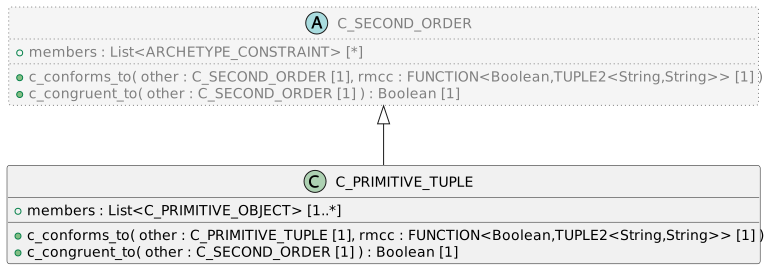
C_ATTRIBUTE_TUPLE Class
-
Definition
-
Effective
-
BMM
-
UML
Class |
C_ATTRIBUTE_TUPLE |
|||
|---|---|---|---|---|
Description |
Object representing a constraint on an attribute tuple, i.e. a group of attributes that are constrained together. Typically used for representing co-varying constraints like |
|||
Inherit |
||||
Attributes |
Signature |
Meaning |
||
0..1 |
tuples: |
Tuple definitions. |
||
0..1 |
members: |
List of |
||
Functions |
Signature |
Meaning |
||
1..1 |
c_conforms_to ( |
True if constraints represented by this node, ignoring any sub-parts, are narrower or the same as other. Typically used during validation of specialised archetype nodes. Parameters
|
||
1..1 |
c_congruent_to ( |
True if constraints represented by this node contain no further redefinitions with respect to the node other. Typically used to test if an inherited node locally contains any constraints. |
||
| C_ATTRIBUTE_TUPLE | |||
|---|---|---|---|
Object representing a constraint on an attribute tuple, i.e. a group of attributes that are constrained together. Typically used for representing co-varying constraints like |
|||
Inherits: C_SECOND_ORDER |
|||
Attributes |
|||
members: |
List of |
||
tuples: |
Tuple definitions. |
||
Functions |
|||
c_conforms_to ( |
True if constraints represented by this node, ignoring any sub-parts, are narrower or the same as other. Typically used during validation of specialised archetype nodes. Parameters
|
||
c_congruent_to ( |
True if constraints represented by this node contain no further redefinitions with respect to the node other. Typically used to test if an inherited node locally contains any constraints. |
||
{
    "name": "C_ATTRIBUTE_TUPLE",
    "documentation": "Object representing a constraint on an attribute tuple, i.e. a group of attributes that are constrained together. Typically used for representing co-varying constraints like `{units, range}` constraints.",
    "ancestors": [
        "C_SECOND_ORDER"
    ],
    "properties": {
        "tuples": {
            "_type": "P_BMM_CONTAINER_PROPERTY",
            "name": "tuples",
            "documentation": "Tuple definitions.",
            "type_def": {
                "container_type": "List",
                "type": "C_PRIMITIVE_TUPLE"
            },
            "cardinality": {
                "lower": 0,
                "upper_unbounded": true
            }
        },
        "members": {
            "_type": "P_BMM_CONTAINER_PROPERTY",
            "name": "members",
            "documentation": "List of `C_ATTRIBUTEs` forming the definition of the tuple.",
            "type_def": {
                "container_type": "List",
                "type": "C_ATTRIBUTE"
            },
            "cardinality": {
                "lower": 0,
                "upper_unbounded": true
            }
        }
    },
    "functions": {
        "c_conforms_to": {
            "name": "c_conforms_to",
            "documentation": "True if constraints represented by this node, ignoring any sub-parts, are narrower or the same as other. Typically used during validation of specialised archetype nodes.",
            "parameters": {
                "other": {
                    "_type": "P_BMM_SINGLE_FUNCTION_PARAMETER",
                    "name": "other",
                    "type": "C_ATTRIBUTE_TUPLE"
                },
                "rmcc": {
                    "_type": "P_BMM_GENERIC_FUNCTION_PARAMETER",
                    "name": "rmcc",
                    "documentation": "RM conformance checker agent.",
                    "type_def": {
                        "root_type": "FUNCTION",
                        "generic_parameters": [
                            "Boolean",
                            {
                                "_type": "P_BMM_GENERIC_TYPE",
                                "root_type": "TUPLE2",
                                "generic_parameters": [
                                    "String",
                                    "String"
                                ]
                            }
                        ]
                    }
                }
            },
            "result": {
                "_type": "P_BMM_SIMPLE_TYPE",
                "type": "Boolean"
            }
        },
        "c_congruent_to": {
            "name": "c_congruent_to",
            "documentation": "True if constraints represented by this node contain no further redefinitions with respect to the node other. Typically used to test if an inherited node locally contains any constraints.",
            "parameters": {
                "other": {
                    "_type": "P_BMM_SINGLE_FUNCTION_PARAMETER",
                    "name": "other",
                    "type": "C_SECOND_ORDER"
                }
            },
            "result": {
                "_type": "P_BMM_SIMPLE_TYPE",
                "type": "Boolean"
            }
        }
    }
}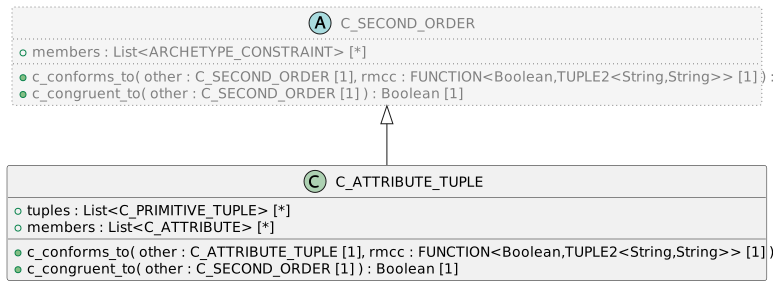
Conformance semantics: C_SECOND_ORDER
The following functions formally define the conformance interfaces of any C_SECOND_ORDER node in a specialised archetype to the corresponding node in a parent archetype, where 'corresponding' means a node found at the same or a congruent path.
c_conforms_to (other: C_SECOND_ORDER; rmcc: FUNCTION<<a_type, other_type: String>, Boolean>): Boolean
        -- True if this node on its own (ignoring any subparts) expresses the same or narrower
        -- constraints as `other`.
        -- Returns False if any of the following is incompatible:
        --	 * cardinality
        --	 * existence
    require
        other /= Void
        rmcc /= Void
    deferred
    end

c_congruent_to (other: C_SECOND_ORDER): Boolean
        -- True if this node on its own (ignoring any subparts) expresses no additional
        -- constraints than `other`.
    require
        other /= Void
    deferred
    end
The following functions implement those of the same names from C_SECOND_ORDER, and formally define the conformance interfaces of any C_ATTRIBUTE_TUPLE node in a specialised archetype to the corresponding node in a parent archetype, where 'corresponding' means a node found at the same or a congruent path.
c_conforms_to (other: C_ATTRIBUTE_TUPLE; rmcc: FUNCTION<<a_type, other_type: String>, Boolean>): BOOLEAN
        -- True if this node is a subset of, or the same as `other'
    do
        Result :=
            for_all t: tuples |
                there_exists ot: other.tuples | t.c_conforms_to (ot, rmcc)
            or else tuples.count < other.tuples.count and
                for_all t: tuples |
                    there_exists ot: other.tuples | t.c_congruent_to (ot)
    end

c_congruent_to (other: C_ATTRIBUTE_TUPLE): BOOLEAN
        -- True if Current adds no further constraints with respect to `other'
    do
        Result := for_all t: tuples |
            there_exists ot: other.tuples | t.c_congruent_to (ot)
    end
The following functions implement those of the same names from C_SECOND_ORDER, and formally define the conformance interfaces of any C_PRIMITIVE_TUPLE node in a specialised archetype to the corresponding node in a parent archetype, where 'corresponding' means a node found at the same or a congruent path.
c_conforms_to (other: C_PRIMITIVE_TUPLE; rmcc: FUNCTION<<a_type, other_type: String>, Boolean>): BOOLEAN
        -- True if this node is a subset of, or the same as `other'
    do
        if count = other.count then
            Result := across members as cpo_csr all
                cpo_csr.item.same_type (other.members.i_th (cpo_csr.cursor_index)) and then
                    cpo_csr.item.c_conforms_to (other.members.i_th (cpo_csr.cursor_index), rmcc)
            end
        end
    end

c_congruent_to (other: C_PRIMITIVE_TUPLE): BOOLEAN
        -- True if Current and `other' are semantically the same
    do
        if count = other.count then
            Result := across members as cpo_csr all
                cpo_csr.item.same_type (other.members.i_th (cpo_csr.cursor_index)) and then
                    cpo_csr.item.c_congruent_to (other.members.i_th (cpo_csr.cursor_index))
            end
        end
    end